Table of Contents
Goods and Services Tax (GST) is India’s most important indirect tax reform, unifying multiple state and central levies into a single national system. Since its implementation, GST collection has become a key indicator of economic activity, consumption trends, and tax compliance across the country. Monthly GST data offers timely insights into the health of sectors such as manufacturing, services, and trade.

In December 2025, India’s GST revenue recorded steady growth, signalling resilient domestic demand and improved compliance. As reported by The Economic Times, the rise reflects stable economic momentum despite global uncertainties.
Overview of GST collection December 2025
| GST indicator | December 2025 figures | Year-on-year change | Key insights |
| Gross GST collections | ~₹1.75 lakh crore | ↑ ~6.1% YoY | Indicates steady economic activity and improved tax compliance across sectors, as reported by The Economic Times. |
| Net GST revenue (post refunds) | ~₹1.45 lakh crore | Moderate YoY growth | Higher refunds compared to the previous year reflect faster processing and increased export-linked claims. |
| Central GST (CGST) | ~₹32,000 crore | Positive YoY growth | Shows stable central tax contribution from domestic transactions. |
| State GST (SGST) | ~₹39,000 crore | Positive YoY growth | Reflects consistent revenue accrual for state governments. |
| Integrated GST (IGST) | ~₹90,000 crore | Strong YoY growth | Growth driven mainly by higher import-related collections. |
| December 2024 comparison | ~₹1.65 lakh crore (gross) | Base year | December 2025 collections were higher, indicating improved consumption and compliance trends. |
Drivers of GST growth in December 2025

Strong import-based GST collections
One of the key drivers of GST growth in December 2025 was a sharp rise in import-related collections. Import GST grew by nearly 19–20% on a year-on-year basis. This increase reflects higher global commodity inflows, steady industrial demand, and resilient trade activity. Higher imports directly boost Integrated GST (IGST) revenues, which formed a significant share of total GST collections during the month.
Resilient domestic economic activity
Domestic consumption remained stable in December 2025, supporting GST revenues from manufacturing and services. As highlighted by The Economic Times, steady demand across sectors such as FMCG, logistics, construction, and professional services contributed to higher domestic GST collections. Improved compliance and wider adoption of digital invoicing also strengthened revenue visibility, even amid global economic uncertainties.
Impact of GST reforms and rate rationalisation
Ongoing GST reforms, often referred to as GST 2.0, have played a supportive role in sustaining revenue growth. Measures such as tighter compliance norms, data analytics, and discussions around rate rationalisation have reduced leakages. These reforms have helped streamline tax administration and improve the overall efficiency of the GST framework.
Higher refunds and their effect on net revenue
While gross GST collections rose, refunds were also higher on a year-on-year basis. As reported by The Economic Times, faster refund processing, especially for exporters, led to a moderation in net GST growth. However, higher refunds indicate improved system efficiency rather than revenue weakness, supporting long-term confidence in the GST regime.
State-wise and sectoral insights
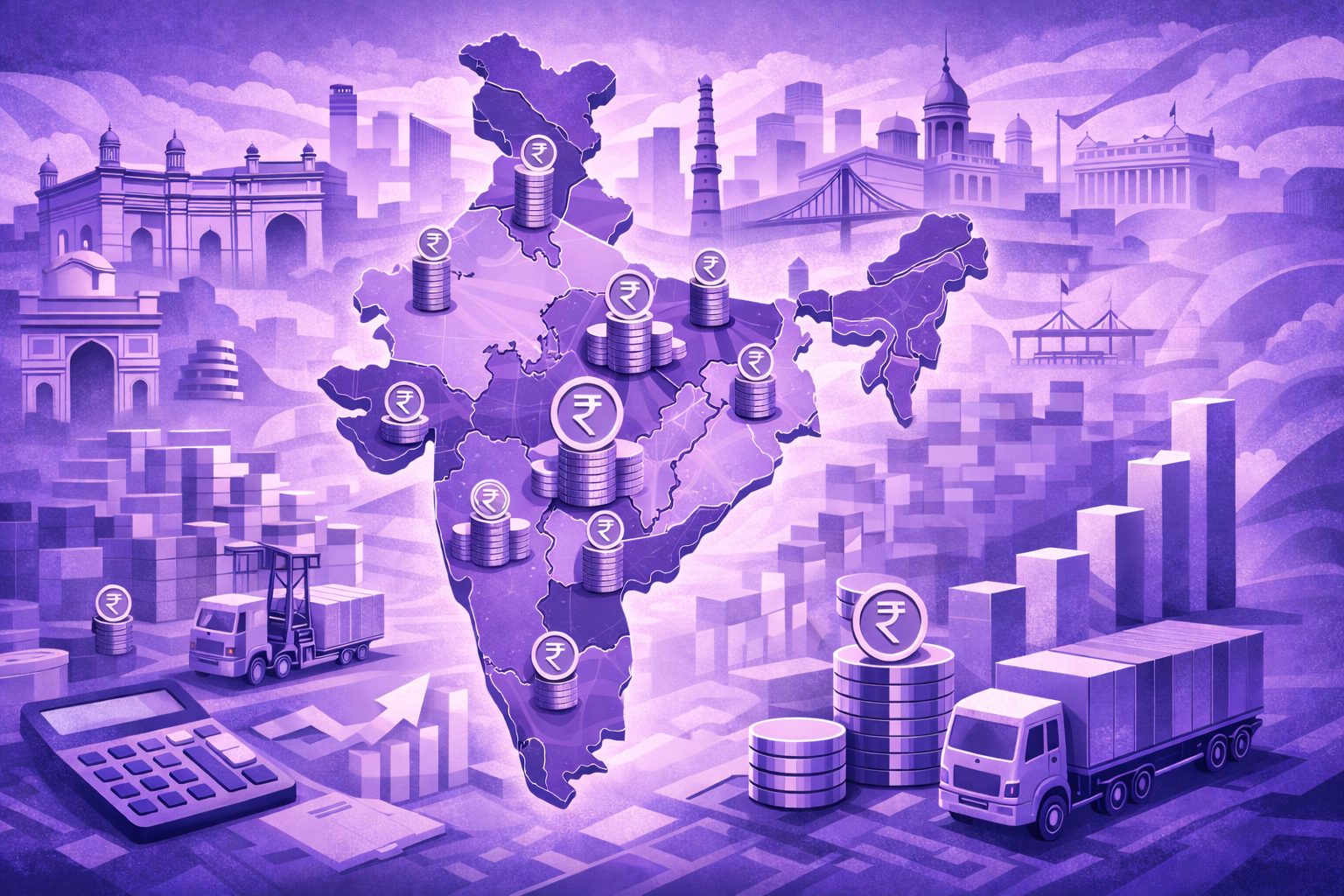
India’s GST performance in December 2025 showed uneven growth across states, reflecting differences in industrial activity, consumption patterns, and trade exposure. According to The Economic Times, large industrial and consumption-led states continued to anchor overall GST revenues, while some regions recorded softer growth due to localised slowdowns.
State-wise performance highlights
- Maharashtra, Gujarat, and Karnataka remained among the top GST contributors, supported by manufacturing, services, and port-led trade activity.
- Tamil Nadu and Uttar Pradesh benefited from steady domestic consumption and infrastructure-linked demand.
- Some smaller and consumption-light states reported slower growth, reflecting weaker festive demand and lower industrial output during the month.
| State/region | GST performance trend (Dec 2025) | Key drivers |
| Maharashtra | Strong | Manufacturing, services, imports. |
| Gujarat | Strong | Export-oriented industries, ports. |
| Karnataka | Stable to strong | IT services, urban consumption. |
| Andhra Pradesh | Robust growth | Improved compliance and trade activity. |
| Select NE & hill states | Modest | Lower consumption base. |
The Times of India highlighted Andhra Pradesh as a standout performer, with improved GST compliance and trade-linked revenues supporting year-on-year growth.
Sectoral contribution to GST
- Manufacturing remained a key driver, especially metals, automobiles, and consumer goods.
- Services, including logistics, IT, and professional services, supported steady domestic GST inflows.
- Imports significantly boosted IGST collections, reinforcing overall revenue growth.
Together, state-wise variations and sectoral trends underline how GST collections mirror India’s diverse economic structure and regional demand patterns.
Historical context and trend analysis
GST collection in December 2025 reflects a continuation of India’s improving indirect tax performance rather than a one-off surge. When viewed in a historical context, the data shows steady momentum supported by structural reforms and seasonal demand patterns.
Year-on-year comparison:
- December 2024 gross GST collections were approximately ₹1.64 lakh crore.
- December 2025 collections were higher, indicating sustained growth in economic activity and compliance.
Monthly trend during FY24–25:
- As per data available on GST Tutorials and the GST portal (Home section), monthly GST collections during FY24–25 largely remained above ₹1.6 lakh crore.
- The consistency suggests a broader and more stable tax base.
- Periodic moderation was visible during months affected by global headwinds, followed by recovery in later months.
Impact of compliance and system improvements:
- Increased GST registrations and improved invoice matching strengthened revenue visibility.
- Enhanced digital monitoring reduced leakages over time.
Role of seasonal factors in December:
- Festive demand from earlier months supports manufacturing and trade receipts.
- Year-end inventory adjustments and import settlements lift Integrated GST collections.
- Higher activity in logistics, transport, and services adds to overall GST revenue.
Overall, December 2025 GST collections combine seasonal strength with long-term improvements in India’s GST framework.
Policy implications of December 2025 GST collections

Implications for government finances and fiscal planning
The GST collections recorded in December 2025 provide a positive signal for both central and state government finances. Strong and stable monthly revenues improve cash flow predictability and support budget planning. Higher GST inflows also reduce pressure on additional borrowing, allowing governments to allocate more resources towards infrastructure, social welfare, and capital expenditure. Consistent collections strengthen fiscal discipline and help authorities maintain deficit targets.
Role of GST reforms in shaping future revenues
Ongoing GST reforms, including discussions around slab rationalisation, are expected to influence future revenue trends. Simplifying tax slabs can reduce classification disputes and improve compliance. Measures such as tighter invoice matching, data analytics, and enhanced scrutiny under GST 2.0 aim to plug leakages. Over time, these reforms could lead to a more stable and predictable revenue base, even if short-term adjustments affect certain sectors.
Broader economic and investment implications
Healthy GST collections act as a barometer of domestic demand and business confidence. Strong revenues indicate steady consumption and improved tax compliance across industries. For investors, rising GST collections signal a formalising economy with lower regulatory uncertainty. This improves India’s attractiveness as an investment destination. At a broader level, sustained GST growth supports economic stability and reinforces confidence in India’s long-term growth outlook.
Conclusion
GST collections in December 2025 underline the sustainability of India’s indirect tax growth and the effectiveness of ongoing policy reforms. Steady revenue performance reflects resilient domestic demand, improved compliance, and a more efficient GST framework. These trends support fiscal stability for both the centre and states, while signalling broader economic health.
Empowering MSMEs to grow smarter
Tata nexarc delivers powerful solutions for MSMEs—discover tenders, logistics solutions, and streamline procurement. Everything your business needs, all in one place.
FAQs
What was India’s GST collection in December 2025?
How did GST collections perform year on year?
What was the net GST revenue after refunds?
Which GST component contributed the most?
Why did IGST collections rise sharply?
Did domestic consumption support GST growth?
Which states performed strongly in December 2025?
Why were refunds higher during the month?
What do December GST numbers indicate about the economy?
What is the outlook for GST revenue in FY26?
A product manager with a writer's heart, Anirban leverages his 6 years of experience to empower MSMEs in the business and technology sectors. His time at Tata nexarc honed his skills in crafting informative content tailored to MSME needs. Whether wielding words for business or developing innovative products for both Tata Nexarc and MSMEs, his passion for clear communication and a deep understanding of their challenges shine through.