
 Check Price Now
Table of Contents
CRCA steel is one of the most widely used flat steel products in India. The CRCA steel full form is Cold Rolled Close Annealed. It refers to cold rolled steel sheets that are annealed to improve strength and formability.
In early 2026, CRCA price in India remains closely linked to Hot Rolled Coil (HRC) benchmarks and demand from the automobile and appliance sectors. Buyers often search for the latest cold rolled steel sheet price per kg or per ton before procurement.
This guide explains CRCA steel meaning, manufacturing process, grades (CR1–CR4), features, applications, and current market prices in India.
What is CRCA steel?
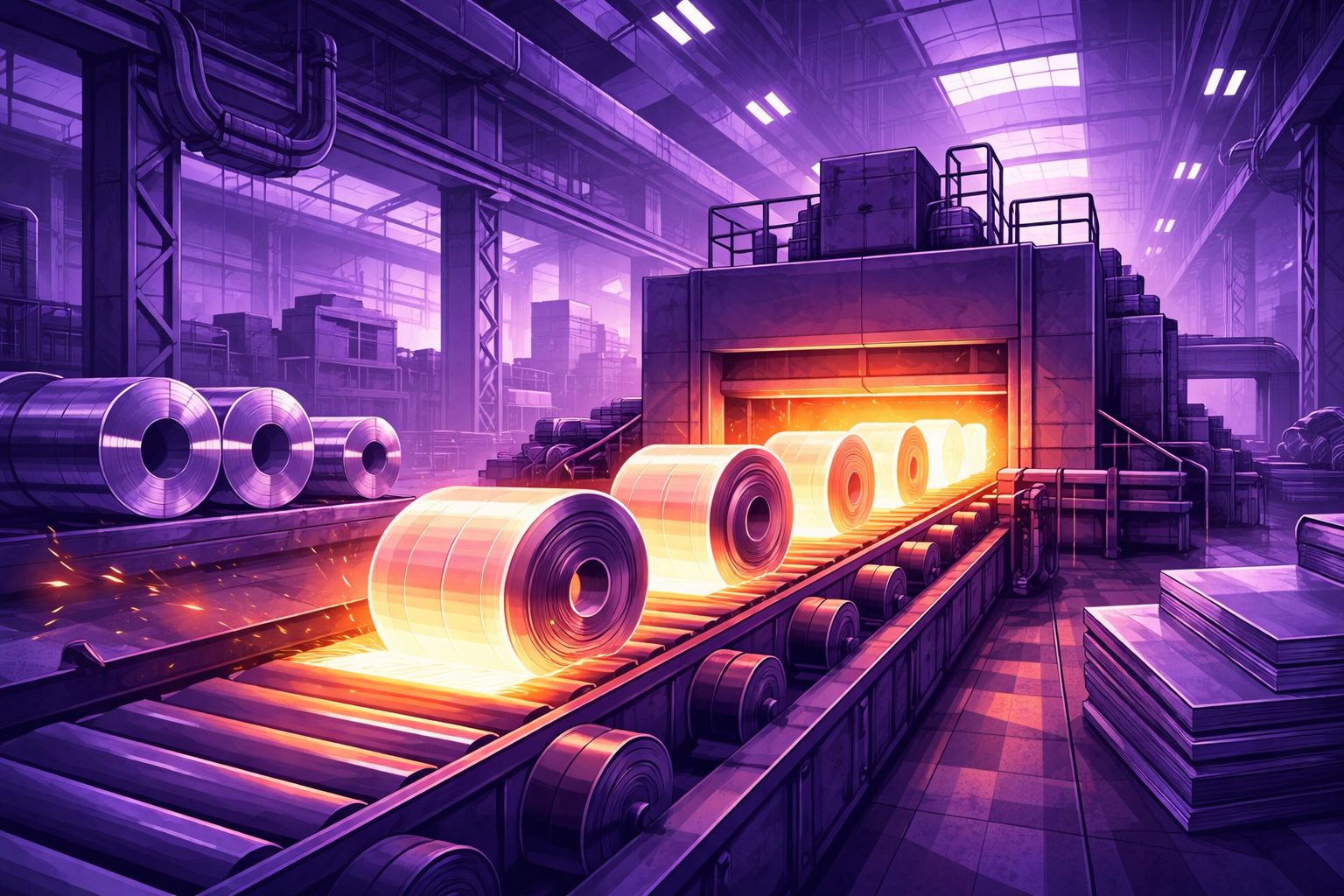
Cold rolled close annealed steel is a low-carbon steel sheet produced by cold rolling hot rolled steel coils, followed by annealing in a closed, non-oxidising atmosphere (usually nitrogen). In simple terms, CRCA is a precision cold rolled steel sheet known for smooth surface finish, tight thickness tolerance, and improved formability.
How is CRCA different from hot rolled steel?
| Parameter | CRCA steel | Hot Rolled (HR) steel |
| Surface finish | Bright, smooth. | Rough, scaled. |
| Dimensional accuracy | High | Moderate |
| Thickness tolerance | Precise | Wider tolerance |
| Formability | Excellent after annealing | Moderate |
Key technical characteristics
- Common thickness range: 0.3 mm to 3.0 mm
- Supplied in sheets and coils
- Superior surface quality for painting and coating
- Manufactured in India as per IS 513 (CRCA standard)
Why is annealing essential?
Cold rolling increases hardness and internal stress. Without annealing, the steel becomes brittle. The close annealing process restores ductility, improves elongation, and enhances deep drawing performance. This is why cold rolled close annealed steel is preferred in automotive panels, appliances, and precision fabrication.
CRCA steel manufacturing process
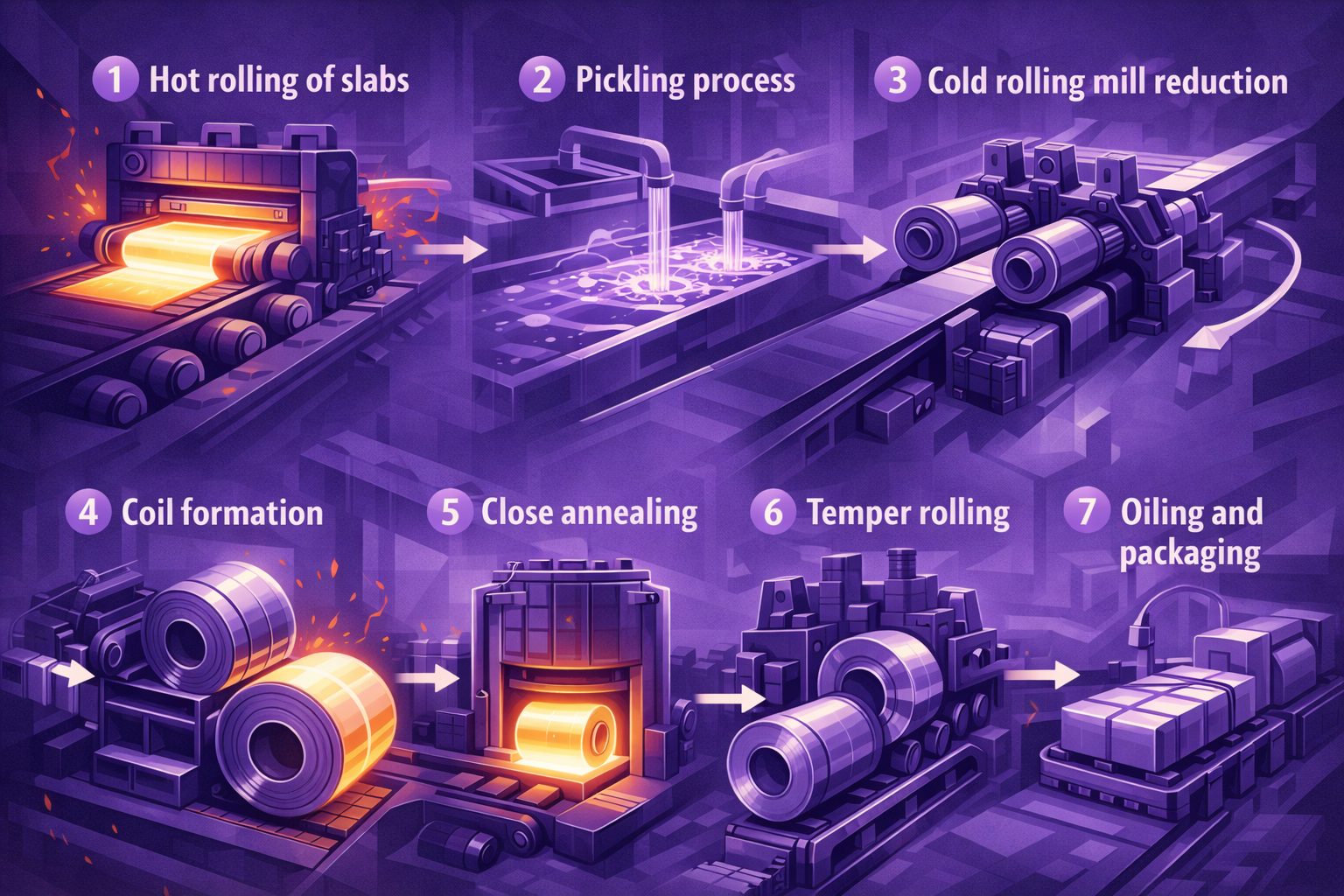
The CRCA manufacturing process involves multiple controlled stages to achieve smooth surface finish and precise thickness. In India, most integrated steel plants follow this sequence:
Hot rolling of slabs
Steel slabs are heated and passed through hot rolling mills to produce Hot rolled coils (HRC). These coils form the base material for CRCA steel.
Pickling process
The hot rolled coils contain oxide scale on the surface. They are passed through acid baths (usually hydrochloric acid) to remove scale and impurities. This ensures a clean surface before cold rolling.
Cold rolling mill reduction
Pickled coils are fed into cold rolling mills. Heavy rollers compress the steel at room temperature to achieve thinner gauges, typically between 0.3 mm and 3.0 mm. This improves dimensional accuracy and surface finish.
Coil formation
The reduced steel is wound into coils for further processing.
Close annealing (bell annealing furnace)
Coils are stacked and placed inside a bell annealing furnace. The furnace is sealed and filled with nitrogen or other non-oxidising gas. Heating and controlled cooling restore ductility and relieve internal stresses developed during cold rolling.
Skin passing/temper rolling
A light rolling process improves flatness, surface texture, and mechanical properties.
Oiling and packaging
Finally, sheets or coils are lightly oiled to prevent rust and then packed for dispatch.
CRCA steel grades in India
Understanding CRCA steel grades is important for OEMs, fabricators, and bulk buyers. In India, cold rolled close annealed sheets are manufactured as per IS 513 CRCA standard, which defines mechanical properties and forming capability.
Grade classification under IS 513
| Grade | Quality type | Forming capability | Typical applications |
| CR1 | Commercial quality. | Basic bending & forming. | General fabrication, panels. |
| CR2 | Drawing quality. | Moderate drawing. | Cabinets, enclosures. |
| CR3 | Deep Drawing quality. | High formability. | Auto components, appliance bodies. |
| CR4 | Extra deep drawing. | Very high ductility. | Complex automotive panels. |
Key differences between grades
- CR1 is suitable for simple fabrication work.
- CR2 offers improved elongation for moderate drawing operations.
- CR3 and CR4 provide superior ductility and uniform grain structure. These grades are widely used in the automobile and white goods sectors in India.
Higher grades have better elongation percentage and controlled chemical composition, especially low carbon content. This ensures crack-free deep drawing and press forming.
International equivalents
ASTM A1008 (USA) – Comparable drawing quality grades.
JIS G3141 (Japan) – SPCC, SPCD, SPCE grades.
EN standards (Europe) – DC01 to DC04.
For steel buyers, selecting the right CRCA grade ensures cost efficiency and performance reliability.
Features & mechanical properties of CRCA steel
High tensile strength
CRCA steel offers controlled mechanical strength suitable for fabrication and forming. Typical tensile strength ranges between 270 MPa to 410 MPa, depending on grade (CR1–CR4). This makes it suitable for structural components, panels, and load-bearing fabricated parts.
Excellent surface finish
One of the key CRCA steel properties is its smooth, bright surface. The cold rolling process removes surface scale and improves texture. This ensures better paint adhesion, powder coating quality, and electroplating performance.
Good dimensional accuracy
CRCA sheets are known for tight thickness tolerance and flatness. Thickness variation is minimal compared to hot rolled steel. This improves precision in CNC cutting, laser profiling, and press operations.
High ductility after annealing
The close annealing process improves elongation and reduces internal stress. Elongation values typically range from 28% to 38%, depending on grade. Higher grades like CR3 and CR4 offer superior formability, making them ideal for deep drawing applications.
Weldability
Low carbon content enhances weldability. CRCA steel can be easily spot welded, seam welded, and arc welded without significant cracking risk.
Uniform thickness
The controlled cold rolling process ensures consistent thickness across the sheet or coil. This uniformity is critical for automotive panels and appliance manufacturing.
Applications of CRCA steel
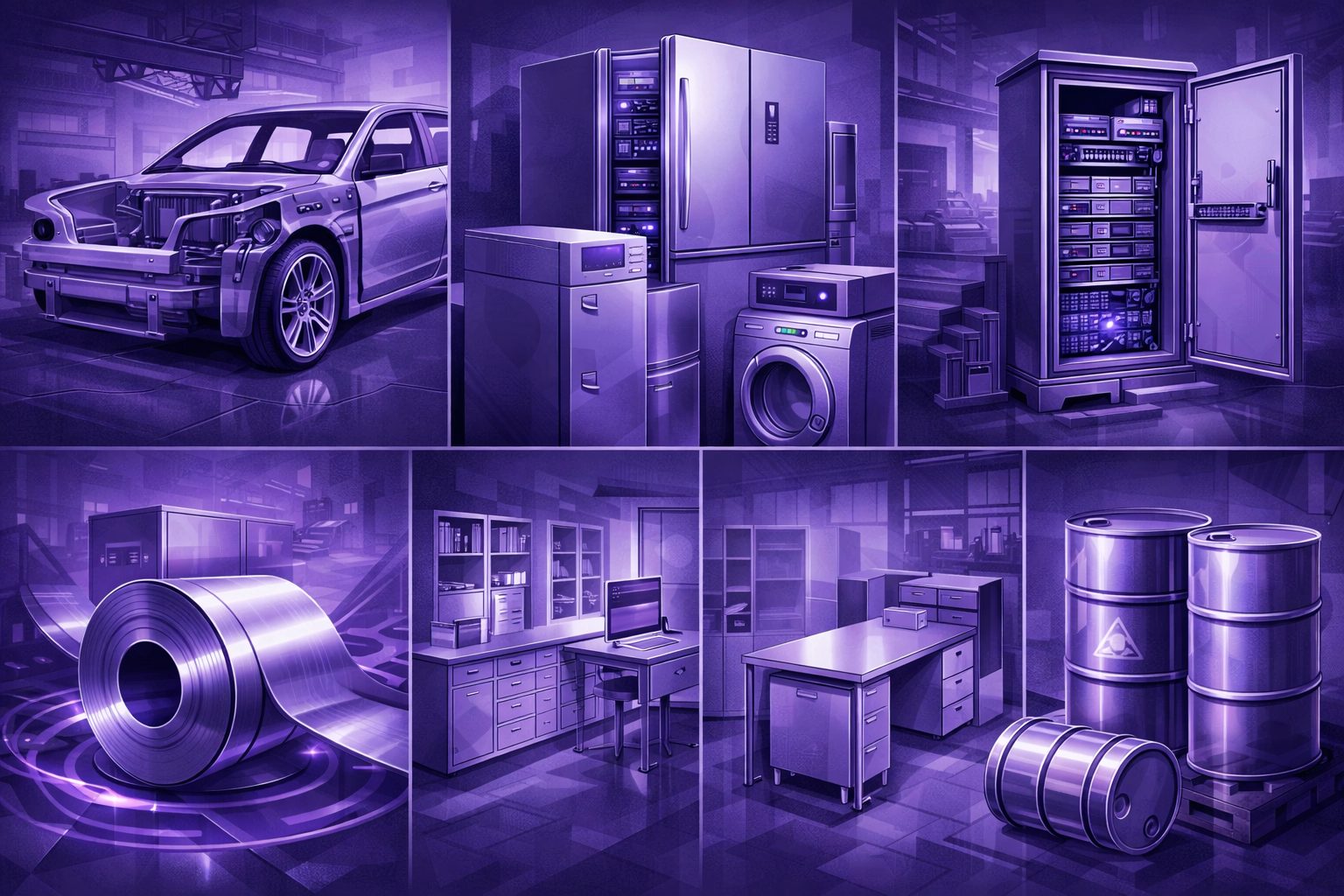
Automobile body panels
One of the largest CRCA steel uses in India is in the automotive sector. Grades like CR3 and CR4 are used for door panels, inner body parts, and structural reinforcements. High formability and uniform thickness make them ideal for press forming and deep drawing operations.
Electrical panels & enclosures
CRCA sheets are widely used to manufacture LT panels, distribution boards, and industrial enclosures. The smooth surface supports powder coating and improves corrosion resistance after painting.
Consumer appliances
Many cold rolled sheet applications in India are in the white goods sector. Refrigerators, washing machines, microwave bodies, and air conditioner casings use CRCA steel for its strength, surface finish, and paint adhesion properties.
Telecom cabinets
Outdoor and indoor telecom cabinets use CRCA sheets for fabrication. These cabinets require dimensional accuracy and consistent thickness for CNC punching and bending.
Office & laboratory furniture
CRCA steel is used in storage racks, filing cabinets, lab benches, and modular furniture. Its weldability and durability make it suitable for long service life.
Drums & barrels
Light-gauge CRCA sheets are used to manufacture industrial drums and barrels where forming quality and strength are required.
CRCA steel price in India (2026 update)
As of early 2026, the CRCA steel price per kg in India ranges between ₹42–₹54 per kg, depending on grade, thickness, and location. The CRCA sheet price per ton in India is closely linked to domestic HRC benchmarks and demand from the automobile and appliance sectors.
Indicative CRCA sheet price
| Price range (₹/ton) | Approx. market share (%) |
| ₹42,000 – ₹45,000 | 26% |
| ₹45,000 – ₹48,000 | 24% |
| ₹48,000 – ₹52,000 | 30% |
| ₹52,000 – ₹55,000 | 20% |
Note: Prices vary by mill, specification, and order size.
Key factors affecting cold rolled steel price today
Thickness
Thinner gauges (0.3–1 mm) typically command higher per-ton rates due to additional processing precision.
Grade (CR1–CR4)
Higher grades such as CR3 and CR4 cost more because of tighter chemical composition control and superior elongation properties.
Location
Prices differ across hubs like Mumbai, Ahmedabad, and Chennai due to freight and regional demand.
Further processing
If CRCA is galvanised (GI) or colour coated (PPGI), prices increase significantly.
Order volume
Bulk procurement generally attracts better negotiated rates.
Buyers should compare Mill Test Certificates (MTC), grade specifications, and freight terms before finalising procurement.
Factors affecting CRCA steel prices in India
Understanding why CRCA steel prices fluctuate helps buyers plan procurement better. In India, cold rolled steel prices are influenced by both global and domestic market trends.
Iron ore prices
Iron ore is the primary raw material for steel production. Any increase in domestic or global iron ore prices directly impacts steel manufacturing costs.
HRC benchmark rates
CRCA steel is produced from hot rolled coils (HRC). When HRC benchmark rates rise, the base cost of cold rolled steel also increases. CRCA prices closely track HRC trends.
Power & fuel costs
Steel manufacturing is energy intensive. Electricity tariffs, coal prices, and fuel costs affect rolling and annealing operations. Higher energy costs lead to higher finished steel prices.
Import duties & trade policies
Government policies such as basic customs duty, anti-dumping duties, or safeguard measures influence domestic supply and pricing. Changes in import regulations can tighten or ease market availability.
Demand from auto & appliance sectors
The automobile and white goods industries are major consumers of CRCA steel. Strong production demand often pushes prices upward.
Rupee-dollar exchange rate
Steel trade is globally linked. A weaker rupee makes imports costlier, which can support higher domestic steel prices.
Monitoring these steel market trends in India helps businesses manage cost risks.
CRCA vs. HR steel – Key differences
Understanding the CRCA vs. hot rolled steel difference is important for selecting the right material for fabrication and manufacturing.
| Parameter | CRCA steel (Cold Rolled Close Annealed) | Hot Rolled (HR) steel |
| Surface finish | Smooth, bright, and scale-free surface suitable for painting and coating. | Rough surface with mill scale. |
| Strength | Higher tensile strength (approx. 270–410 MPa) due to cold reduction. | Moderate strength, depends on grade. |
| Cost | Higher price due to additional processing (cold rolling + annealing). | Lower cost as processing is simpler. |
| Applications | Automobile panels, appliances, electrical enclosures, furniture. | Structural sections, construction, pipes, general fabrication. |
| Thickness tolerance | Tight tolerance and precise gauge control. | Wider tolerance compared to CRCA. |
Key takeaway
CRCA steel is preferred where surface finish, dimensional accuracy, and formability are critical. HR steel is suitable for structural and heavy fabrication work where surface appearance is less important. Buyers should choose based on application requirements, not just price difference.
Conclusion
CRCA steel continues to be a core material for India’s growing manufacturing and infrastructure sectors. Its consistent quality, wide grade availability, and suitability for precision fabrication make it a dependable choice for OEMs and industrial buyers.
With steel markets remaining cyclical in 2026, procurement planning and timing play a key role in cost control. Businesses should track market trends, assess volume requirements carefully, and align purchases with production schedules to optimise pricing and inventory efficiency.
Looking to procure steel?
Tata nexarc helps manufacturers, builders and MSMEs source certified steel products, compare prices, and choose the right grade as per IS codes—with complete traceability and procurement confidence.
FAQs
What is the full form of CRCA steel?
What is CRCA steel used for?
What is the difference between CRCA and hot rolled steel?
What are CRCA steel grades in India?
What is the thickness range of CRCA sheets?
What is the tensile strength of CRCA steel?
Why is annealing important in CRCA steel?
What is the CRCA steel price per kg in India (2026)?
Is CRCA steel suitable for welding?
What factors affect CRCA steel prices in India?
Priyanka is a seasoned content marketing professional with more than 6 years of experience crafting various forms of business and technology sector content. Her insightful writing tackles critical issues faced by small-scale manufacturing businesses. Priyanka's clear and concise communication empowers businesses to make informed decisions and thrive in today's dynamic business environment.





Are there different grades of CRCA steel available? Asking so I can choose the right material for my fabrication work. Also, can you share a list of reliable suppliers as well?
Yes, CRCA steel comes in different grades with varying properties. Common grades include Deep Drawing (DD) for high formability, Extra Deep Drawing (EDD) for even better formability, Skin Passed (SP) for superior surface finish, and Full Hard (FH) for high strength. Reliable suppliers in India include JSW Steel, Tata Steel, Essar Steel, and SAIL. Consult a steel expert to determine the most suitable grade for your specific fabrication needs.
How can I ensure the CRCA steel I receive meets the specified standards? Are there any certifications to look for?
To be sure you’re getting top-notch CRCA steel, always ask your supplier for certifications like ISO 9001 and test reports verifying the steel’s quality. If you’re extra cautious, you can even get the steel tested yourself. Don’t forget to give it a good look-over when it arrives to make sure there aren’t any obvious problems