
 Check Price Now
Table of Contents
- Introduction
- Mandi Gobindgarh Ingot Price Today (Per Kg / Per Ton)
- Mandi Gobindgarh Ingot Price Trend (2026)
- Mandi Gobindgarh Ingot Rates vs Other Indian Markets
- What Affects Ingot Prices in Mandi Gobindgarh
- Why Mandi Gobindgarh Matters for Ingot Buyers in India
- Types of Steel Ingots and Indicative Price Differences
- How MSME Buyers Should Calculate Final Landed Cost
- How to Buy Steel Ingots in India (Practical Checklist for MSMEs)
- Conclusion
- FAQs
Introduction
Mandi Gobindgarh remains one of India’s most closely tracked secondary steel markets, especially for MSMEs that buy raw material for rolling, fabrication, and manufacturing. For many buyers, the MS ingot price in Mandi Gobindgarh is a daily benchmark because it directly affects procurement planning, quote negotiation, and production costing.
This guide focuses only on Mandi Gobindgarh ingot price today and related buyer decisions. It covers indicative per kg and per tonne rates, recent price trend movement, key factors that influence ingot prices, and practical checks before purchase.
Mandi Gobindgarh ingot price today (per kg / per ton)
Let us take a look at the Mandi Gobindgarh ingot price today by kg and tonne. For MSME buyers, this is a useful benchmark for planning purchases, comparing supplier quotes, and estimating material cost before placing orders.
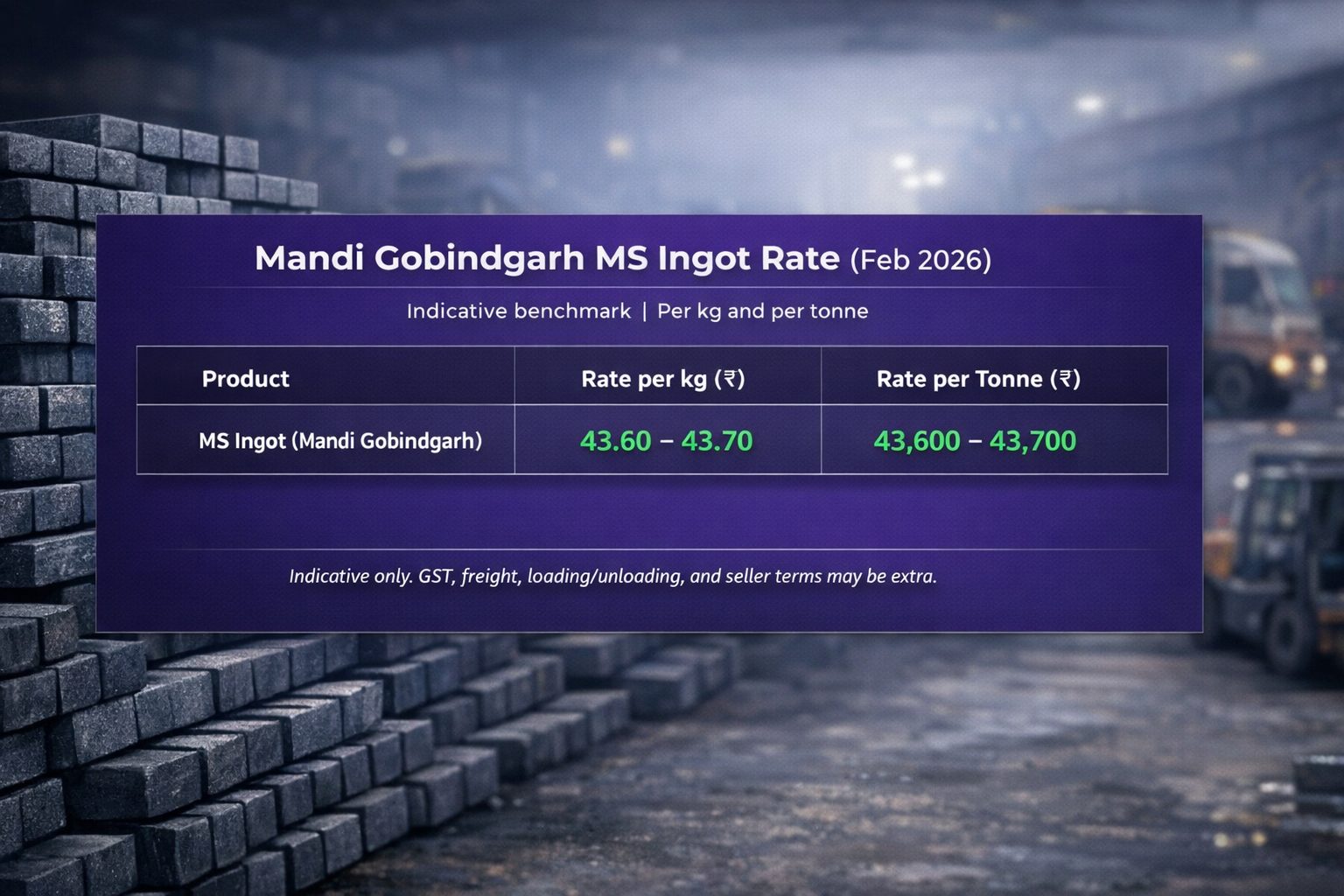
Mandi Gobindgarh MS ingot rate per kg/ton (February 2026)
| Product | Rate per kg (₹) | Rate per Tonne (₹) |
| MS Ingot (Mandi Gobindgarh) | 43.60 – 43.70 | 43,600 – 43,700 |
*Prices are indicative and subject to change. Price does not include GST, transport, freight, loading, unloading, and seller-specific commercial terms. Rates are listed for information only. Buyers should check the final price with the seller before confirming the order. Public market trackers on 23–24 Feb 2026 show Mandi Gobindgarh ingot rates around this range.
Mandi Gobindgarh ingot price trend (2026)
Mandi Gobindgarh ingot prices have remained range-bound to mildly soft in recent sessions, with small day-to-day movements rather than sharp swings. For MSME buyers, this usually indicates a market where mills and buyers are balancing production and procurement, instead of aggressive buying or panic selling.
Recent public market tracker entries for Mandi Gobindgarh ingot show quotes around ₹43,600-₹43,700 per tonne in late February 2026, while 7-day and 14-day tracker summaries indicate a broader recent trading band with higher levels seen earlier in the period. This suggests that the market has seen some easing from recent highs, but is still moving within a workable range for procurement planning.
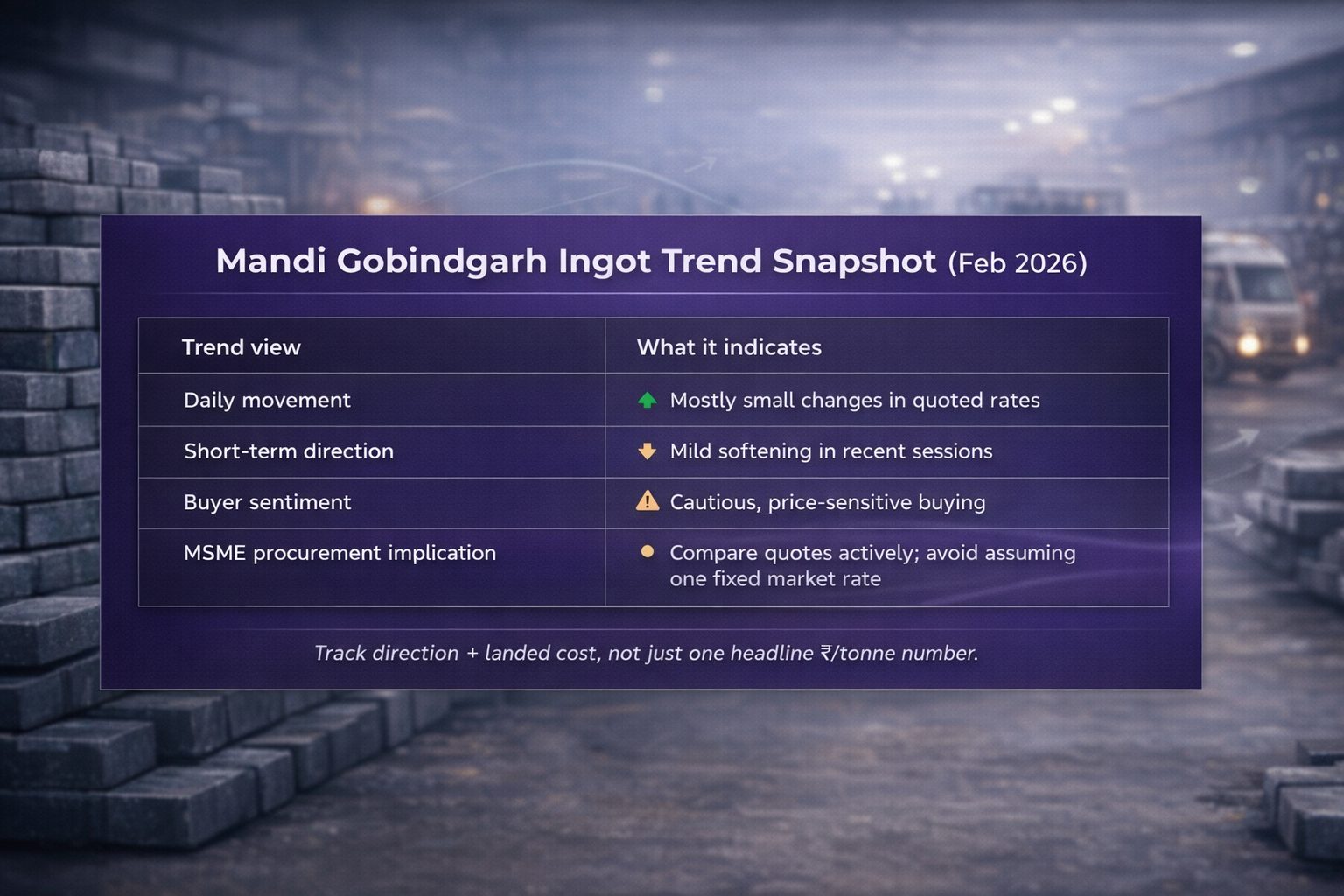
Mandi Gobindgarh ingot trend snapshot (February 2026)
| Trend view | What it indicates |
| Daily movement | Mostly small changes in quoted rates |
| Short-term direction | Mild softening in recent sessions |
| Buyer sentiment | Cautious, price-sensitive buying |
| Procurement implication for MSMEs | Compare quotes actively and avoid assuming one fixed market rate |
In practical terms, MSME buyers should track the direction of the market, not just one quoted rate. Even when the headline price looks stable, the final landed price can change because of freight, quantity slab, and seller terms.
*Trend interpretation is based on recent public market tracker updates and rolling price summaries for Mandi Gobindgarh ingot in February 2026.
Mandi Gobindgarh ingot rates vs other Indian markets
It is useful to compare the Mandi Gobindgarh ingot price with a few other markets in India, especially when MSME buyers are checking whether a supplier quote is in line with the broader market.
Mandi Gobindgarh is often tracked as a key northern benchmark for secondary steel. However, prices can differ across cities due to local scrap availability, demand, mill concentration, freight, and regional buying activity.
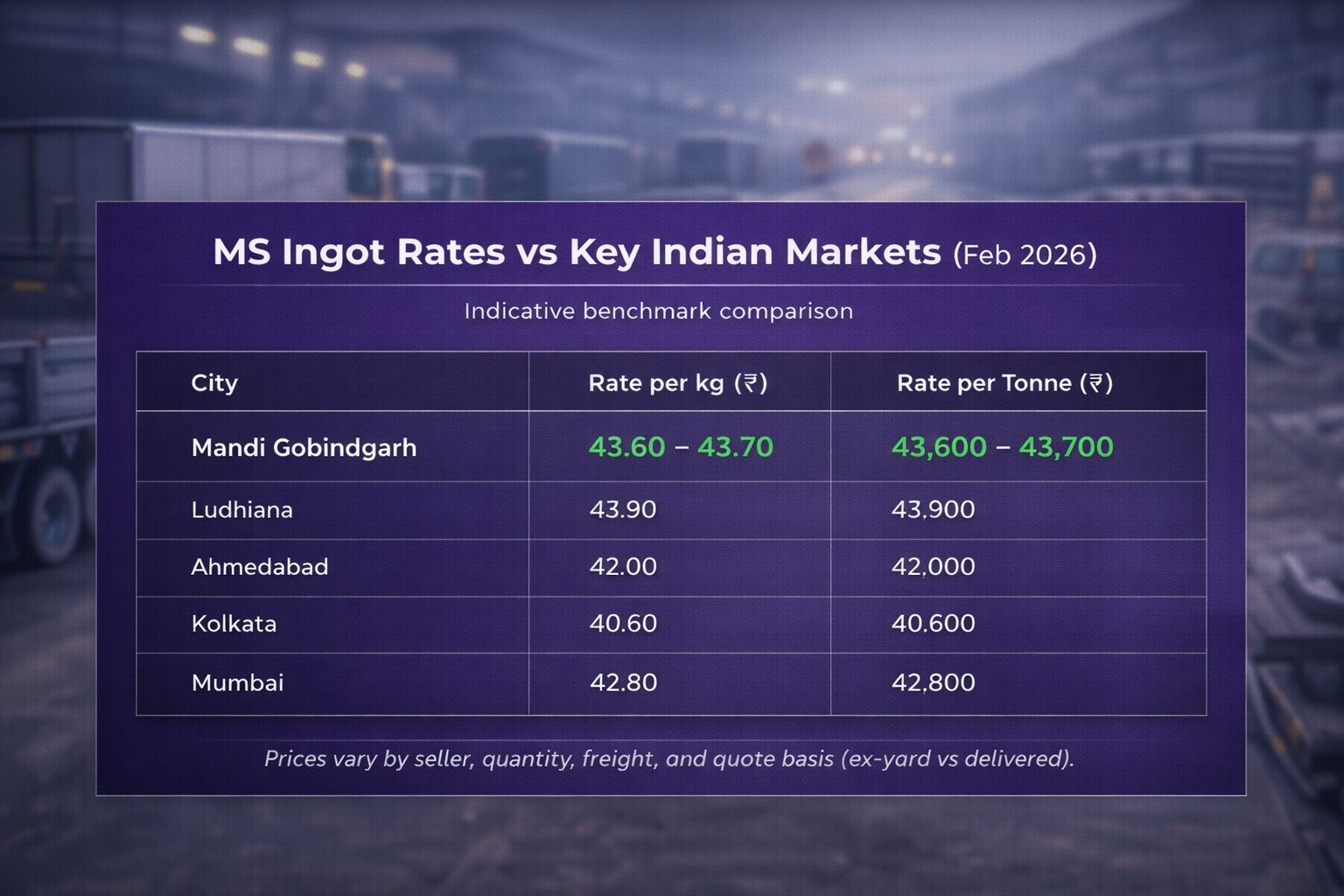
MS ingot rate in Mandi Gobindgarh city-wise (February 2026)
| City | Rate per kg (₹) | Rate per Tonne (₹) |
| Mandi Gobindgarh | 43.60 – 43.70 | 43,600 – 43,700 |
| Ludhiana | 43.90 | 43,900 |
| Ahmedabad | 42.00 | 42,000 |
| Kolkata | 40.60 | 40,600 |
| Mumbai | 42.80 | 42,800 |
*Prices are indicative and subject to change. Price does not include GST, transport and freight. Rates are listed for information only and may vary by seller, quantity, and delivery terms. Public trackers on 23–24 February 2026 show Mandi Gobindgarh around ₹43,600–₹43,700/tonne, with other cities quoted at different levels on the same or nearby dates
In general, Mandi Gobindgarh trades at a premium to Kolkata and Ahmedabad in this snapshot, while being closer to Ludhiana in the north market belt. Buyers should use this table as a benchmark only, and compare it with the supplier’s quote basis (ex-yard or delivered) before making a purchase decision.
Also read: Mandi Gobindgarh steel rates today – for MS billet, steel scrap price per kg
What affects ingot prices in Mandi Gobindgarh
Mandi Gobindgarh ingot prices do not move for one reason alone. In most cases, the final market rate changes because of a combination of input cost, local demand, and mill-side operating conditions. For MSME buyers, understanding these factors helps in comparing quotes more accurately and planning purchases better.
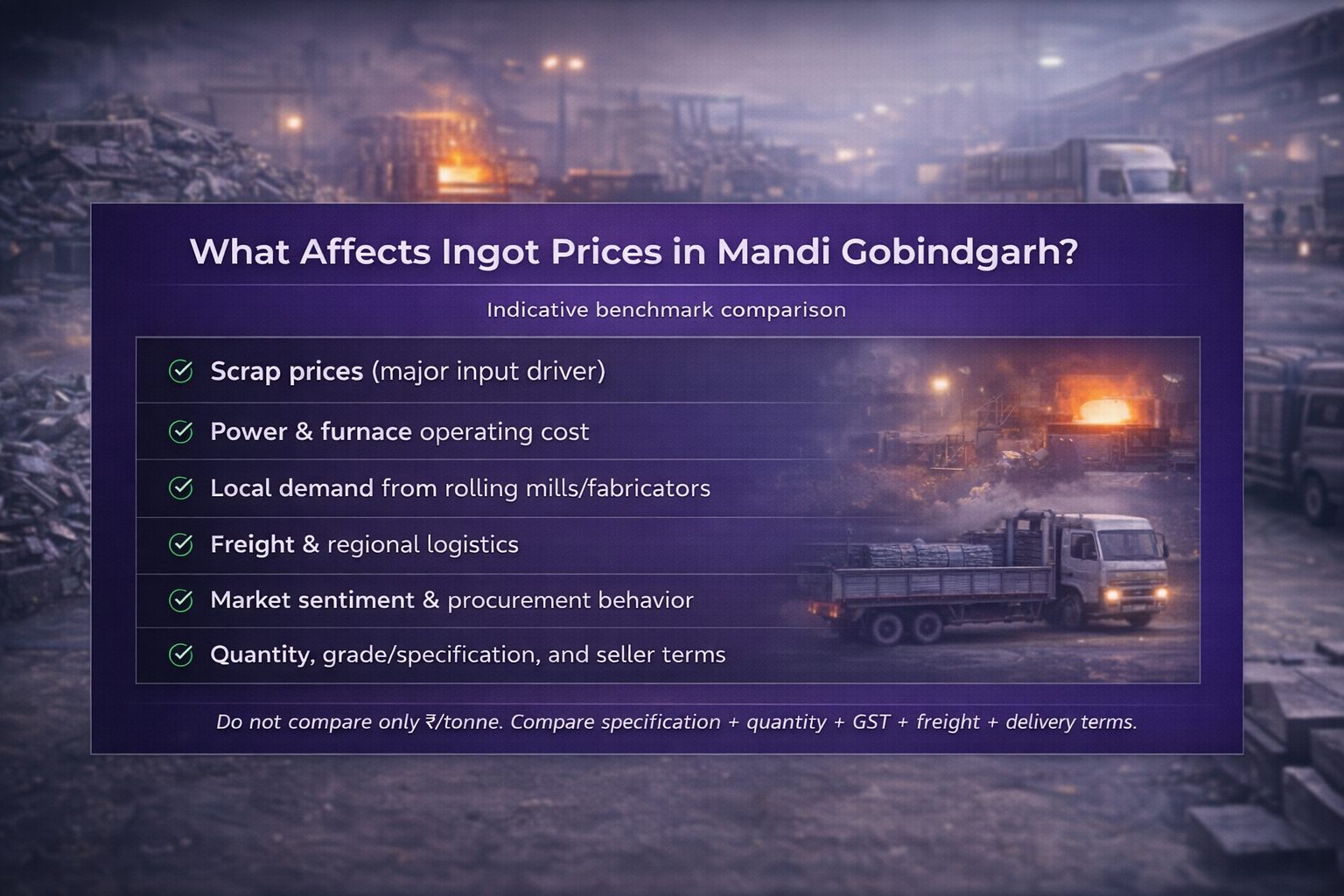
Key factors that influence ingot prices
- Scrap prices (major input driver)
Mandi Gobindgarh is a secondary steel market, and scrap is a key raw material for many mills. When scrap prices move up, ingot prices usually rise as mills pass on the higher input cost. When scrap supply improves and prices soften, ingot rates may ease. - Power and furnace operating cost
Electricity and fuel cost can directly affect production cost in secondary steel units. Higher power tariffs or operating cost pressure can push mills to revise ingot quotes, especially when margins are already tight. - Local demand from rolling mills and fabricators
Demand from TMT rolling mills, re-rollers, and fabricators in and around Punjab and nearby markets influences buying activity. If downstream demand is strong, mills can hold or increase quotes. If buying is slow, prices may remain range-bound or soften. - Freight and regional logistics
Even if the ex-yard ingot price looks similar across markets, freight and transport availability can change the final delivered cost. This is one reason city-wise ingot prices differ across India. - Market sentiment and procurement behavior
When buyers expect further softening, they may purchase in smaller lots. When they expect price recovery, they may book faster. This buying behavior itself can affect near-term market movement. - Quantity, grade/specification, and seller terms
Bulk orders may get different commercial terms than smaller lots. Final price also varies by grade/specification, payment terms, dispatch timeline, and seller relationship.
In short, MSME buyers should not compare only the headline ₹/tonne figure. It is better to compare the full quote basis – product specification, quantity, GST, freight, and delivery terms – before making a decision. Public market commentary and trackers also frequently note the role of scrap and freight in secondary steel price movement.
Why Mandi Gobindgarh matters for ingot buyers in India
Mandi Gobindgarh is one of the most important secondary steel markets in North India, and that is why its ingot rates are closely tracked by traders, rolling mills, and MSME buyers. For many businesses, it works as a practical reference market for checking steel price direction before finalising purchase decisions.
The market is known for its strong cluster of steel-related businesses, including scrap traders, furnace units, rerollers, transport operators, and downstream buyers. This ecosystem supports regular buying and selling activity, which is one reason Mandi Gobindgarh prices are widely followed in the secondary steel trade.
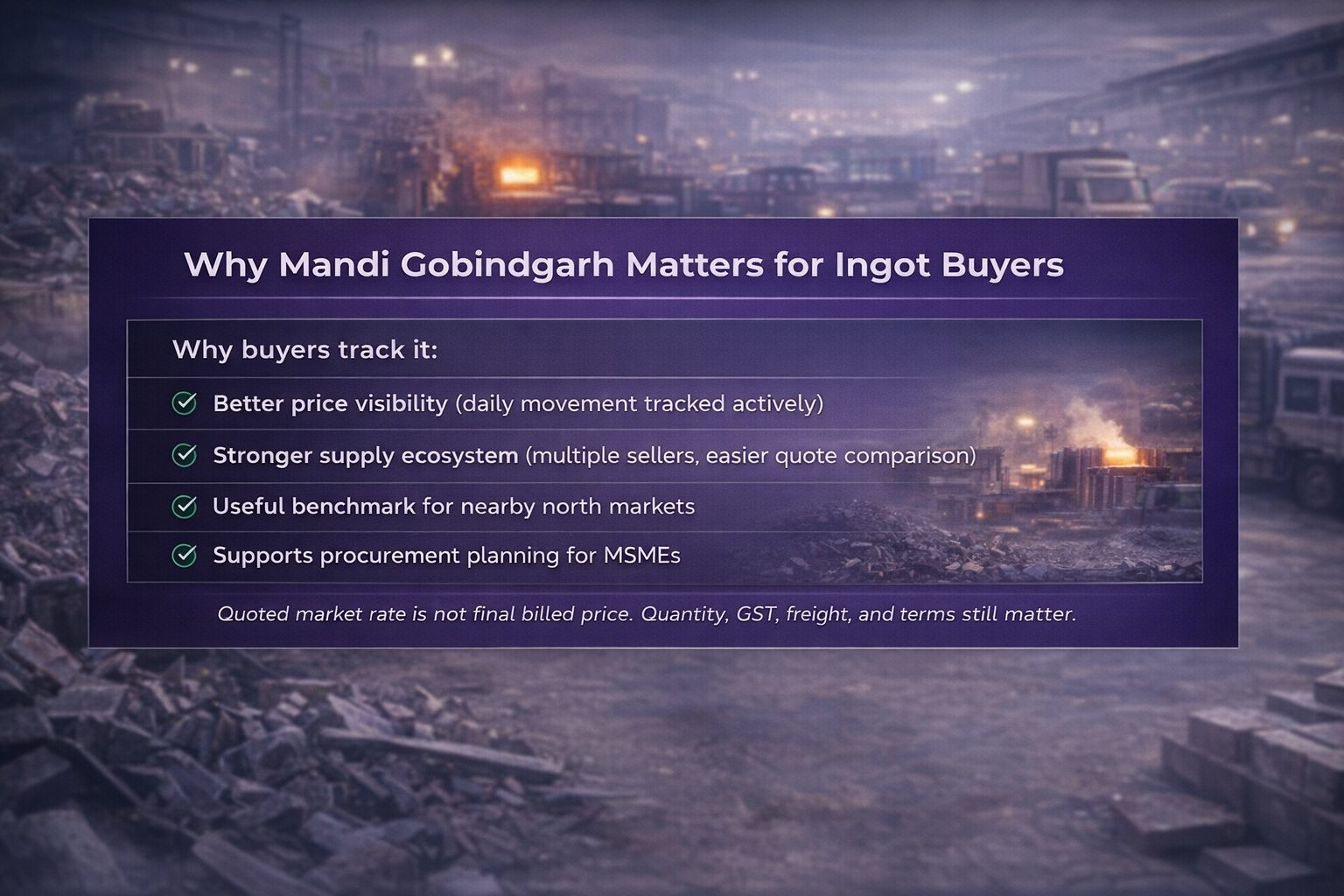
For ingot buyers, this matters in a few practical ways:
- Better price visibility: Daily market movement is tracked more actively than in many smaller local markets.
- Stronger supply ecosystem: Buyers can usually access multiple sellers and compare quotes more easily.
- Useful benchmark for nearby markets: Rates in Punjab and nearby regions are often compared against Mandi Gobindgarh levels.
- Procurement planning support: A visible market range helps MSMEs plan purchase quantity and timing with more confidence.
At the same time, buyers should not assume that a quoted “Mandi Gobindgarh rate” is the final payable amount. The actual billed price still depends on quantity, specification, taxes, freight, and seller terms.
The region’s steel ecosystem is also shaped by factors such as secondary steel production activity, scrap availability, and operating conditions in local units. Industry reporting and public coverage continue to identify Mandi Gobindgarh as a major steel manufacturing and trading belt in Punjab, which is why this market remains important for price tracking.
Types of steel ingots and indicative price differences
There are different types of steel ingots in the market, and the price can vary significantly depending on the material category, grade, and end use. For most MSME buyers in construction-related and general fabrication supply chains, MS ingot (mild steel ingot) is the most commonly tracked category in Mandi Gobindgarh.
At the same time, alloy steel and stainless steel ingots are also used in engineering, manufacturing, and specialised industrial applications. These products are priced differently from MS ingots because of composition, grade requirements, and processing standards.
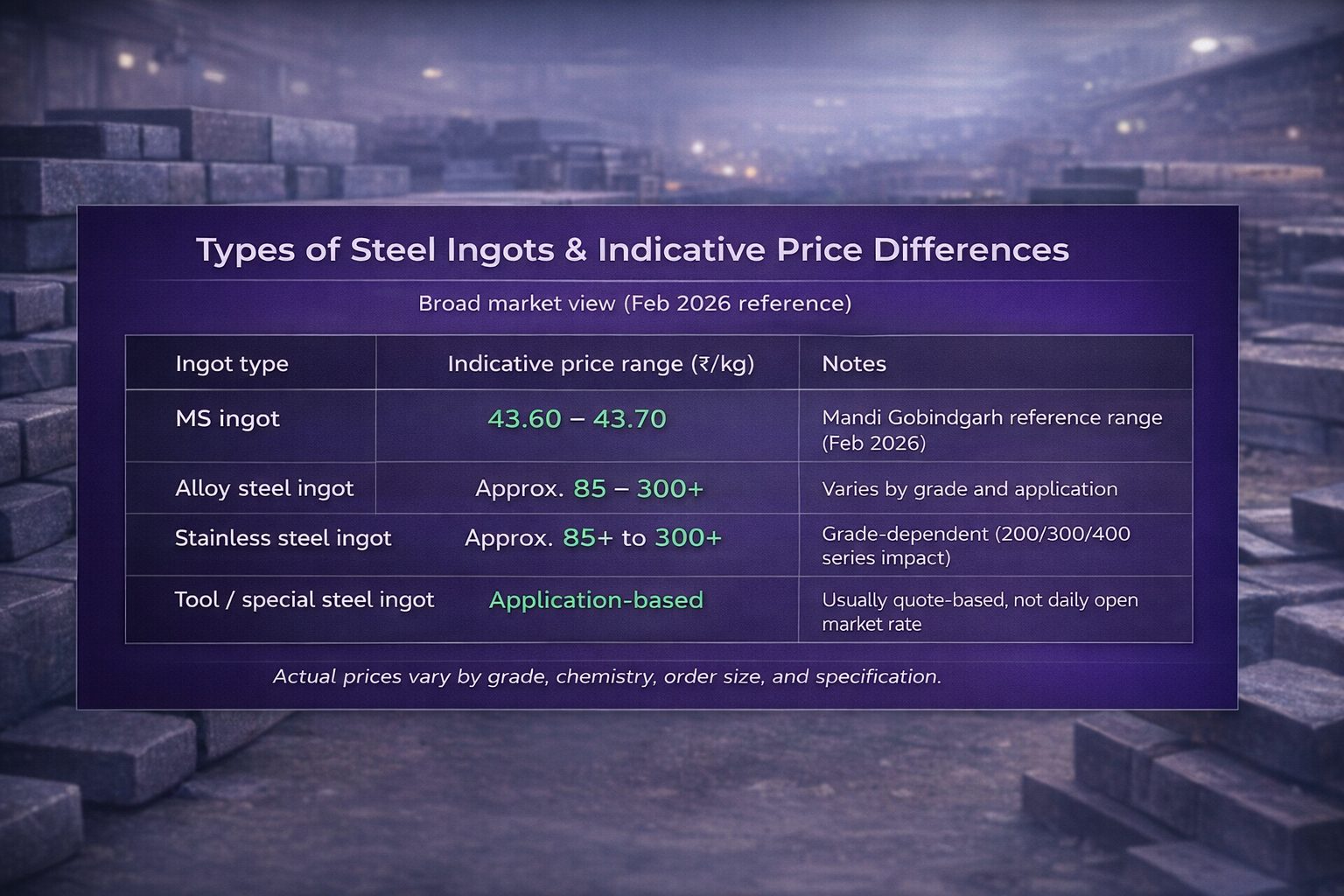
Common steel ingot categories
- MS ingot (Mild Steel Ingot): Commonly used as input for rerolling and making finished steel products.
- Alloy steel ingot: Used in engineering and industrial applications where specific mechanical properties are required.
- Stainless steel ingot: Used in sectors where corrosion resistance and grade-specific performance are important.
- Tool/ special steel ingot: Used for specialised industrial applications and tooling requirements.
Indicative price comparison (broad market view)
| Ingot type | Indicative price range (₹/kg) | Notes |
| MS ingot | 43.60 – 43.70 | Mandi Gobindgarh reference range (Feb 2026) |
| Alloy steel ingot | Approx. 85 – 300+ | Varies widely by grade and application |
| Stainless steel ingot | Approx. 85+ to 300+ | Grade-dependent; 200/300/400 series usage can affect price |
| Tool / special steel ingot | Application-based | Usually quote-based, not a standard open market daily rate |
*MS ingot rates above are based on public Mandi Gobindgarh trackers in late February 2026. Alloy/stainless ranges are broad indicative market references from supplier listings and can vary significantly by grade, chemistry, order size, and specification.
How MSME buyers should calculate final landed cost
The listed ingot price is only the starting point. For MSME buyers, the actual procurement decision should be based on the final landed cost, because the payable amount can be higher than the quoted market rate after taxes and logistics are added.
A supplier may quote an attractive ex-yard ingot rate, but the delivered cost can change depending on quantity, transport distance, loading/unloading, and commercial terms. This is why two buyers can get different final rates even when the market benchmark is the same.
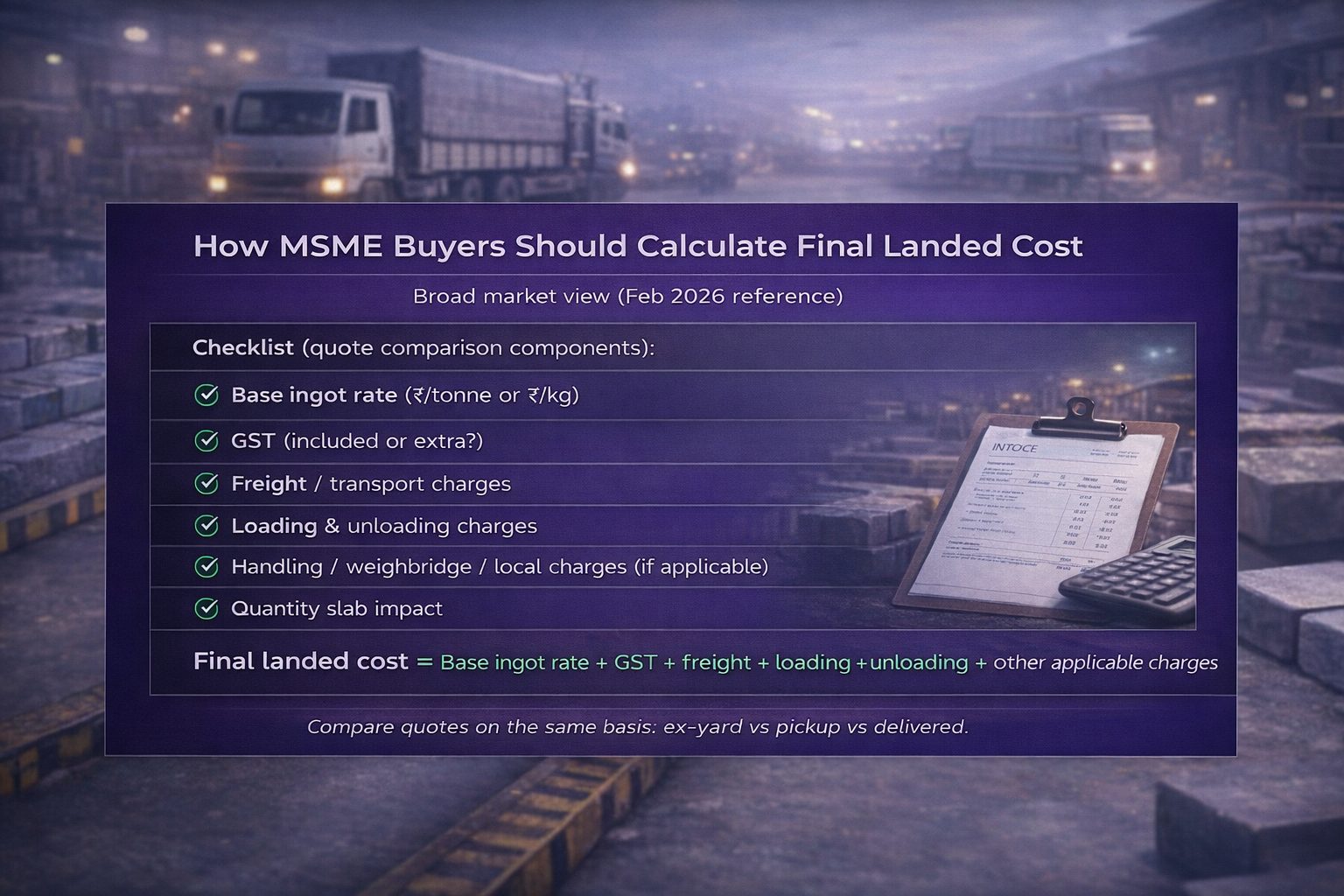
Components of final landed cost
Use this simple checklist while comparing quotes:
- Base ingot rate (₹/tonne or ₹/kg)
Confirm whether the quote is ex-yard, pickup basis, or delivered basis. - GST
Check whether GST is included or extra in the quoted price. - Freight / transport charges
Freight can vary based on route, vehicle type, distance, and dispatch urgency. - Loading and unloading charges
Some sellers include loading, while unloading may be buyer-side. - Handling/ weighbridge/ local charges (if applicable)
Small charges can affect the final comparison, especially in smaller lots. - Quantity slab impact
Bulk quantity may attract better pricing than small-lot orders. - Payment terms
Immediate payment vs credit terms can affect the final commercial rate.
Simple landed cost formula:
Final landed cost = Base ingot rate + GST + freight + loading/unloading + other applicable charges
How to buy steel ingots in India (Practical checklist for MSMEs)
Buying steel ingots becomes easier when the process is handled with a clear checklist. For MSME buyers, this helps reduce pricing confusion, avoids mismatch in specifications, and improves supplier comparison before the order is finalised.
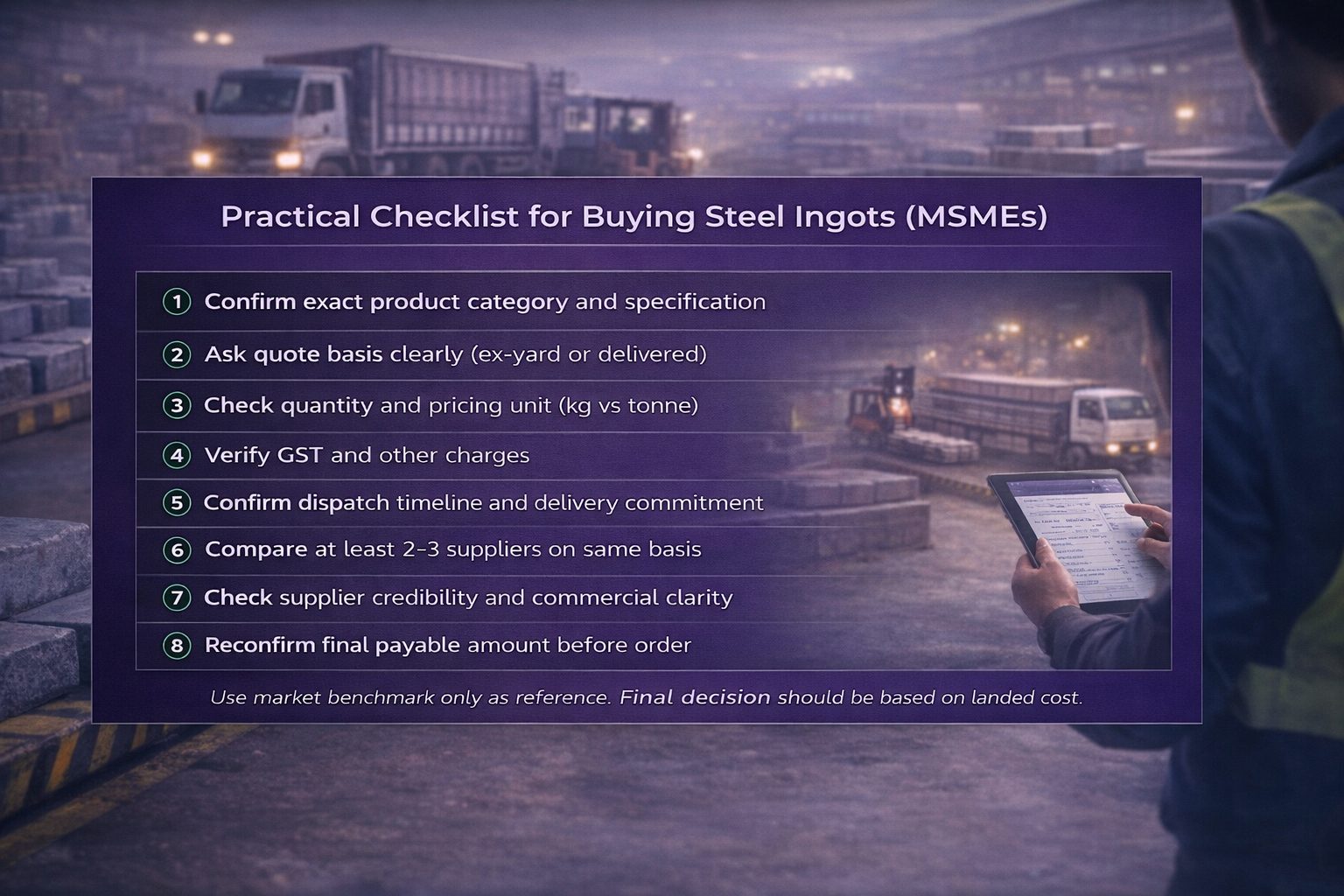
Practical checklist for buying steel ingots
- Confirm the exact product requirement
Ask for the correct material category and specification before comparing rates. Do not compare a general ingot quote with a grade-specific or application-specific quote. - Ask for quote basis clearly (ex-yard or delivered)
A “lower” quote may only be ex-yard. Always confirm whether the rate includes transport or if freight is extra. - Check quantity and unit of pricing
Confirm whether the quote is per kg or per tonne, and whether pricing changes for different order quantities. - Verify GST and other charges
Check if GST, loading, unloading, and local handling charges are included or extra. - Confirm dispatch timeline and delivery commitment
Price is important, but delay in dispatch can affect production planning. Ask for expected dispatch date and delivery timeline. - Compare at least 2-3 suppliers
Use the market range as a benchmark and compare multiple quotes on the same commercial basis. - Check supplier credibility and commercial clarity
Before finalising, confirm invoice terms, payment terms, and basic commercial commitments in writing. - Reconfirm final payable amount before order
Ask for the final landed cost summary, especially when freight is variable.
Conclusion
Mandi Gobindgarh ingot price today is a useful reference point for MSME buyers, traders, and manufacturers who track steel input cost regularly. A clear market benchmark helps in comparing supplier quotes, planning purchases, and managing production cost more efficiently.
In February 2026, MS ingot prices in Mandi Gobindgarh are moving in a relatively narrow range, which supports better quote comparison when buyers check rates carefully and compare on the same basis.
To use this information effectively, compare the quoted price with the market range, confirm whether GST and freight are extra, and calculate the final landed cost before placing the order. This simple approach helps businesses make more practical and cost-aware procurement decisions.
Looking to procure steel?
Tata nexarc helps manufacturers, builders and MSMEs source certified steel products, compare prices, and choose the right grade as per IS codes—with complete traceability and procurement confidence.
FAQs
How often should MSMEs benchmark Mandi Gobindgarh ingot rates before bulk booking?
What is the best quote format to request for Mandi Gobindgarh ingot procurement?
Why do two Mandi Gobindgarh ingot quotes differ even when the market rate is the same?
Should MSME buyers negotiate ingot prices on ex-yard rate or landed rate?
How can businesses avoid quote mismatch in MS ingot procurement?
What is a practical purchase strategy when ingot prices are range-bound?
How important is quote validity in steel ingot purchases?
What should procurement teams document after every ingot purchase?
How can recurring buyers improve steel ingot procurement decisions over time?
What is the biggest mistake businesses make while comparing ingot quotes?
Sohini is a seasoned content writer with 12 years’ experience in developing marketing and business content across multiple formats. At Tata nexarc, she leverages her skills in crafting curated content on the Indian MSME sector, steel procurement, and logistics. In her personal time, she enjoys reading fiction and being up-to-date on trends in digital marketing and the Indian business ecosystem.


Is there any way to obtain even more recent ingot prices in Mandi Gobindgarh than Jan 2024? I need the latest prices to decide to buy from there.
you can check out raise a request on https://www.tatanexarc.com/buy/inquiry-form/. You can get the prices update prices regularly. You could also try contacting steel traders or suppliers directly in Mandi Gobindgarh
Can I negotiate bulk discounts? Since I’m a frequent buyer, can I get better rates for larger orders compared to the listed prices?