
 Check Price Now
Table of Contents
Introduction
I-section steel beams are common in sheds, factories, mezzanines, platforms, and many civil works across India. Yet procurement often gets delayed because drawings mention sizes, while suppliers quote in kg. Material arrives in pieces, invoices arrive by weight, and teams struggle to reconcile what was ordered versus what was supplied.
What this guide helps MSMEs do
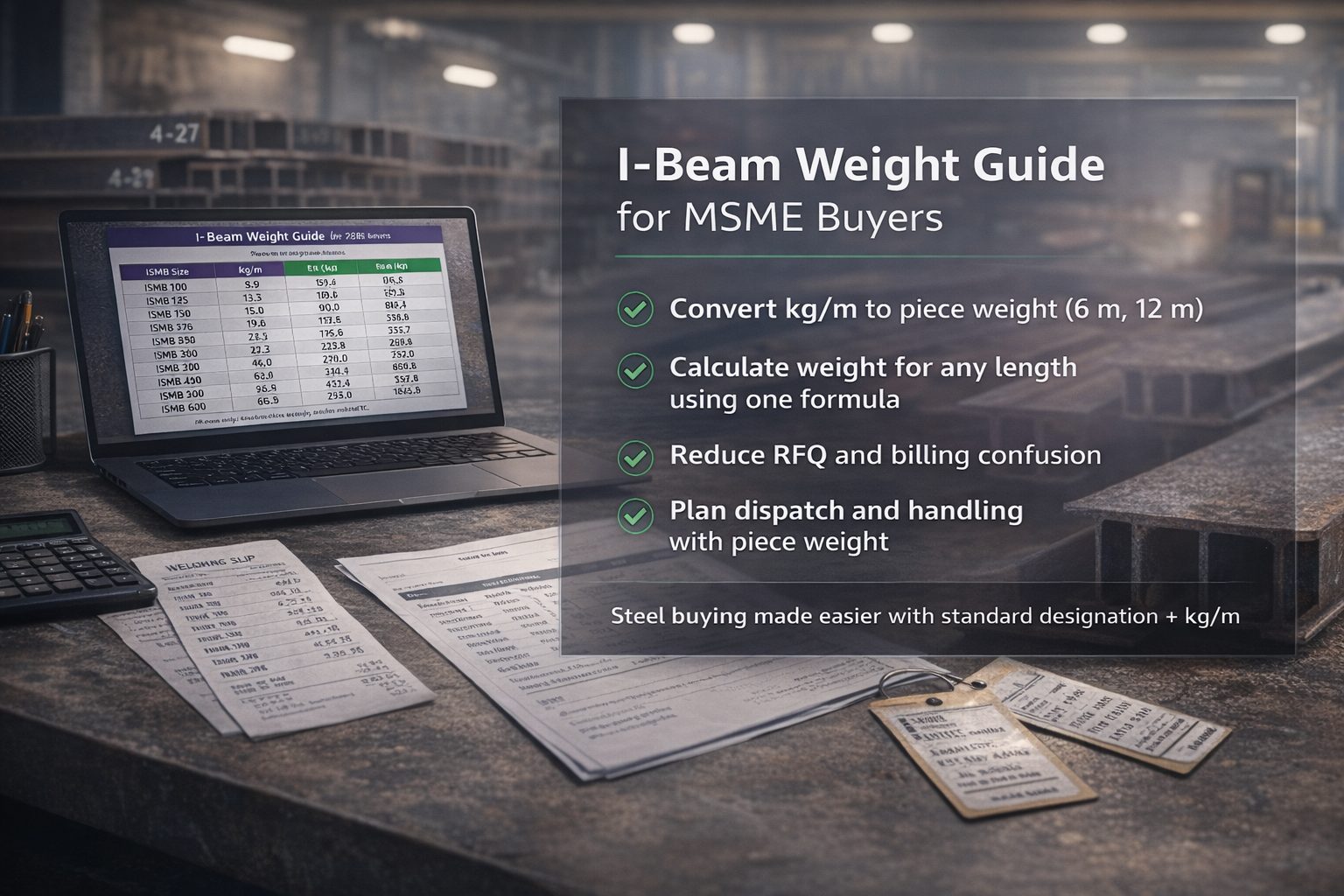
This article makes the I-beam weight chart practical for Indian MSMEs and procurement teams.
- Convert kg/m into piece weight for 6 m and 12 m
- Calculate weight for any length using a simple formula
- Reduce RFQ confusion, billing disputes, and GRN mismatches
- Support dispatch and site handling by estimating piece weight in advance
Disclaimer
This is a reference guide to understand I-beam weights and calculations. Actual weights and dimensions can vary by series, standard, mill practice, and permissible tolerance. Always confirm specifications and MTC details with the supplier or manufacturer.
I-Beam weight chart
Understanding I-beam weight helps with RFQ, billing checks, and transport planning decisions. Most suppliers quote beams by kg/m, then convert it to piece weight based on the length supplied. This section keeps the charts practical for Indian MSMEs by using standard ISMB (MB series) reference values and simple conversions. This avoids confusion when quotes are in kilograms but delivery is in pieces.
Also read: MS Flat weight chart – How to calculate MS flat bar weight
Chart 1: ISMB quick weight chart (kg/m) with 6 m and 12 m piece weight
Formula used
- 6 m weight (kg) = kg/m × 6
- 12 m weight (kg) = kg/m × 12
| ISMB designation | Weight (kg/m) | 6 m weight (kg) | 12 m weight (kg) |
| ISMB 100 | 8.9 | 53.4 | 106.8 |
| ISMB 125 | 13.3 | 79.8 | 159.6 |
| ISMB 150 | 15.0 | 90.0 | 180.0 |
| ISMB 175 | 19.6 | 117.6 | 235.2 |
| ISMB 200 | 24.2 | 145.2 | 290.4 |
| ISMB 250 | 37.3 | 223.8 | 447.6 |
| ISMB 300 | 46.0 | 276.0 | 552.0 |
| ISMB 350 | 52.4 | 314.4 | 628.8 |
| ISMB 400 | 61.5 | 369.0 | 738.0 |
| ISMB 450 | 72.4 | 434.4 | 868.8 |
| ISMB 500 | 86.9 | 521.4 | 1042.8 |
| ISMB 600 | 123.0 | 738.0 | 1476.0 |
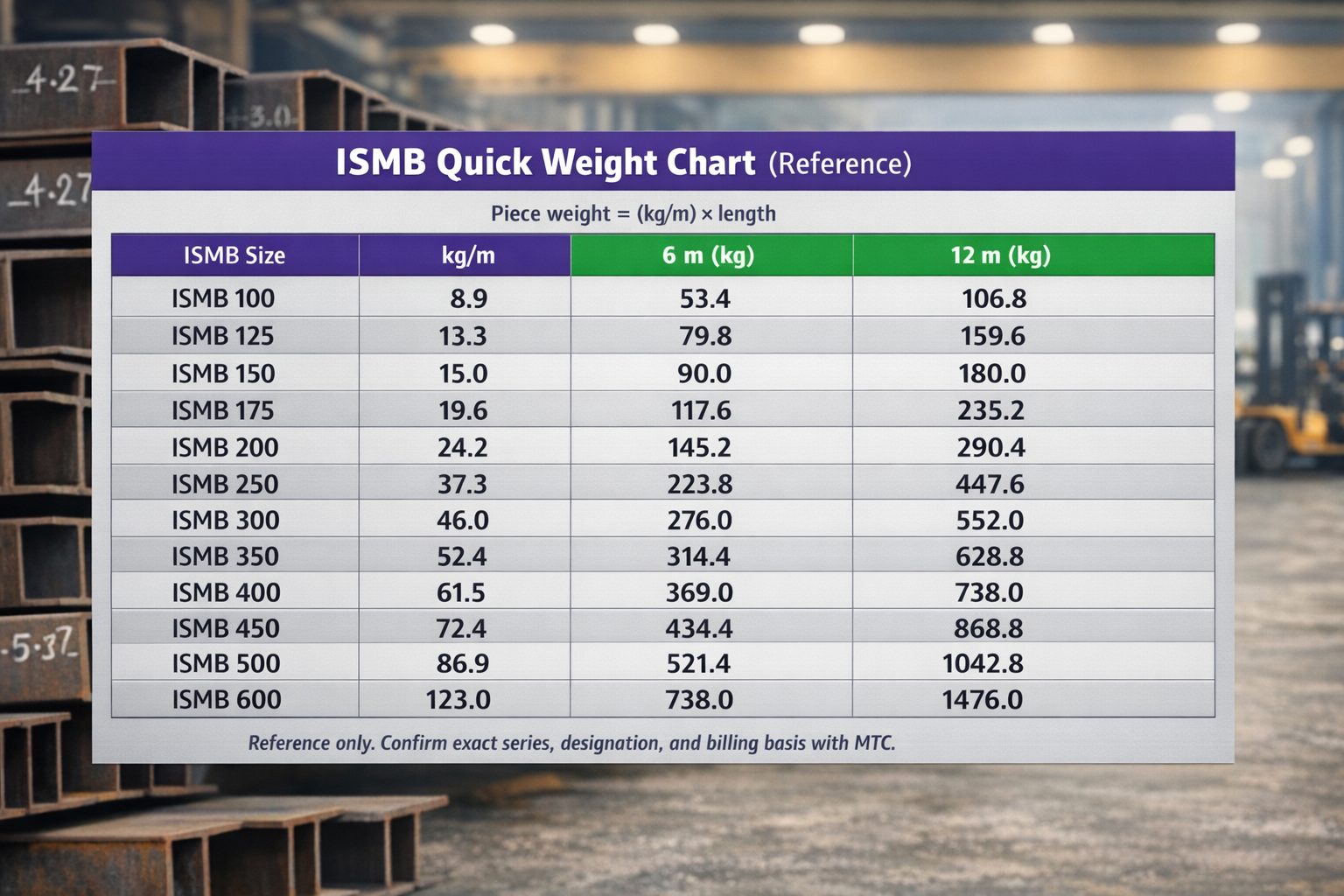
*Reference only. Always confirm the exact section series, designation, and billing basis (theoretical vs actual weighment) with the supplier and MTC.
Quick procurement tip
- If the BOQ says “300 × 140”, confirm whether it maps to ISMB 300 or another series before finalising rates.
- Record section designation, length, and number of pieces in GRN so invoice reconciliation becomes easier.
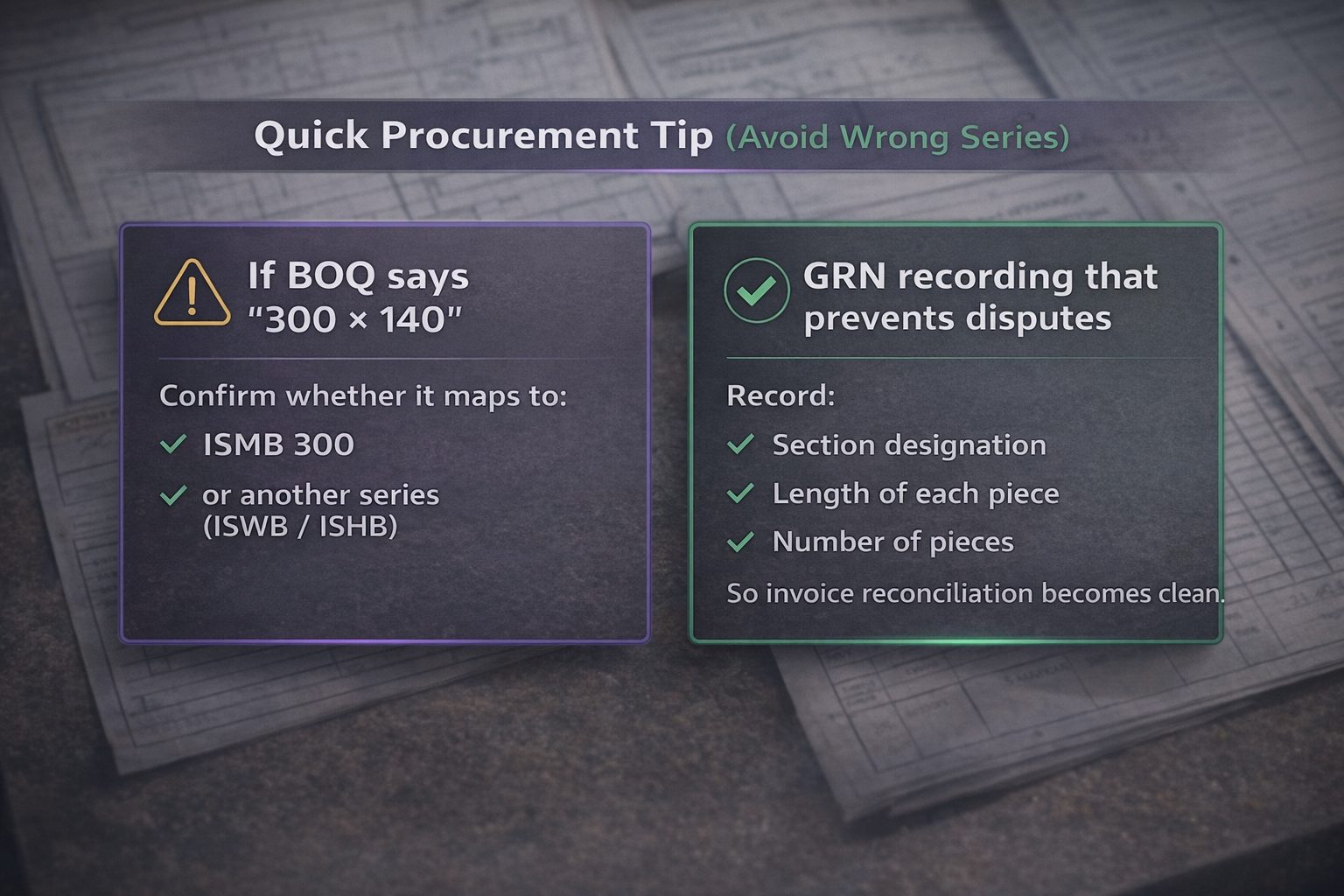
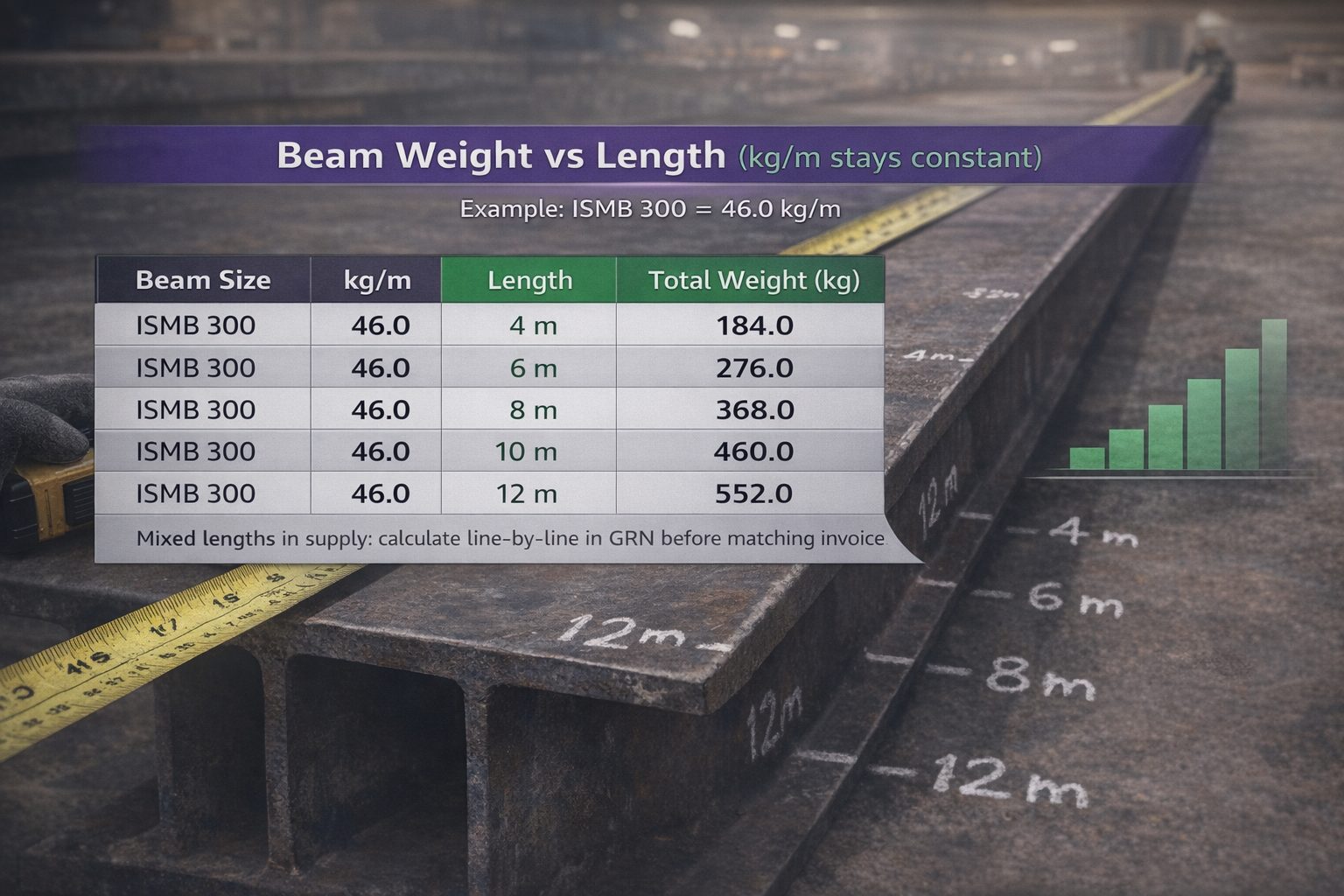
Chart 2: How beam weight changes with length (kg/m stays constant)
This chart shows the key idea behind I-beam weight calculations. Weight per metre stays the same, total weight increases only because length increases.
Example shown for MB 300 (46.0 kg/m).
| Beam size | Weight (kg/m) | Length | Total weight (kg) |
| ISMB 300 | 46.0 | 4 m | 184.0 |
| ISMB 300 | 46.0 | 6 m | 276.0 |
| ISMB 300 | 46.0 | 8 m | 368.0 |
| ISMB 300 | 46.0 | 10 m | 460.0 |
| ISMB 300 | 46.0 | 12 m | 552.0 |
Practical note for MSMEs
- If the PO says “12 m fixed length” but supply comes as mixed lengths, calculate piece weight line by line in the GRN.
- If there is a mismatch, check length variation first, then check whether billing is theoretical or actual weighbridge weight.
Disclaimer: These charts are for reference and understanding. Actual weights and dimensions can vary by series, mill practice, and permissible tolerance. Always confirm the exact section designation and MTC details with the supplier or manufacturer.
Also read: How to calculate chequered plate weight
How to calculate I-beam weight?
Once the beam size is confirmed, weight calculation becomes straightforward. For standard ISMB sections, the fastest approach is to use the kg/m value from the chart, then multiply by the required length. Geometry-based calculation is useful only when the kg/m value is not available, or when dealing with a non-standard fabricated section.
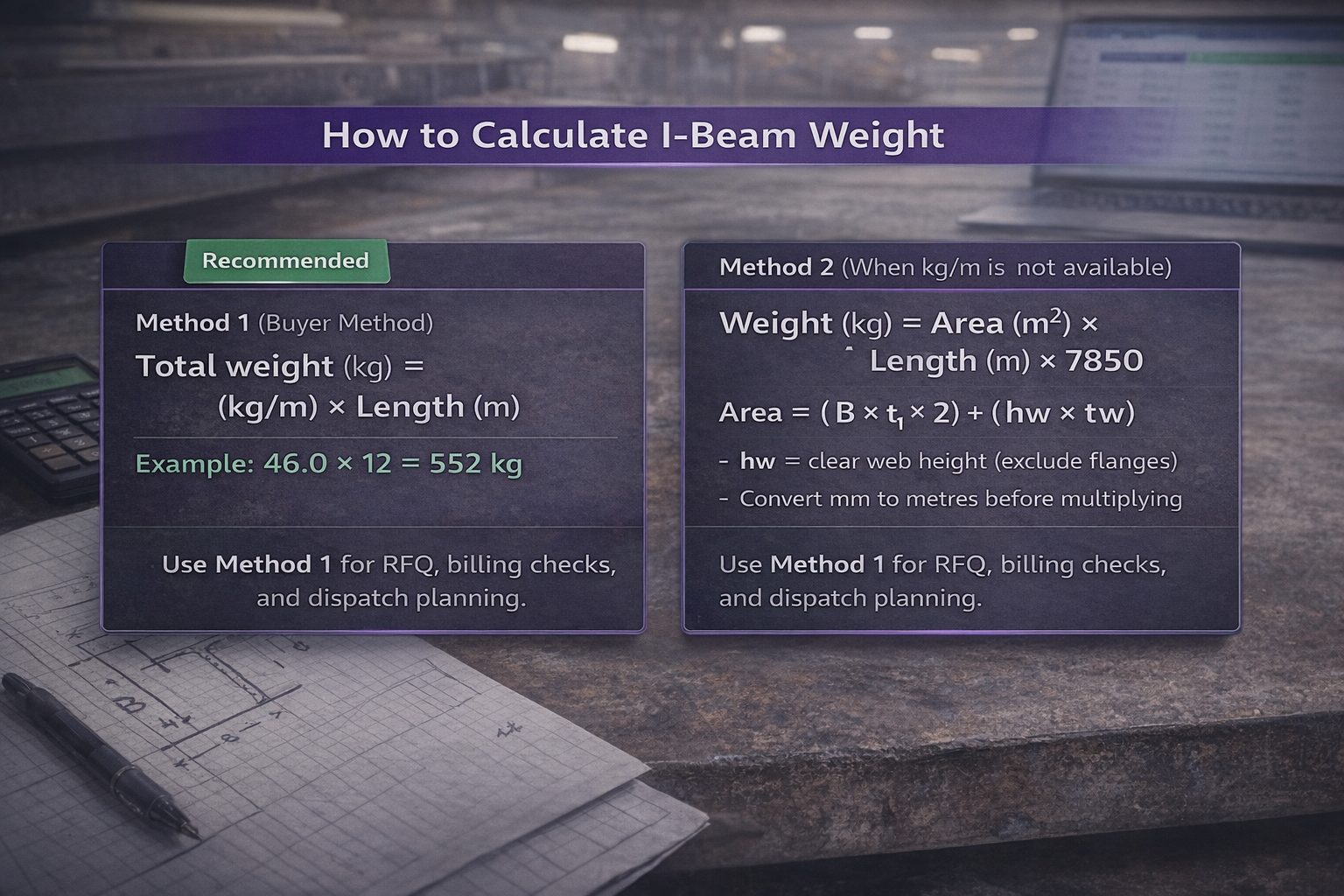
Method 1: kg/m × length (fast buyer method)
This is the best method for procurement, billing checks, and logistics planning.
- Total weight (kg) = Weight per metre (kg/m) × Length (m)
Example
If a beam is 46.0 kg/m and the length is 12 m, then:
Total weight = 46.0 × 12 = 552 kg
Method 2: Area × length × density (only if kg/m is not available)
This method helps when dimensions are known but kg/m is not provided.
- Weight (kg) = Volume (m³) × Density (kg/m³)
- Volume (m³) = Cross-sectional area (m²) × Length (m)
- For estimation, steel density is commonly taken as 7850 kg/m³
Cross-sectional area for an I-section
- Area (A) = (Flange width × Flange thickness × 2) + (Web height × Web thickness)
- Web height here means clear web height, excluding the two flange thicknesses.
Example of I-beam weight calculator
Let’s take an example to calculate weight of a standard I-beam. Here:
Flange width = 150 mm
Flange thickness = 15 mm
Web thickness = 10 mm
Web height = 300 mm (height of the web excluding the flange thickness)
Length of the beam = 8 m or 8000 mm
Density of steel = 7850 kg/m³
Steps to I-beam weight calculator
Step 1:
Cross sectional area (A) = (Flange width x Flange thickness x 2) + (Web height x Web thickness)
A = (150 × 15 × 2) + (300 × 10)
A = 4500 + 3000
A = 7500 mm²
Step 2:
Volume (V) = A x Length, where (Length = 8 m = 8000 mm)
= 7500 mm² x 8000 mm
=60,000 mm³
Convert Volume to Cubic metres
V = 60,000 mm³ / 1,00,000,000
= 0.060 m³
Step 3:
Weight = Volume x Density
= 0.06 m³ x 7850 kg/m³
= 471 kg
Total weight of an I-beam = 471 kg
Common calculation mistakes to avoid
- Mixing mm and metres in the same step without converting units.
- Using overall depth as “web height” without subtracting 2 × flange thickness.
- Copying non-standard charts for standard buying, and then expecting invoice weight to match exactly.
- Forgetting to multiply by the correct length, especially when deliveries come in mixed lengths.
Now that we understand how to calculate weight of I-beams, let’s look at some popular I-beam sizes and how much they weigh.
What is the weight of I-beam 175mm?
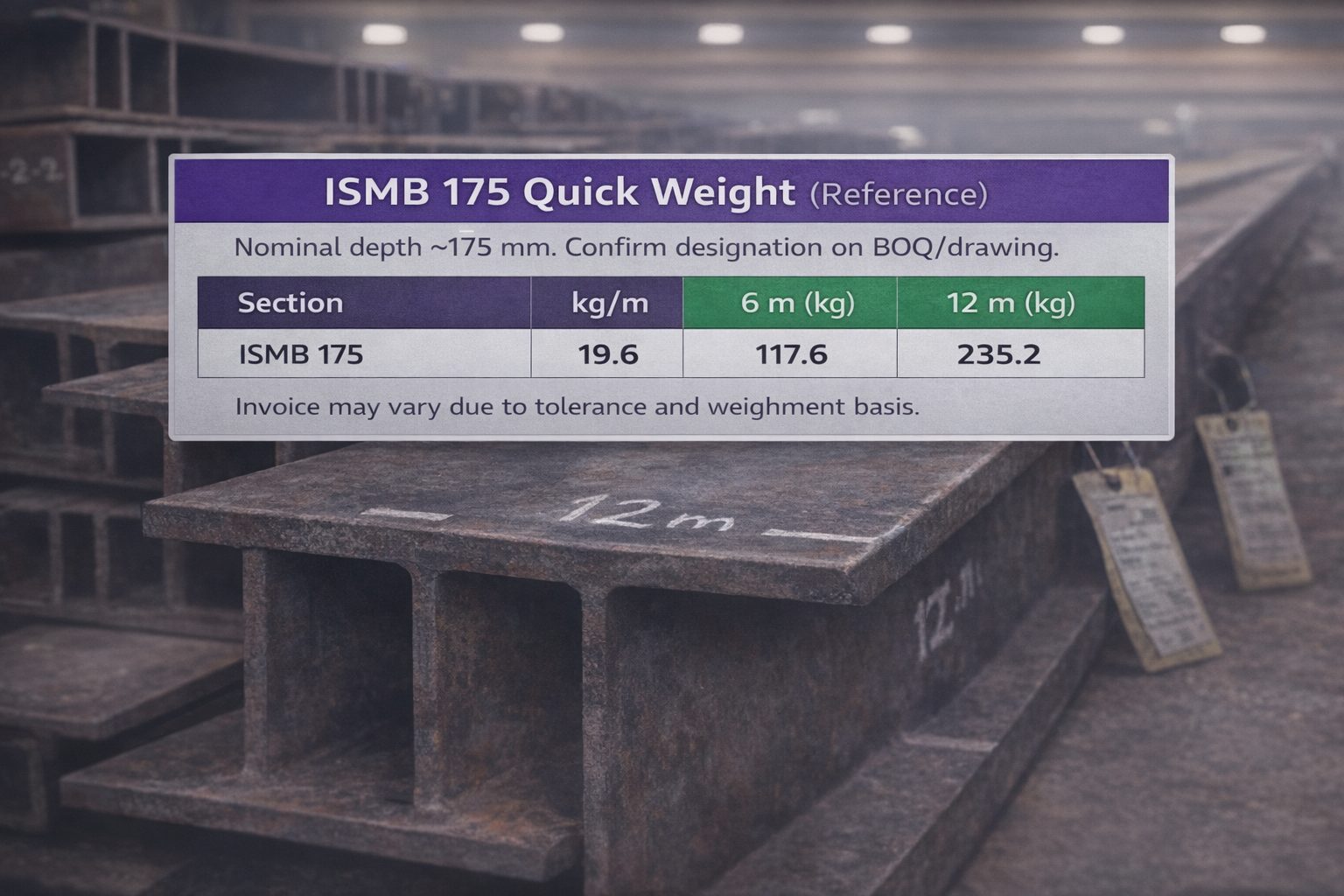
In most Indian catalogues, ISMB 175 (MB 175) refers to a beam with nominal depth around 175 mm, not a “175 mm width”. Confirm the exact designation on the drawing or BOQ before finalising the RFQ, because vendors quote by section series and kg/m, not by a single number.
Quick weight using kg/m (recommended for procurement)
Once the section is confirmed, weight is a straight conversion:
- Total weight (kg) = kg/m × length (m)
Reference kg/m for ISMB 175: commonly listed as 19.6 kg/m.
| Section | kg/m | 6 m weight (kg) | 12 m weight (kg) |
| ISMB 175 (MB 175) | 19.6 | 117.6 | 235.2 |
Billing reality (important for MSMEs): Invoice weight can differ slightly because tolerance on weight per metre may apply and billing may be on actual weighment.
What is the weight of 300 × 140 I-beam?
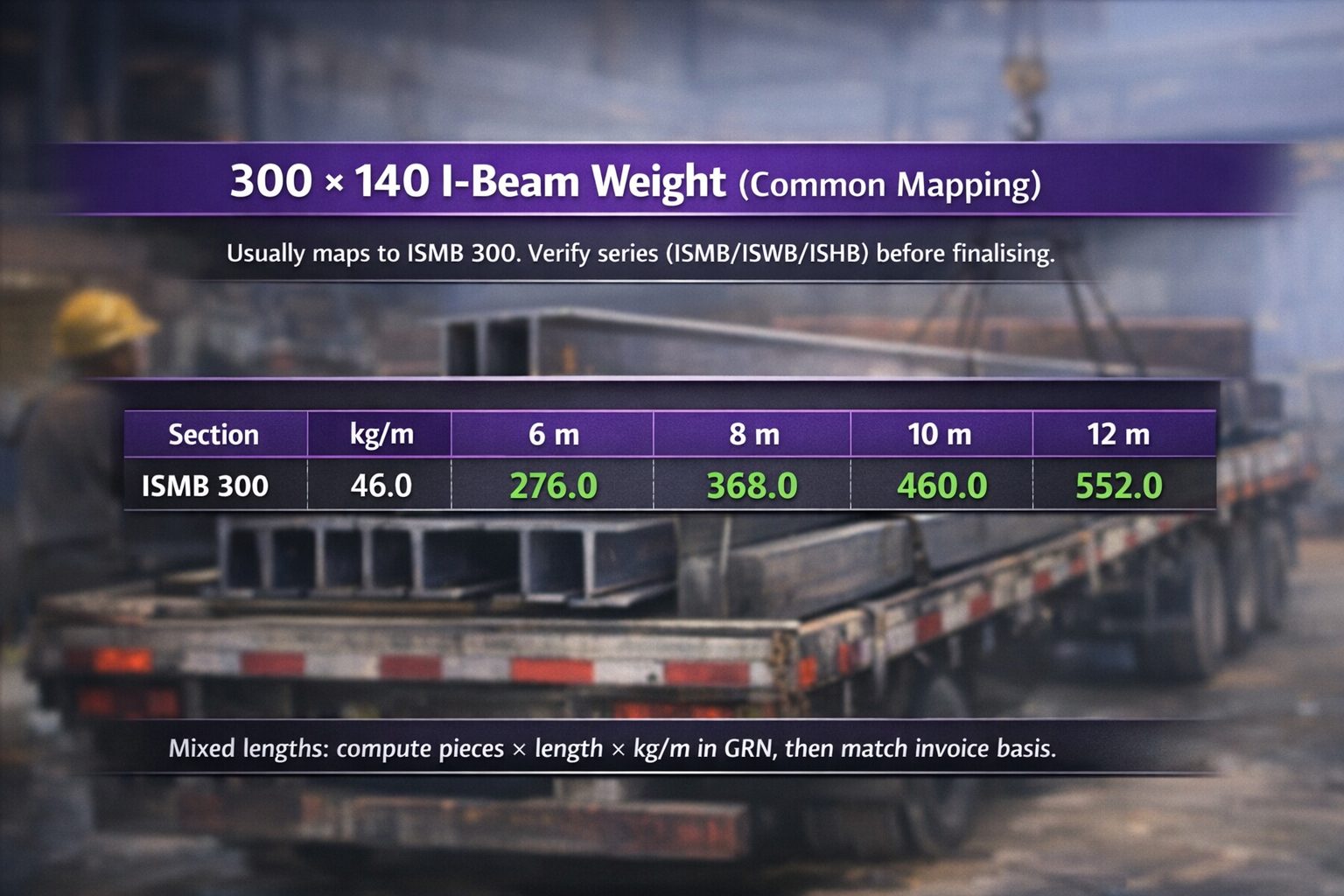
“300 × 140” usually describes depth 300 mm and flange width 140 mm. In Indian tables, this commonly maps to ISMB 300. Always verify the designation (ISMB/ISWB/ISHB) on the drawing, because similar dimensions can exist across series.
Weight for common lengths (6 m, 8 m, 10 m, 12 m)
For ISMB 300, kg/m is often shown around 46.0 kg/m (some vendor tables show 46.1 kg/m due to rounding).
| Section | kg/m | 6 m (kg) | 8 m (kg) | 10 m (kg) | 12 m (kg) |
| ISMB 300 (300 × 140) | 46.0 | 276.0 | 368.0 | 460.0 | 552.0 |
Procurement tip: If the vendor supplies mixed lengths, calculate weight line-by-line in the GRN (pieces × length × kg/m) and match it against the invoice basis (theoretical or weighbridge).
Also read: TMT bar unit weight calculation
How heavy is a 20ft I-beam?
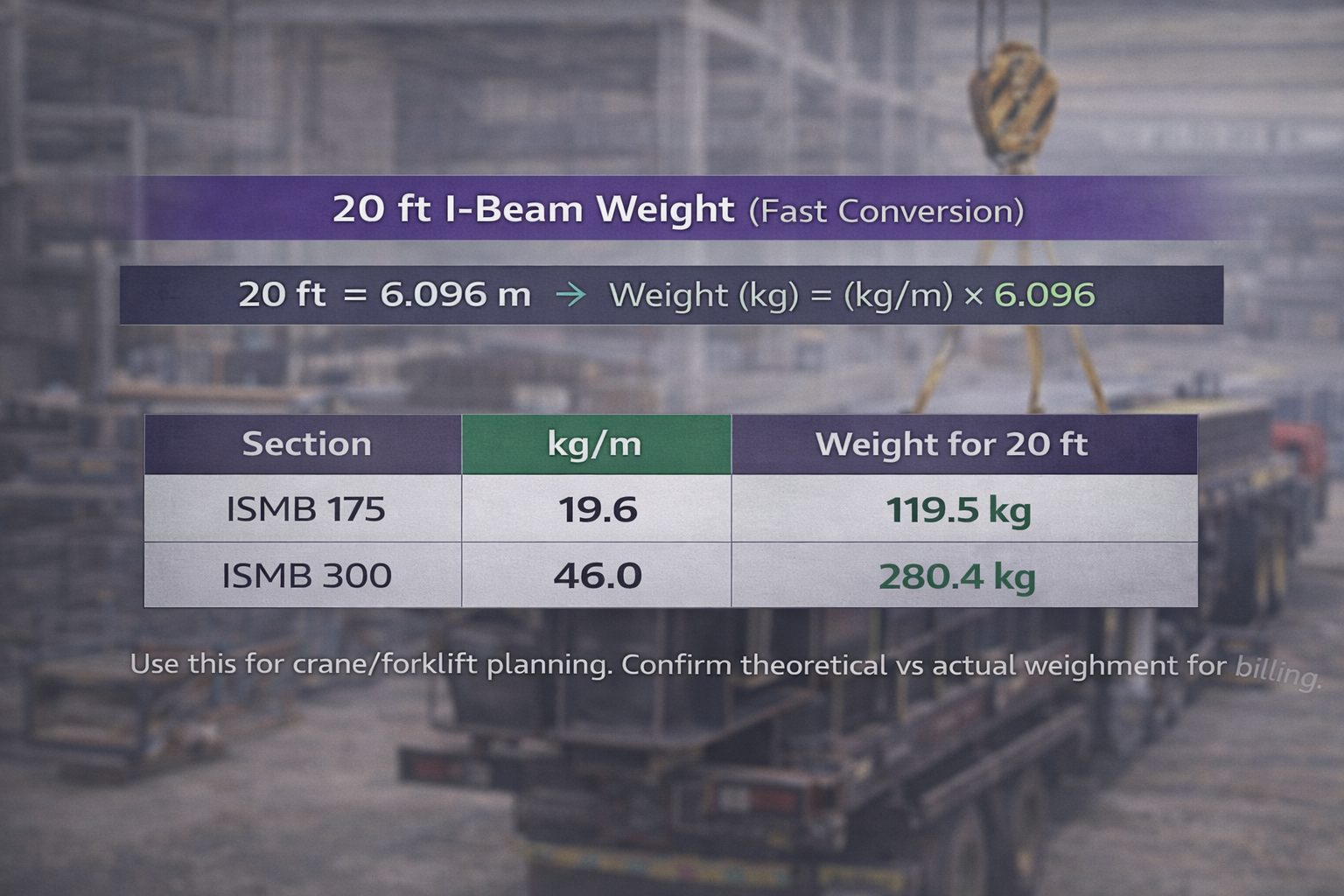
Convert 20 ft to metres, then use kg/m
- 20 ft = 6.096 m
- Weight (kg) = kg/m × 6.096
Example conversions
| Section | kg/m | Weight for 20 ft (6.096 m) |
| ISMB 175 | 19.6 | 119.5 kg |
| ISMB 300 | 46.0 | 280.4 kg |
Practical note for dispatch and site teams
- Use 20 ft weight to plan crane or forklift capacity.
- Confirm whether the supplier bills by theoretical weight or actual weighment to avoid last-minute reconciliation issues.
Also read: Steel bar weight chart
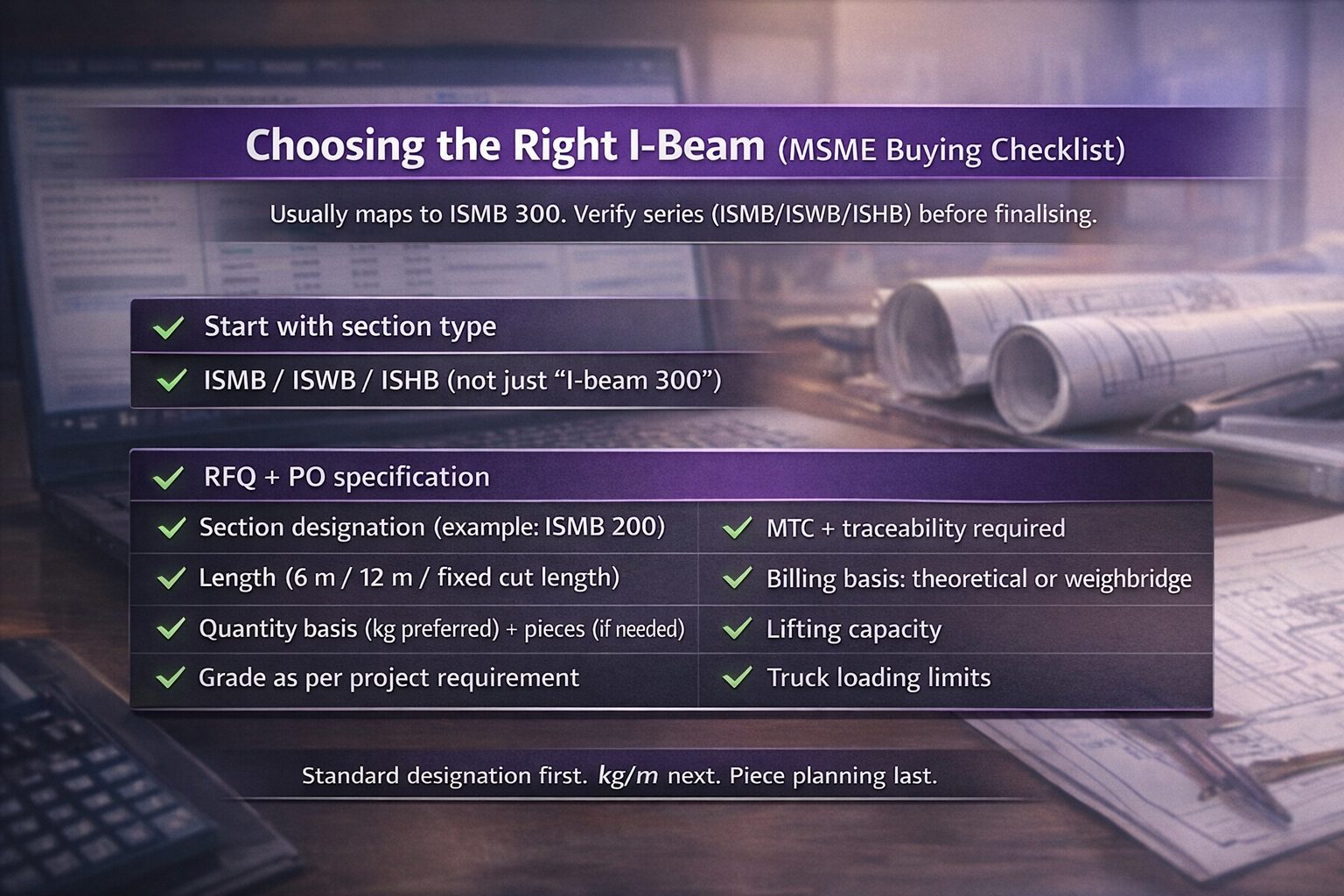
How do I choose an I-Beam size?
Selecting an I-beam requires more than a number – it begins with the correct section standard, designation, and application context.
Here’s a quick look at the key considerations to help you get it right.
Confirm the section type first (avoid wrong ordering)
“I-beam” is a generic term. In Indian procurement, beams are typically specified as ISMB, ISWB, or ISHB, and each series has different kg/m and dimensions. The correct starting point is the section designation used in IS 808 and the BOQ or drawing, not just a single number like “200” or “300 × 140”.
Lock the buying specification (RFQ and PO ready)
Keep the requirement unambiguous so quotes stay comparable across vendors.
- Section designation: ISMB 200 (or ISWB, ISHB as per design)
- Length: 6 m, 12 m, or fixed cut length, clarify if random lengths are acceptable
- Quantity basis: by kg (preferred for billing) or by number of pieces, mention both if needed
- Grade: specify as per project requirement, commonly aligned to IS 2062 for structural steel
- Documentation: ask for MTC and traceability details for approval and audit readiness
- Tolerance clarity: state whether billing is on theoretical weight or actual weighbridge weighment
Convert kg/m into piece weight for planning
Once the designation is fixed, use the kg/m value from the chart to estimate:
- crane or forklift capacity
- truck loading limits
- unloading and stacking plan on site
This avoids last-minute changes at dispatch because the team only planned by pieces and not by weight.
Tender and compliance readiness (often missed)
For government or large enterprise procurement, include the standard references in the BOQ line item:
- section standard for dimensions and mass (IS 808)
- steel grade standard where applicable (IS 2062)
This reduces clarifications and keeps approvals smoother.
Receiving checks that reduce disputes at delivery
At the time of GRN and billing reconciliation:
- verify section marking and designation on the material or tags
- count pieces, measure actual lengths, record heat or batch details from MTC
- reconcile invoice basis: theoretical vs actual weighment
- allow for permissible variation, as producer references note tolerance on weight per metre can be ±2.5%, or alternatively +4%, −1%.
Conclusion
I-beam buying becomes easier when the requirement is pinned to a standard section designation and weight is calculated using kg/m. Once kg/m is known, converting to 6 m and 12 m piece weight supports faster RFQs, cleaner billing checks, and better dispatch planning. The same approach also reduces site-level confusion during GRN and invoice reconciliation.
Quick recap for MSME buyers
- Confirm the correct section series and designation, not just “I-beam 300”
- Use kg/m for quote comparison, and then convert to required lengths
- Specify length, grade, and billing basis clearly in the PO
- Record pieces, lengths, and supporting documents during receipt
*Disclaimer: This article is for information and reference only. For standard i-beam sizes, ISMB weight chart, and more please consult your steel manufacturer.
Looking to procure steel?
Tata nexarc helps manufacturers, builders and MSMEs source certified steel products, compare prices, and choose the right grade as per IS codes—with complete traceability and procurement confidence.
FAQs
How should MSMEs compare quotes from multiple beam suppliers?
What is the ideal way to mention I-beams in an RFQ to avoid rework?
How can businesses reduce last-minute dispatch delays for I-beams?
What is the risk of ordering beams only by number of pieces?
How should companies handle supplier deviations in beam length?
Why is it important to align BOQ and supplier designation early?
What documents should procurement teams mandate for audit compliance?
How can businesses avoid disputes in weighment during delivery?
What is the impact of incorrect beam selection on project cost?
How can procurement teams improve internal coordination for steel buying?
Sohini is a seasoned content writer with 12 years’ experience in developing marketing and business content across multiple formats. At Tata nexarc, she leverages her skills in crafting curated content on the Indian MSME sector, steel procurement, and logistics. In her personal time, she enjoys reading fiction and being up-to-date on trends in digital marketing and the Indian business ecosystem.




This is a helpful resource for preliminary planning, but remember, engineers need precise data. Our technical specifications provide the exact dimensions and weights for Ibeams.
Macha, I’m building a small commercial complex in Bangalore, and the budget is tight I need to optimize my I-beam usage without making the structure weak. Do you have any tips for using fewer I-beams without compromising the building’s safety?
and how to choose right i beams?..i want budget friendly options