Table of Contents
India tracks GST collections closely every month. They show how the economy is performing in real time. The March 2026 GST collection in India is especially important. It marks the close of the financial year and reflects overall business activity.

GST remains one of the largest sources of government revenue. It covers goods and services across sectors. Strong GST revenue in India usually signals healthy demand and better compliance. A weaker number can point to slowing activity or gaps in reporting.
In this article, we break down the monthly GST collection for March 2026. We look at key trends, growth patterns, and state-wise performance. We also explain what these numbers mean for businesses. This will help you understand demand signals and plan better.
March 2026 GST collection – Key highlights
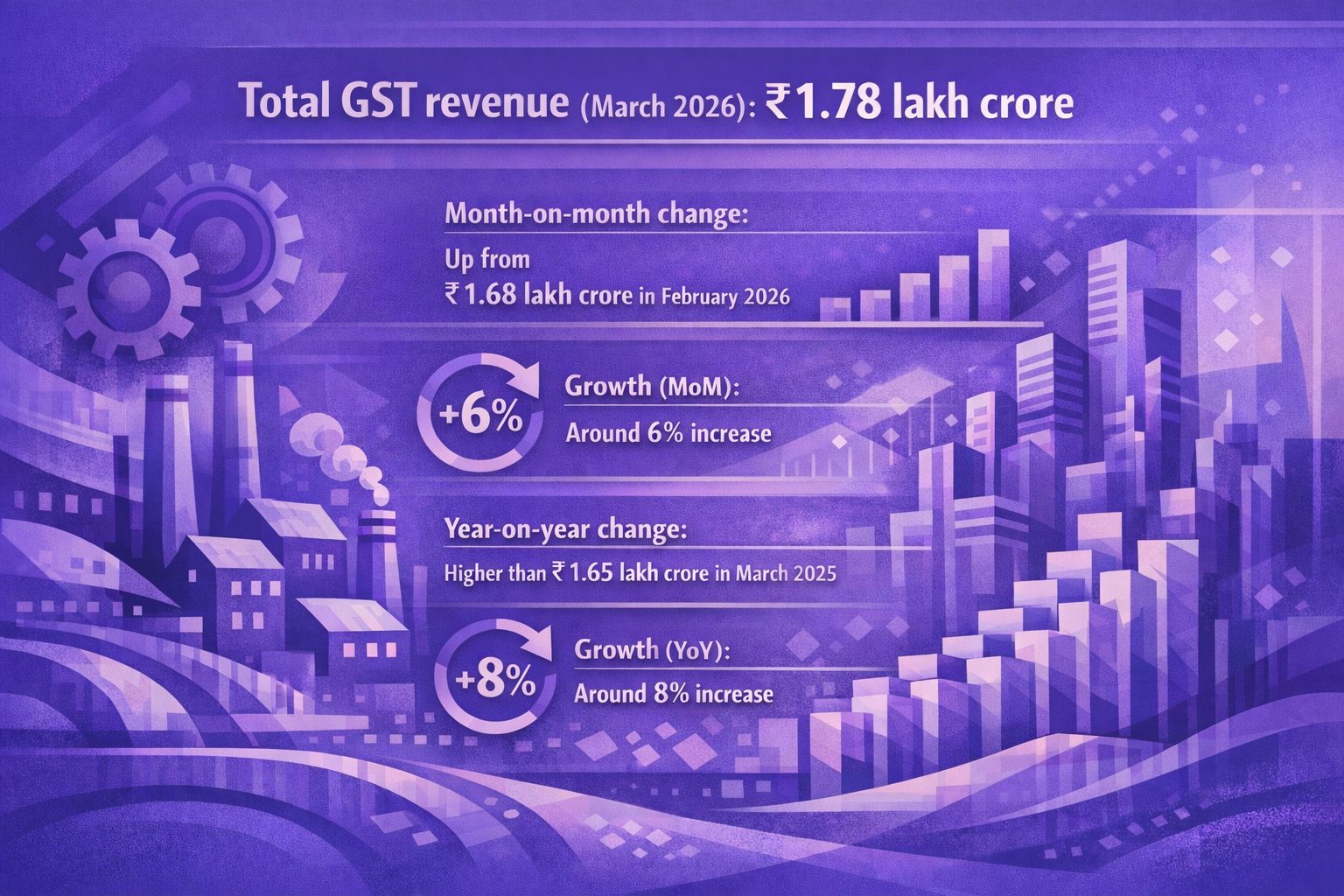
The key highlights of March 2026 GST collection show a strong close to the financial year. Collections rose on the back of steady demand and improved compliance.
Total GST revenue (March 2026): ₹1.78 lakh crore
Month-on-month change: Up from ₹1.68 lakh crore in February 2026
Growth (MoM): Around 6% increase
Year-on-year change: Higher than ₹1.65 lakh crore in March 2025
Growth (YoY): Around 8% increase
March typically records higher collections. Businesses settle dues before year-end. This pushes up the monthly GST collection.
Highest trend: Strong growth in domestic transactions
Support factor: Better compliance and invoice matching
Moderate area: Import-linked GST remained stable
Overall, GST revenue in India stayed on a steady growth path. The March numbers reflect healthy economic activity. They also show improved tax compliance across sectors.
GST collection breakdown
The detailed breakup of the March 2026 GST collection follows a familiar pattern. While official component-wise figures are awaited, the structure remains consistent with previous months.
| Component | Share trend | What it means |
| CGST (Central GST) | Moderate share | Collected by the Centre on intra-state sales |
| SGST (State GST) | Moderate share | Collected by states on intra-state sales |
| IGST (Integrated GST) | Highest share | Comes from inter-state trade and imports |
| GST Cess | Smallest share | Levied on luxury and sin goods |
CGST vs SGST
These apply to transactions within a state. Revenue is split between the Centre and states. Both usually move in line with domestic consumption.
IGST share
IGST continues to contribute the largest portion. This reflects strong inter-state trade and import activity. In recent months, IGST has crossed ₹90,000 crore levels.
GST Cess
This remains the smallest component. It applies to select goods such as tobacco and luxury products.
Overall, IGST likely remained the biggest contributor in March 2026. This points to steady movement of goods across states and healthy trade activity.

Month-on-month & year-on-year trends
The GST trend analysis for March 2026 shows steady growth. Collections increased on both a monthly and yearly basis. This reflects stable demand and better compliance.
GST collection comparison
| Period | GST collection (₹ lakh crore) | Change |
| March 2026 | ₹1.78 | — |
| February 2026 | ₹1.68 | ↑ ~6% (MoM) |
| March 2025 | ₹1.65 | ↑ ~8% (YoY) |
Key trend insights
Month-on-month (MoM)
GST collections rose by around 6% compared to February 2026. This is typical for March. Businesses close books and clear pending dues before the financial year ends.
Year-on-year (YoY)
Collections grew by about 8% compared to March 2025. This shows a consistent GST growth rate in India despite global uncertainties.
What drove the March 2026 GST revenue increase?
Seasonality: March is usually the strongest month for GST. Year-end adjustments push collections higher.
Improved compliance: Tighter invoice matching and tracking systems have reduced leakages.
Stable demand: Consumption across sectors remained steady, supporting tax collections.
Overall, the monthly GST collection trend remains positive. For a broader view, you can also review past GST reports to track how this growth has evolved over time.
State-wise GST performance
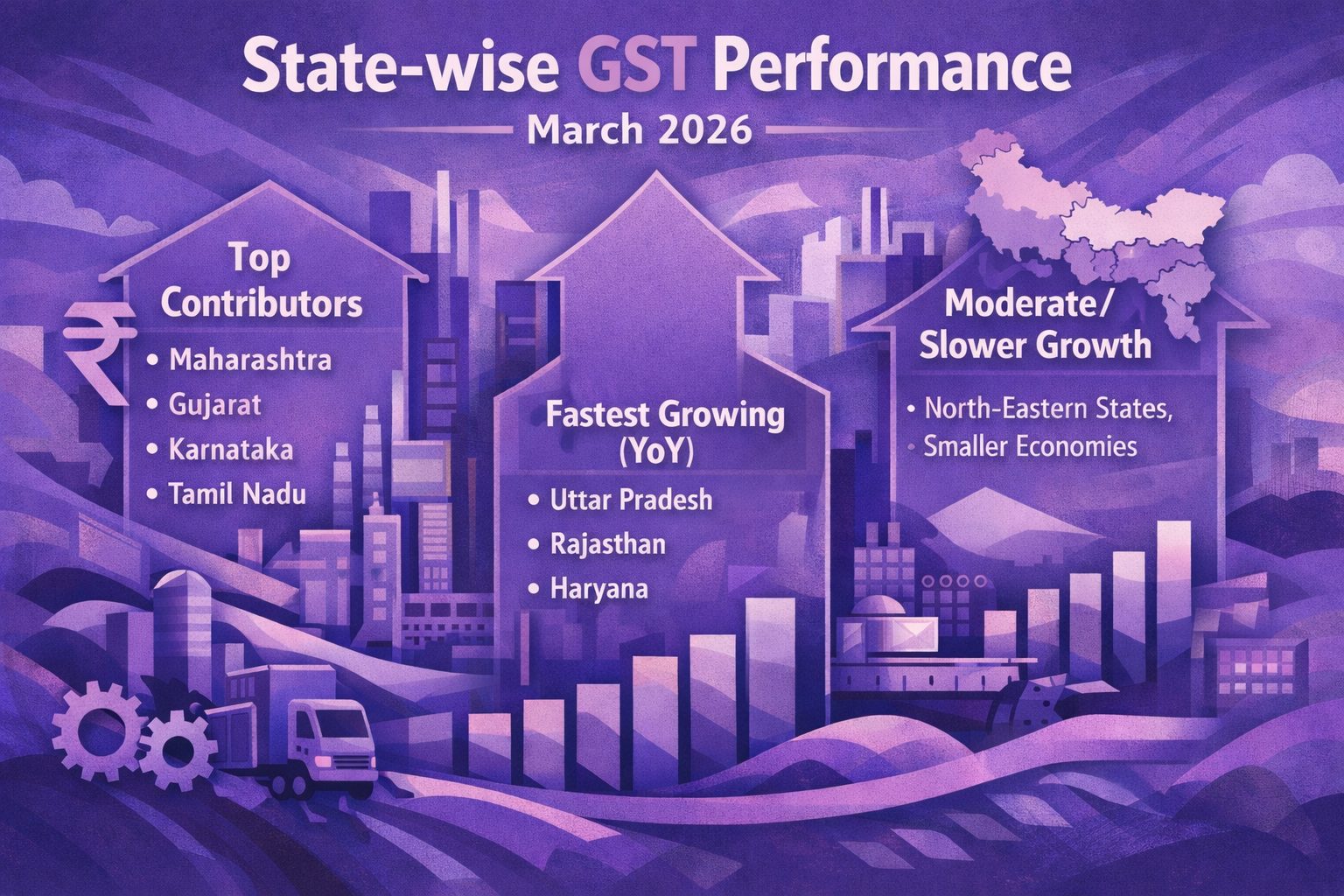
State-wise GST trends for March 2026 remain broadly consistent with previous months. Large, industrialised states continue to dominate collections. At the same time, a few emerging states show faster growth on a year-on-year basis.
| Category | States | Key drivers |
| Top contributors | Maharashtra, Gujarat, Karnataka, Tamil Nadu. | Strong industrial base, services sector, high consumption. |
| Fastest growing (YoY) | Uttar Pradesh, Rajasthan, Haryana. | Rising compliance, infrastructure push, expanding trade. |
| Moderate/slower growth | North-eastern states, smaller economies. | Lower industrial activity, smaller tax base. |
Key insights
Top-performing states
GST collection Maharashtra remains the highest. This is due to a strong mix of manufacturing and services. GST revenue Gujarat stays robust, supported by exports and industrial output. Karnataka and Tamil Nadu also contribute significantly through services and manufacturing.
Fastest-growing states
Uttar Pradesh and Rajasthan continue to improve. Better compliance and economic activity support growth. Haryana benefits from its proximity to NCR and strong industrial clusters.
Lagging regions
Smaller states and north-eastern regions show slower GST growth. Limited industry and consumption affect collections.
Overall, GST revenue remains concentrated in a few key states. However, growth is gradually spreading across regions.
Key factors driving March 2026 GST collection
Strong economic activity
Manufacturing and services remained steady in March. Sectors like auto, construction, and FMCG saw stable demand. This supported higher billing and tax payments. Strong business activity is one of the main reasons for GST growth in India.
Improved GST compliance
GST compliance in India continues to improve. More businesses are filing returns on time. Invoice matching and digital tracking have reduced leakages. This has helped increase reported tax collections without a major rate change.
Financial year-end impact
March is always a high-collection month. Businesses close their books before the financial year ends. They clear pending dues and reconcile invoices. This seasonal push leads to a spike in monthly GST collection.
Government enforcement measures
Authorities have tightened checks on fake invoicing and tax evasion. Data analytics and e-invoicing systems help track transactions better. These steps improve transparency and boost collections.
Overall, a mix of demand, better compliance, and year-end adjustments drove the March 2026 GST numbers.
What this means for businesses

Impact on pricing and demand
The steady rise in GST collections points to stable demand across sectors. For businesses, this means pricing power may remain balanced. Sharp price cuts may not be necessary, but cost control stays important. The GST impact on businesses in India is closely linked to demand trends like these.
Procurement and working capital
Higher GST collections often mean faster movement of goods. This can tighten working capital cycles. Businesses need to plan procurement carefully. Bulk buying at the right time can help manage costs. Efficient inventory planning becomes critical in such periods.
Compliance expectations
GST compliance in India is getting stricter. Authorities are using better tracking tools. Businesses must ensure accurate invoicing and timely filings. Errors can lead to penalties or blocked input tax credit. Clean compliance is now a basic requirement, not an option.
Smarter sourcing and cost control
Rising collections highlight the need for smarter sourcing. Businesses should compare suppliers, negotiate better rates, and optimise logistics. Small cost savings can make a big difference at scale.
Overall, businesses that stay efficient and compliant are better placed to benefit from steady GST trends.
GST collection trend in FY 2025-26
The GST collection for FY 2025–26 shows steady and consistent growth. Monthly collections stayed strong throughout the year. This reflects stable demand and better compliance across sectors.
FY 2025–26 GST trend snapshot
| Metric | Value (approx.) |
| Total GST revenue (FY 2025–26) | ₹21–22 lakh crore |
| Average monthly GST collection | ₹1.70–1.75 lakh crore |
| Peak month | March 2026 (~₹1.78 lakh crore) |
Key trend summary
Consistent monthly growth: Most months stayed above ₹1.65 lakh crore. This shows a stable GST collection trend in India.
Stronger second half: Collections improved in the later months. Festive demand and year-end activity supported growth.
Growth vs previous year: GST revenue saw a moderate increase compared to FY 2024–25. The rise is estimated at around 8–10%.
What this means
- Better compliance continues to support annual GST revenue in India
- Economic activity remained stable despite global pressures
- Businesses operated in a relatively predictable demand environment
Overall, the GST collection trend in FY 2025–26 reflects steady economic momentum and improved tax efficiency.
Expert insights/market outlook
Near-term GST outlook
Experts expect GST collections to remain stable in the coming months. After the March peak, numbers may soften slightly in April. This is a normal trend seen every year. Overall, the GST outlook in India for 2026 remains positive.
Future GST trends
Analysts believe future GST trends will depend on demand and compliance levels. Continued use of e-invoicing and data tracking should support steady growth. No major spikes are expected, but gradual improvement is likely.
Economic signals to watch
Businesses should track key indicators such as consumption demand, infrastructure spending, and exports. These directly affect GST collections. Any slowdown in these areas may impact monthly numbers.
Overall, the outlook remains balanced. Stable growth, rather than sharp jumps, is expected in the near term.
Conclusion
GST collections remain a reliable indicator of market momentum. The latest data points to a stable and predictable business environment. For companies, this makes planning easier. It also highlights the importance of staying compliant and cost-efficient. Tracking these trends can support better decisions around sourcing, pricing, and cash flow.
Empowering MSMEs to grow smarter
Tata nexarc delivers powerful solutions for MSMEs—discover tenders, logistics solutions, and streamline procurement. Everything your business needs, all in one place.
FAQs
What is GST collection?
What is India’s GST collection for March 2026?
How is GST calculated?
What are CGST, SGST, IGST?
Which state collects the highest GST?
Why does GST collection increase in March?
What is the average monthly GST collection in India?
How does GST affect businesses?
What is GST compliance?
What is the GST growth rate in India?
A product manager with a writer's heart, Anirban leverages his 6 years of experience to empower MSMEs in the business and technology sectors. His time at Tata nexarc honed his skills in crafting informative content tailored to MSME needs. Whether wielding words for business or developing innovative products for both Tata Nexarc and MSMEs, his passion for clear communication and a deep understanding of their challenges shine through.