Check Price Now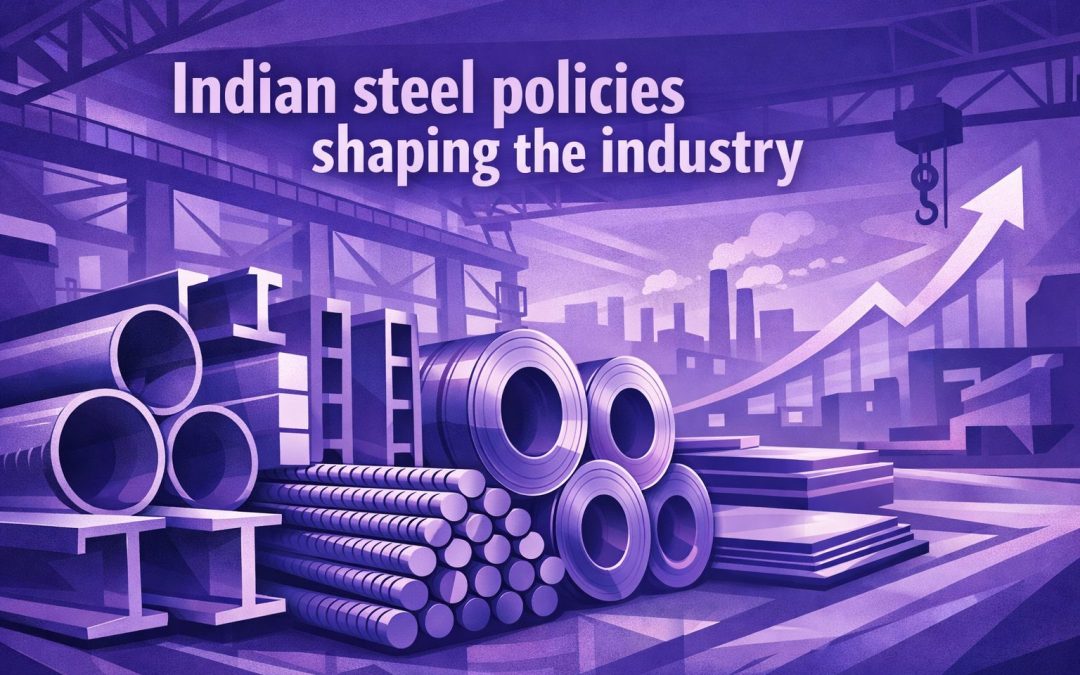
Table of Contents
- National Steel Policy (NSP)
- Production-Linked Incentive (PLI) Scheme
- Domestically Manufactured Iron & Steel Products (DMI&SP) Policy
- Trade protection & import control measures
- Raw material & supply chain policies
- Environmental & green transition policies
- Quality standards, recycling, and safety policies
- Inter-sector linkages & infrastructure demand drivers
- Conclusion
Steel is a backbone of India’s economy, driving infrastructure, manufacturing, defence, and exports. Key sectors such as construction, automobiles, railways, and engineering rely heavily on it. Government policies play a central role in shaping the industry by guiding investment, expanding production capacity, regulating trade, and promoting technology adoption. They also support sustainability, resource efficiency, and the shift toward self-reliance.
At the same time, the sector faces global challenges, including cheap imports, environmental regulations, and evolving trade remedies. Strong and coordinated policy measures are therefore essential to ensure a competitive, resilient, and future-ready Indian steel industry.
National Steel Policy (NSP) 2017 & long-term vision
The National Steel Policy (NSP) 2017 provides the long-term roadmap for India’s steel sector. It articulates a clear vision to make India self-sufficient, globally competitive, and resilient to external shocks. The policy continues to serve as the central reference point for most steel-related government initiatives.
Overview of NSP 2017
| Policy area | Focus |
| Long-term vision | Self-sufficiency, competitiveness, and resilience |
| Production capacity | Expansion to meet domestic and strategic needs |
| Consumption growth | Driven by infrastructure and manufacturing |
| Quality and efficiency | High-grade steel, R&D, and resource security |
| Policy alignment | Foundation for future steel and decarbonisation policies |
Key vision and objectives
The NSP defines clear national objectives to guide the sector’s growth.
- Achieve self-sufficiency in steel production by 2030–31.
- Build a globally competitive steel industry supported by strong domestic demand.
- Reduce dependence on imports, particularly for high-grade and special steels.
These objectives aim to strengthen India’s industrial base while improving supply security.
Capacity and consumption targets
The policy sets ambitious but achievable production and consumption goals.
- Crude steel capacity to reach around 300 million tonnes (MT) by 2030–31.
- Finished steel production to exceed 255 MT.
- Per capita steel consumption to rise in line with infrastructure and manufacturing growth.
These targets reflect India’s expanding requirements across construction, transport, energy, and defence sectors.
Focus on quality, efficiency, and resources
The NSP places strong emphasis on improving the structural strength of the steel industry.
- Development of high-grade and value-added steel for advanced and strategic applications.
- Strengthening raw material security, including iron ore and coking coal linkages.
- Increased investment in research and development (R&D).
- Improvements in energy efficiency, environmental performance, and plant safety standards.
This focus supports sustainable growth while enhancing global competitiveness.
Foundation for future policies
The National Steel Policy acts as a long-term policy anchor for subsequent initiatives.
Schemes such as the Production-Linked Incentive (PLI) for specialty steel, domestic procurement policies, and emerging green steel and decarbonisation efforts are aligned with NSP objectives. Together, these initiatives form a coordinated strategy to strengthen India’s steel sector over the long term.
Production-Linked Incentive (PLI) Scheme for specialty steel

The Production-Linked Incentive (PLI) Scheme for specialty steel aims to strengthen India’s steel value chain. It shifts focus from volume to value. The scheme supports domestic production of high-end and specialised steel grades that were earlier imported.
The core objective is clear. Build capability in advanced steel. Reduce import dependence. Attract long-term private investment.
Key objectives of the PLI Scheme
- Promote value-added and high-grade steel production
- Reduce imports of critical steel products
- Encourage investment in modern technology and processes
- Support self-reliance in strategic steel segments
Incentives are linked to incremental production. This improves project viability for capital-intensive steel investments.
Evolution of the PLI Scheme
The scheme has evolved over time based on industry response and market needs.
| Phase | Key focus |
| Initial PLI Scheme | Covered core specialty steel categories such as coated steel, alloy steel, and electrical steel. Aimed to establish domestic capability. |
| PLI 1.1 (2025) | Extended timelines and relaxed conditions. Improved participation and addressed early implementation gaps. |
| PLI Round 3 | Targets fresh investment of around ₹44,000 crore. Focuses on unmet demand and deeper value addition. |
This phased design reflects a flexible and adaptive policy approach.
Impact across the steel ecosystem
The PLI Scheme is expected to deliver broad benefits.
Impact on the industry
- Higher capital investment in steel plants and processing units
- Expansion of downstream and finishing capacity
- Improved product quality and consistency
Employment and sectoral benefits
- Creation of skilled and semi-skilled jobs
- Growth in downstream industries and logistics
Key beneficiary sectors
- Automobiles: high-strength and lightweight steel
- Defence: specialised and armour-grade steel
- Aerospace and renewables: high-performance steel products
Strategic importance
The PLI Scheme improves India’s global competitiveness. It supports deeper supply chains and advanced manufacturing. Over time, it helps Indian steel producers meet global quality and performance standards.
Domestically Manufactured Iron & Steel Products (DMI&SP) Policy & ‘Make in India’ push
The Domestically Manufactured Iron & Steel Products (DMI&SP) Policy is a key instrument supporting India’s Make in India agenda. It mandates preference for domestically produced iron and steel products in government procurement, thereby strengthening local manufacturing, reducing import dependence, and creating stable demand for Indian steel producers.
Overview of the DMI&SP Policy
| Policy area | Focus |
| Government procurement | Mandatory preference for Indian steel |
| Local content norms | Minimum domestic value addition |
| Industry support | MSMEs and domestic technology suppliers |
| Strategic objective | Import substitution and demand creation |
| Policy alignment | Make in India and infrastructure programmes |
Preference for Made-in-India steel
The policy requires government agencies and public sector undertakings to give preference to domestically manufactured iron and steel products in procurement.
- Imported steel is permitted only when domestic alternatives are unavailable or technically unsuitable.
- Certification and compliance mechanisms ensure transparency and accountability.
This provision creates assured demand for Indian producers while encouraging capacity expansion and technology upgrades.
Revised norms and local content requirements
Revised guidelines introduced in 2025 strengthened the policy’s impact.
- Clearer local content thresholds were defined to promote domestic value addition.
- Relaxed conditions were introduced to support Indian technology suppliers and equipment manufacturers.
- Simplified compliance norms improved participation, especially for smaller firms.
These changes improved policy effectiveness without compromising procurement efficiency.
Role in import substitution and MSME support
The DMI&SP policy plays a direct role in import substitution by discouraging reliance on foreign steel products.
- It supports MSMEs by reserving space for domestic suppliers in large public projects.
- Local sourcing strengthens supply chains and reduces exposure to global price volatility.
As a result, domestic steel demand becomes more predictable and resilient.
Link to Make in India and infrastructure policies
The DMI&SP policy is closely integrated with Make in India, national infrastructure programmes, and public capital expenditure.
By aligning procurement rules with infrastructure spending, the policy ensures that growth in roads, railways, energy, and urban development directly benefits Indian steel manufacturers.
Trade protection & import control measures

Trade protection and import control measures are vital tools used by India to safeguard its domestic steel industry from sudden surges in imports and unfair trade practices. These measures balance cheap foreign steel with the viability of local producers, encouraging sustainable sector growth.
Overview of trade protection measures
| Measure | Purpose |
| Anti-dumping duties | Counteract unfairly priced imports |
| Safeguard duties | Provide temporary relief from import surges |
| Import tariffs | Set thresholds (e.g., 11–12%) to protect local prices |
| DGTR role | Investigates trade threats and recommends remedies |
Anti-dumping & safeguard duties
India has recently imposed anti-dumping duties on certain Chinese steel imports for five years following investigations that found low-priced imports hurting domestic producers. These duties apply to specific products such as cold-rolled electrical steel to level the playing field for Indian manufacturers.
Alongside anti-dumping measures, safeguard duties of around 12 % have been applied to selected imported steel products for 200 days in 2025 to curb the rapid influx of cheap steel that threatens domestic viability. These duties aim to provide immediate relief while longer-term protections are evaluated.
Import tariffs and historical trends
Trade agencies have recommended import tariffs in the vicinity of 11–12 % on targeted steel products as part of a phased protection strategy. The Directorate General of Trade Remedies (DGTR) also proposed multi-year safeguard duties starting at 12 % and gradually decreasing over a three-year period, reflecting industry expectations for sustained support.
Historically, safeguard and antidumping duties have been used flexibly, with temporary increases or extensions considered in response to market dynamics and import pressures from key exporters.
Role of DGTR & Trade-remedy tools
The Directorate General of Trade Remedies (DGTR) plays a central role in assessing import-related threats, investigating allegations of dumping or import surges, and recommending appropriate duties. Its trade-remedy tools, anti-dumping, safeguard, and counter-vailing measures, help balance the need for affordable inputs with protection of domestic viability and production capacity.
Together, these measures aim to ensure a resilient Indian steel sector capable of weathering global market volatility and supporting long-term growth.
Raw material & supply chain policies
Raw material availability and supply chain efficiency are critical cost drivers for India’s steel sector. Recent policy measures focus on improving access to coal, monitoring imports, reducing input costs, and strengthening coordination across ministries to ensure long-term resource security.
Overview of key supply-side measures
| Policy area | Focus |
| Coal availability | Transparent coal linkages via CoalSETU |
| Import tracking | Enhanced monitoring through SIMS 2.0 |
| Input cost relief | Customs duty cuts and exemptions |
| Resource security | Inter-ministerial coordination |
| Logistics | Supply chain and transport optimisation |
CoalSETU and coal linkage reforms
The CoalSETU single-window platform was introduced to streamline coal linkage allocation and improve transparency.
- It simplifies access to domestic coal for steel producers.
- Improved linkages help manage coking coal availability, which remains a key cost component.
These reforms reduce procurement uncertainty and help stabilise steel production costs.
Steel Import Monitoring System (SIMS 2.0)
The SIMS 2.0 platform strengthens oversight of steel imports.
- It enables real-time tracking of import volumes, grades, and countries of origin.
- Early visibility helps policymakers respond to sudden import surges.
Effective monitoring supports timely trade and safeguard interventions.
Customs duty cuts and scrap incentives
Input cost pressures are addressed through targeted duty reforms.
- Customs duty reductions on ferro-nickel lower alloy steel production costs.
- Duty exemptions on ferrous scrap support electric arc furnace and secondary steel producers.
These measures encourage circularity while improving cost competitiveness.
Inter-ministry coordination and logistics
Stronger coordination between steel, coal, railways, ports, and commerce ministries improves resource security and logistics efficiency.
Aligned planning reduces bottlenecks, lowers transportation costs, and strengthens the resilience of India’s steel supply chain over the long term.
Environmental & green transition policies
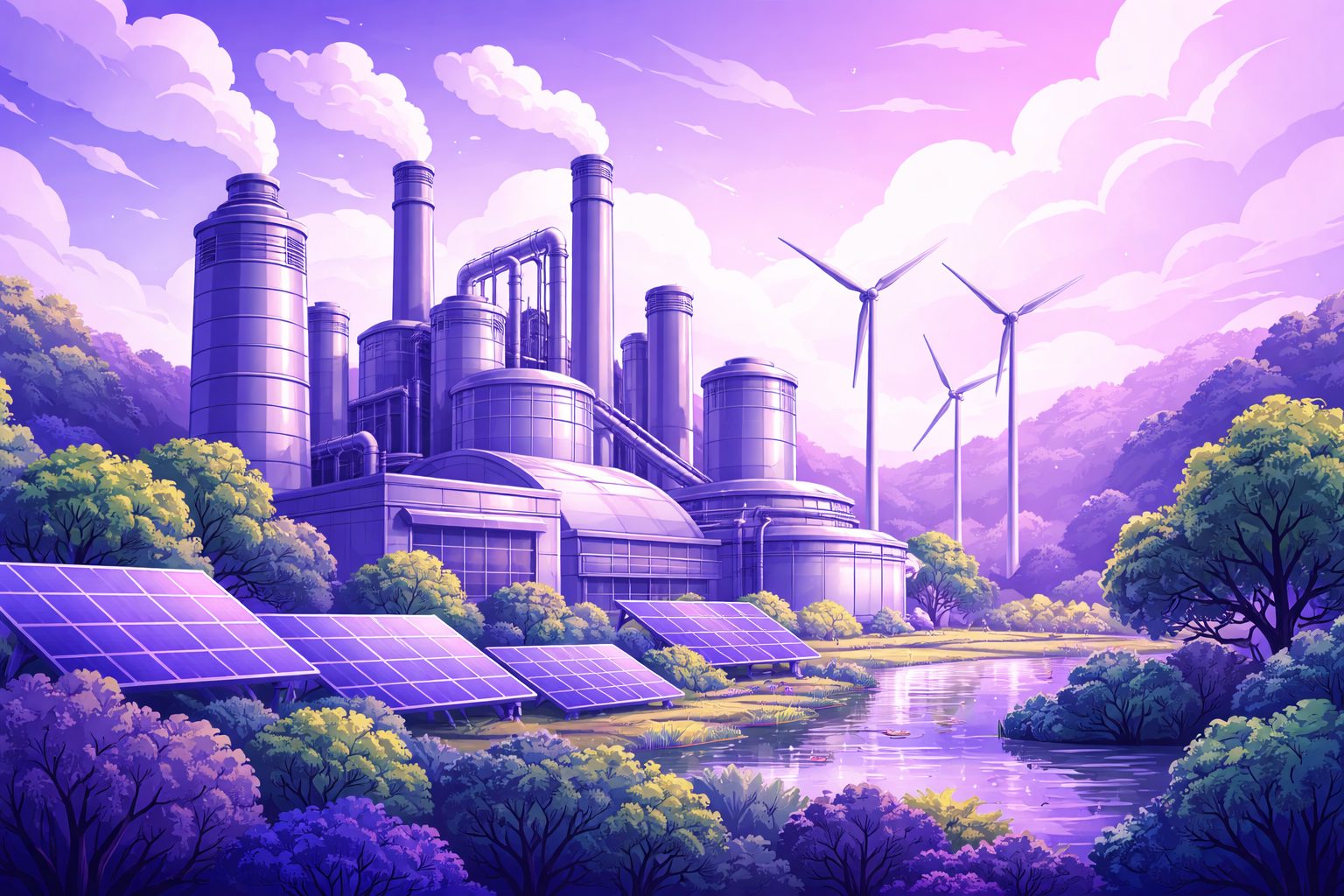
India’s steel sector is increasingly shaped by environmental and climate considerations. Environmental and green transition policies aim to reduce emissions, promote cleaner technologies, and align steel production with India’s long-term net-zero commitments, while maintaining industrial competitiveness.
Overview of green transition measures
| Policy area | Focus |
| Green Steel Mission | Emissions reduction and decarbonisation |
| Technology shift | Cleaner energy and low-carbon processes |
| Financial incentives | Support for green investments |
| Public procurement | Demand creation for green steel |
| Climate alignment | India’s 2070 net-zero target |
Green Steel Mission and decarbonisation roadmap
The Green Steel Mission provides a structured roadmap for lowering carbon emissions across steelmaking.
- Focus areas include energy efficiency, renewable energy use, and reduced reliance on fossil fuels.
- The roadmap encourages adoption of technologies such as hydrogen-based steelmaking, increased scrap usage, and carbon capture solutions.
This framework supports a gradual but sustained transition toward low-emission steel production.
Green Steel Taxonomy and financial incentives
A proposed green steel taxonomy aims to define emission thresholds and classify steel based on its carbon intensity.
- Clear definitions improve transparency and prevent greenwashing.
- Financial incentives are expected for producers using cleaner energy, efficient furnaces, and low-carbon technologies.
Access to concessional finance and policy support reduces the cost burden of early adoption.
Green steel procurement mandates
The government plans to introduce green steel procurement mandates for public projects starting 2027–28.
- Public infrastructure projects will prioritise low-carbon steel.
- This creates assured demand and improves commercial viability for green steel producers.
Procurement-led demand is expected to accelerate industry-wide adoption.
Alignment with climate commitments
These policies directly support India’s international climate commitments.
By encouraging decarbonisation while maintaining growth, they align the steel sector with India’s 2070 net-zero target and enhance the global competitiveness of Indian green steel in export markets.
Quality standards, recycling, and safety policies
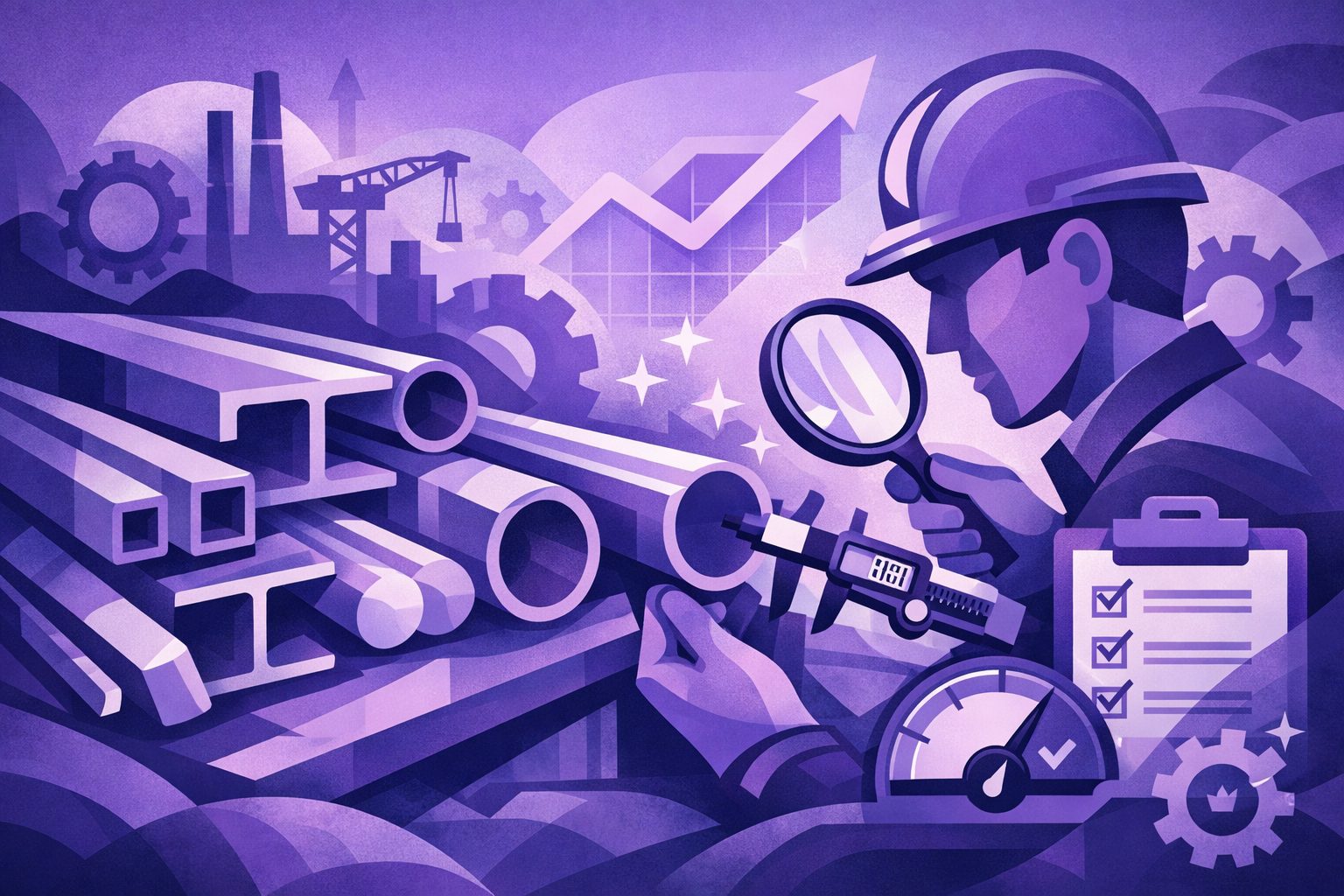
Quality assurance, resource efficiency, and workplace safety form the backbone of a competitive and export-ready steel industry. India’s steel policies in this area aim to eliminate sub-standard products, promote circularity through recycling, and improve operational safety across the value chain.
Overview of quality, recycling, and safety measures
| Policy Area | Focus |
| Quality control | Mandatory standards for domestic and imported steel |
| Recycling | Scrap-based steelmaking and circular economy |
| Safety | Improved workplace and operational safety |
| Competitiveness | Export readiness and market credibility |
Steel Quality Control Order (QCO)
The Steel Quality Control Order (QCO) mandates compliance with Indian Standards for specified steel products.
- Non-standard steel is restricted in both domestic markets and imports.
- Mandatory certification ensures consistency, reliability, and structural safety.
The QCO protects end users while strengthening confidence in Indian steel.
Steel Scrap Recycling Policy
The Steel Scrap Recycling Policy promotes systematic collection, processing, and use of scrap.
- It supports resource efficiency and reduces dependence on virgin raw materials.
- Greater scrap usage lowers energy consumption and emissions, especially for EAF-based producers.
This policy reinforces the transition toward a circular economy in steelmaking.
Safety guidelines and operational standards
New and updated safety guidelines focus on improving workplace conditions across steel plants.
- Emphasis is placed on accident prevention, equipment safety, and workforce training.
- Standardised safety norms improve operational reliability and productivity.
Stronger safety frameworks reduce disruptions and long-term operational risks.
Importance for competitiveness and exports
High quality standards, efficient recycling, and strong safety practices are essential for global competitiveness.
They improve export acceptance, reduce reputational risk, and position Indian steel producers as reliable suppliers in international markets while supporting sustainable domestic growth.
Inter-sector linkages & infrastructure demand drivers
India’s steel policy is closely aligned with national infrastructure and industrial growth strategies. Strong inter-sector linkages help ensure sustained steel demand and efficient capacity utilisation.
Key demand drivers
| Sector | Steel demand impact |
| PM Gati Shakti | Integrated, large-scale infrastructure demand |
| Transport | Railways, highways, ports |
| Strategic sectors | Defence and energy |
| Manufacturing | Urban and industrial growth |
Infrastructure-led demand growth
Integration with PM Gati Shakti strengthens coordination across ministries and accelerates infrastructure execution. Railways, highways, logistics corridors, and urban projects generate predictable and long-term steel consumption.
Policy support for end-use expansion
Government engagement with user ministries promotes wider steel use through standardisation and material substitution. Defence, energy, and manufacturing policies further support demand for high-grade and specialty steels.
Link to industrial growth
By aligning steel policy with infrastructure and manufacturing priorities, India positions steel as a core enabler of broader industrial and economic growth.
Conclusion
India’s steel policies strengthen domestic competitiveness while reducing import dependence. By promoting recycling and green transition initiatives, they support a more sustainable industry. Integration with infrastructure and industrial growth ensures steady, long-term demand. Together, these measures balance growth, trade realities, and environmental commitments for a resilient steel sector.
Looking to procure steel?
Tata nexarc helps manufacturers, builders and MSMEs source certified steel products, compare prices, and choose the right grade as per IS codes—with complete traceability and procurement confidence.
FAQs
What is the National Steel Policy (NSP) 2017?
What are the key objectives of NSP 2017?
What is the Production-Linked Incentive (PLI) Scheme for specialty steel?
How does the DMI&SP Policy support Make in India?
What trade protection measures exist for Indian steel?
How are raw material costs and supply chains managed?
What are India’s green steel initiatives?
How is steel quality and safety ensured?
How do infrastructure and industrial sectors drive steel demand?
Why are government policies important for the steel sector?
A product manager with a writer's heart, Anirban leverages his 6 years of experience to empower MSMEs in the business and technology sectors. His time at Tata nexarc honed his skills in crafting informative content tailored to MSME needs. Whether wielding words for business or developing innovative products for both Tata Nexarc and MSMEs, his passion for clear communication and a deep understanding of their challenges shine through.