Check Price Now
Table of Contents
- What Are Electric Arc Furnaces and Why They Matter
- MSMEs & EAFs – A Practical Business Case
- Scrap Availability & Supply Chain in India
- MSME EAF Adoption Patterns Across Indian Steel Clusters
- Power Infrastructure & Load Requirements for EAF Plants
- Navigating Procurement – GeM, eProcure & What Businesses Often Overlook
- Policy, Pressure, and Progress
- Cost, ROI, and Getting Started
- Conclusion
- FAQs
Steel is no longer judged by strength alone. It is judged by how it is made, and the Electric Arc Furnace is increasingly at the centre of that shift.
In the Indian steel sector, cost pressures, tighter compliance, and carbon scrutiny are shaping everyday decisions for MSMEs. Buyers now ask how steel is melted, where scrap is sourced, and what the emission footprint looks like. Over 50% of India’s secondary steel production is scrap-based. That reality makes electric arc furnace adoption critical for MSMEs aiming for efficient, low carbon steel production in a market moving steadily towards greener standards.
What are electric arc furnaces and why they matter
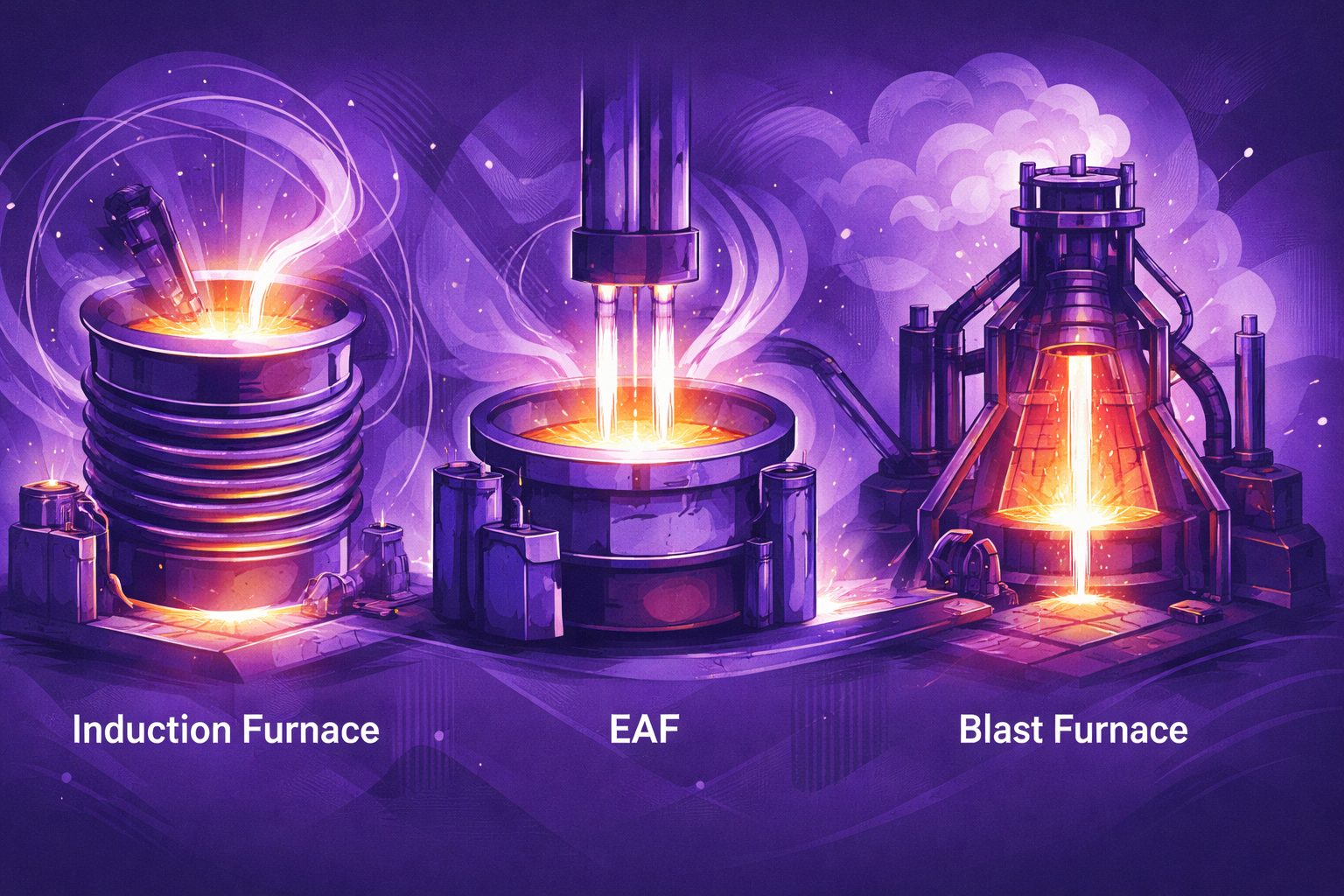
An electric arc furnace process melts steel using high-voltage electric arcs between graphite electrodes and scrap metal. There is no coke, no sinter plant, and no blast furnace stack. Instead, electricity does the melting.
In India, this matters more than ever. The country is targeting 300 MTPA of steel capacity by 2030. Much of that growth will come from secondary producers. For them, a scrap melting furnace India solution like an EAF is practical and scalable.
How the EAF process works
- Scrap is charged into the furnace shell
- Electrodes create arcs reaching 3,000°C+
- Metal melts within 45–60 minutes
- Slag removes impurities before tapping
Key performance metrics (2026 models)
- 45–60 minute tap-to-tap cycle
- 100% scrap melting capability
- Up to 60% lower CO₂ than the blast furnace route
- 400–600 kWh power use per tonne
AC vs. DC electric arc furnace
AC (Alternating Current) EAF: Lower upfront cost. Easier maintenance. Widely used in India.
DC (Direct Current) EAF: More stable arc. Slightly lower electrode consumption. Better for continuous operation.
Induction furnace vs. EAF vs. blast furnace
| Parameter | Electric Arc Furnace (EAF) | Induction furnace | Blast furnace |
| Primary raw material | 100% scrap | Scrap + sponge iron | Iron ore + coke |
| Scrap flexibility | Handles wider scrap mix | Requires cleaner scrap | Not scrap-based |
| Chemistry control | Good refining via slag control | Limited refining control | Full primary refining route |
| Tap-to-tap time | 45–60 minutes | 60–90 minutes | Continuous process |
| Power / fuel source | Electricity | Electricity | Coal/coke |
| Energy use | 400–600 kWh/tonne | 550–700 kWh/tonne | Coal-intensive |
| Emissions profile | Lower (with controls) | Moderate | High |
| Scale suitability | Small to mid, scalable | Small to mid | Very large integrated plants |
| Capex requirement | Moderate | Lower upfront | Very high |
For MSMEs weighing induction furnace vs EAF, the decision now hinges on quality control, productivity, and future compliance, not just cost.
MSMEs & EAFs – A practical business case
For many units, an Electric Arc Furnace for small steel plant is not about expansion. It is about control.
MSMEs in rebar rolling, billet casting, and component manufacturing already operate within tight margins. With scrap recycling India gaining momentum, melting in-house is becoming a strategic move rather than a technical upgrade.
Why it works for MSMEs
- Converts internal scrap into usable billets
- Reduces dependence on volatile billet markets
- Supports steel MSME modernisation
- Enables entry into higher-spec tenders
States such as Gujarat, Maharashtra, Tamil Nadu, and Punjab are seeing faster EAF adoption, driven by strong secondary steel clusters and access to industrial power.
Power economics in 2026
Electricity is the biggest variable.
Many units now use:
- State industrial tariff slabs
- Open access power procurement
- Rooftop solar or group captive models
- DISCOM incentives for efficient loads
A solar powered furnace India setup can reduce effective power cost by 15–20%, depending on state policy.
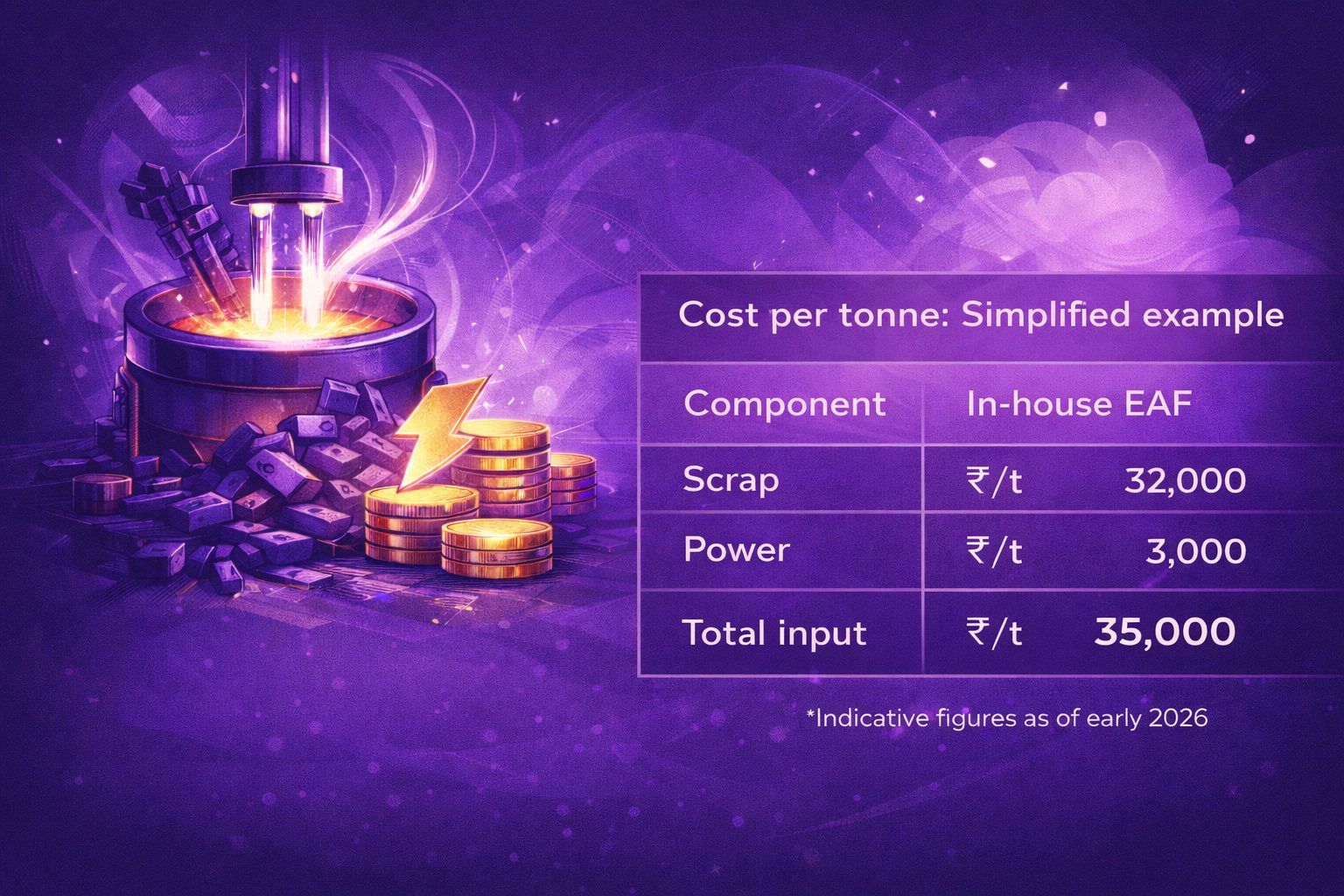
Cost per tonne: Simplified example
| Component | In-house EAF | Buying billet |
| Scrap (₹/t) | 32,000 | — |
| Power (₹/t) | 3,000 | — |
| Total input | 35,000 | 39,000–42,000 |
Even after maintenance and electrode cost, savings of ₹2,000–4,000 per tonne are realistic for rebar and billet MSMEs. This shift strengthens the circular steel economy. Scrap stays within the plant. Margins improve. Quality control increases.
For secondary steel producers, the question is no longer whether EAFs are viable. It is whether relying fully on external billet supply still makes commercial sense in 2026.
Scrap availability & supply chain in India
Electric arc furnaces depend on one thing above all: steady scrap supply. In 2026, that equation is improving, but not without friction.
Ferrous scrap price India trends
Ferrous scrap price India remains linked to global markets. Imported HMS and shredded scrap move with US and Middle East benchmarks. Prices can swing ₹2,000–4,000 per tonne within weeks, affecting working capital planning for MSMEs.
Domestic scrap supply
India’s domestic scrap supply is growing, though still fragmented.
Key sources include:
- Alang shipbreaking yards (Gujarat), a major contributor of structural scrap
- Construction and demolition scrap
- Rail and infrastructure dismantling
- Automotive scrap under the Vehicle Scrappage Policy
Automotive scrap volumes are rising, but organised collection networks are still scaling. Quality sorting remains uneven across regions.
Scrap import dependence
India continues to import a meaningful share of high-grade scrap. Scrap import duty India adjustments and currency fluctuations directly impact landed cost. For coastal plants, imports may remain viable. Inland units rely more heavily on domestic aggregation.
What this means for MSMEs
Scrap-based steel production works best with supply discipline. Units must:
- Lock in supplier contracts
- Diversify scrap grades
- Monitor import duty and freight trends
- Budget for price volatility
The opportunity is real. So is the risk. In 2026, competitive EAF operators are not just melting scrap. They are managing a supply chain.
MSME EAF adoption patterns across Indian steel clusters
| Region/cluster | Typical shift observed | Production impact | Cost/efficiency impact | Market outcome |
| Gujarat (Rajkot, Kutch belt) | Billet purchase → In-house EAF melting | Higher monthly output due to faster tap cycles | Reduced exposure to billet price volatility | Increased participation in state infrastructure tenders |
| Tamil Nadu (Coimbatore belt) | Induction / outsourced melting → EAF + captive /solar power | Improved melt consistency | Lower effective energy intensity | Better qualification for automotive supply chains |
| Punjab (Mandi Gobindgarh cluster) | Older induction setups → AC EAF upgrades | Broader scrap mix utilisation | Improved refining control and slag management | Entry into PSU-linked fabrication contracts |
Power infrastructure & load requirements for EAF plants
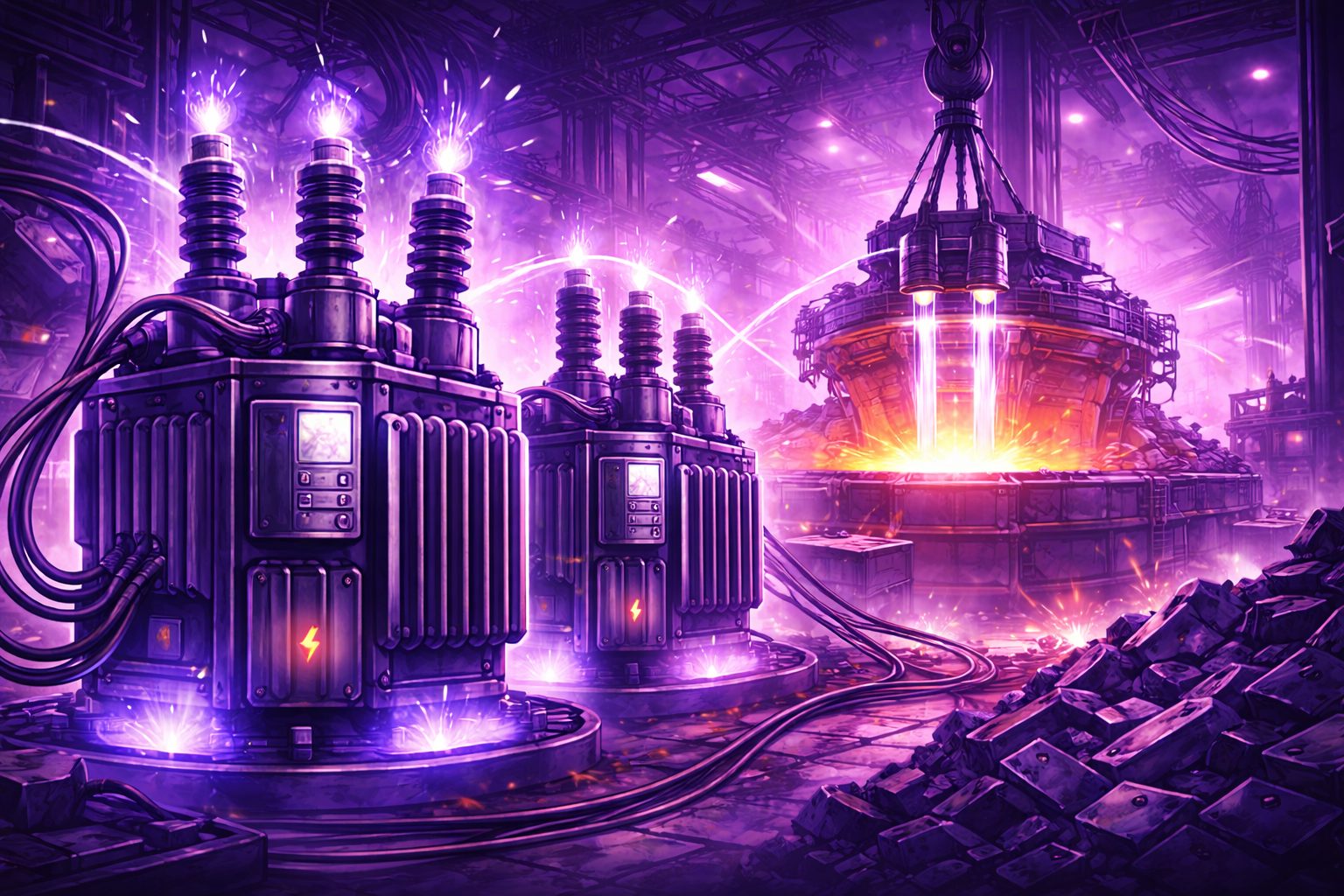
An electric arc furnace is only as reliable as the power behind it. In India, this is often the deciding factor between smooth operations and repeated downtime.
Transformer and load planning
EAFs draw high, concentrated loads. A 3–5 tonne furnace typically requires a transformer in the 2–5 MVA range, depending on design and melting rate. Sanctioned load approval from the DISCOM must match peak demand, not average consumption. Under-sizing transformers leads to overheating, voltage dips, and unstable arcs.
Voltage fluctuation risks
Industrial clusters in some regions still face:
- Voltage swings
- Grid instability during peak hours
- Flicker complaints from nearby units
AC furnaces are more sensitive to fluctuations. Stable incoming supply improves electrode life and melt consistency.
Industrial tariff comparison (2026 reality)
Power cost varies sharply by state.
| State | Industrial tariff range (₹/kWh) |
| Gujarat | 6–7 |
| Maharashtra | 7–9 |
| Tamil Nadu | 6–8 |
| Punjab | 7–8 |
Open access and group captive models can reduce effective cost, but approvals take time.
What MSMEs should plan for
- Confirm sanctioned load before installation
- Budget for transformer and panel upgrades
- Evaluate rooftop solar or captive options
- Assess grid reliability in your industrial zone
EAF adoption is not just a furnace decision. It is a power infrastructure decision. Plants that plan load correctly avoid costly corrections later.
Navigating procurement – GeM, eProcure & what businesses often overlook
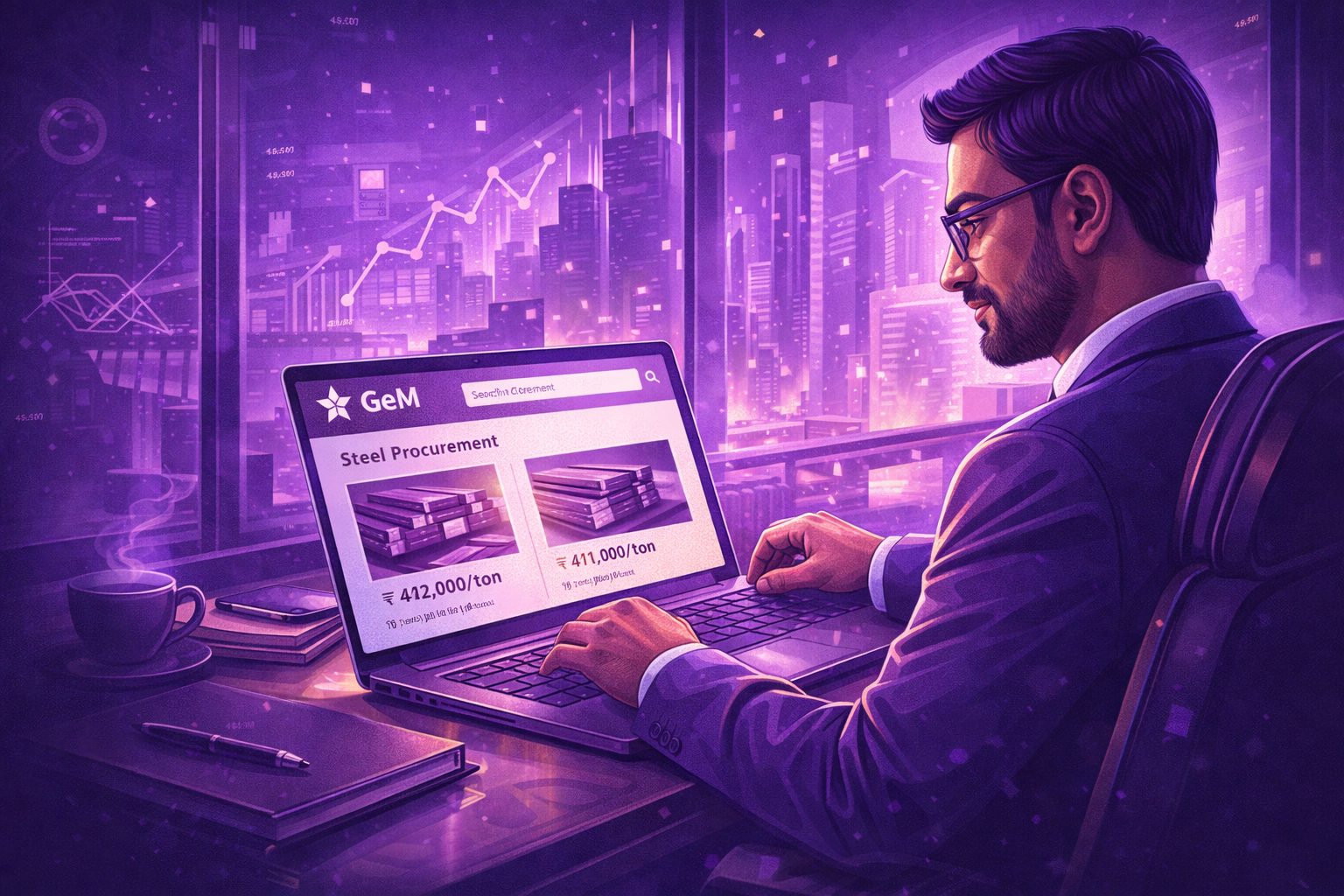
Buying through GeM
A GeM industrial furnace listing does exist, but options are limited. Specifications are often generic. Pricing may not reflect turnkey installation. For effective EAF procurement India, many MSMEs first shortlist vendors offline, then check whether they are GeM-registered. This avoids delays and incomplete bids.
MSMEs can buy electric arc furnaces on GeM. However, due diligence is still required before placing an order.
Exploring eProcure and PSU steel tenders
The central and state eProcure portals regularly publish PSU steel tenders for fabrication, structural steel, and rail or infrastructure components. An EAF-enabled unit can respond faster to bulk or spec-heavy orders. Capacity perception changes once melting is in-house.
Financing through TReDS
TReDS MSME financing helps unlock working capital against government-backed receivables. Some units align furnace procurement with confirmed orders, reducing cash-flow stress during installation.
Vendor qualification matters
Not every EPC steel plant India supplier offers the same depth. Check:
- Installed base in India
- Local service team availability
- Electrode and spare supply chain
- Commissioning timeline
Technical checklist before ordering
- Transformer capacity required and sanctioned load
- Pollution NOC and SPCB compliance
- Emission control system included
- Cooling system adequacy
- DGFT certifications, if exporting
Power load approvals
State utilities require formal approval for high-load equipment. Ignoring this step can delay commissioning by months. Procurement is not just about price. It is about readiness, compliance, and long-term operability in India’s evolving steel environment.
Policy, pressure & progress
Green steel is now policy-backed
The direction is clear. The Green steel policy India framework, alongside the Ministry of Steel’s low-emission roadmap, is pushing producers towards measurable carbon reduction. This aligns with India’s 2070 net-zero target and growing scrutiny on industrial emissions. For MSMEs, this is no longer distant policy. It is moving into supply contracts.
Scrap policy and domestic sourcing
The updated Scrap Recycling Policy India continues to encourage organised collection and in-house reuse. Scrap-based routes reduce dependence on imported coking coal and lower carbon intensity steel India metrics. Electric arc furnaces fit directly into this structure.
Export pressure: CBAM and compliance
The EU’s Carbon Border Adjustment Mechanism (CBAM) is reshaping export economics. Indian exporters supplying to Europe must now disclose embedded emissions. High carbon intensity directly affects competitiveness. This is where decarbonisation steel India becomes commercial, not theoretical.
ESG compliance reaches MSMEs
Large automotive and infrastructure buyers increasingly demand ESG disclosures from vendors. Many are requesting Environmental Product Declarations (EPDs) for steel inputs.
That means:
- Energy source transparency
- Emission tracking
- Waste and scrap management data
ESG compliance MSMEs are becoming part of vendor qualification, especially in automotive and rail supply chains.
Hydrogen, electrification, and future direction
Under the National Green Hydrogen Mission, pilot projects are exploring cleaner reduction methods. While large plants lead, secondary producers using electric melting are already aligned with electrification trends. Policy pressure is no longer abstract. It shapes tenders, exports, and vendor selection in 2026. For MSMEs, cleaner production is increasingly tied to market access.
Cost, ROI, and getting started
The electric arc furnace cost India varies by capacity and automation level. For a 3–5 tonne setup, the small steel plant setup cost typically ranges between ₹30 lakh and ₹1.5 crore.
A simplified capital snapshot
| Item | Cost estimate |
| Transformer | ₹15–25 lakh |
| Furnace shell | ₹20–50 lakh |
| Pollution control system | ₹10–20 lakh |
| Cooling & auxiliaries | ₹5–15 lakh |
Final cost depends on emission controls, automation, and site readiness.
Operating economics
Modern units report EAF power consumption per ton between 400–600 kWh. At an industrial tariff of ₹6–8 per kWh, power cost ranges from ₹2,400–4,800 per tonne. If scrap is sourced at ₹30,000–32,000 per tonne and billet prices trade at ₹39,000–42,000, in-house melting can generate a ₹2,000–4,000 per tonne advantage, before maintenance.
ROI outlook
Typical steel plant ROI India timelines range from 18 to 30 months. With steady production and internal scrap reuse, payback may occur sooner. Over a five-year horizon, cumulative savings often exceed initial capex. Financing support through SIDBI steel financing, term loans, or lease structures reduces upfront pressure.
Key risks to factor in
- Power fluctuation and load instability
- Scrap quality inconsistency
- Electrode cost volatility
- Delays in pollution approvals
The numbers are workable. The discipline lies in planning inputs, power contracts, and compliance before switching on the furnace.
Conclusion
India’s steel demand is projected to cross 190 million tonnes by 2030. Growth will favour producers who modernise early. For MSMEs, electric arc furnace adoption India is becoming a practical route to stronger margins and lower emissions. Green steel MSMEs are already gaining preference in tenders and export-linked supply chains.
Scrap-based steel production offers flexibility, compliance readiness, and cost control. In today’s steel market, staying competitive means melting smarter, not just producing more.
Looking to procure steel?
Tata nexarc helps manufacturers, builders and MSMEs source certified steel products, compare prices, and choose the right grade as per IS codes—with complete traceability and procurement confidence.
FAQs
What is the average power requirement for running an electric arc furnace in India?
Can EAFs run on solar or hybrid energy systems in industrial settings?
How does slag management differ in EAFs compared to traditional furnaces?
What safety precautions are required for operating an EAF?
How do EAFs support circular economy principles in the steel sector?
Are there government subsidies or incentives for adopting EAF technology in India?
What kind of training or skilled manpower is needed to operate an EAF?
How do EAFs affect the quality of steel compared to blast furnaces?
Can electric arc furnaces be integrated with existing foundry or fabrication setups?
What are the key maintenance practices to extend the life of an EAF?
Ananya Mittal blends a background in data science with a passion for writing, contributing to Tata Nexarc’s efforts in creating insightful, data-informed content for MSMEs. Her work focuses on exploring sector-specific challenges and opportunities across procurement, logistics, and business strategy. She is also involved in leveraging analytics to strengthen content performance and deliver actionable insights to India's growing B2B ecosystem.