Check Price Now
Table of Contents
- Introduction: Why Monitoring Matters for Modern Facilities
- Building the Basics for Reliable Monitoring
- What to Monitor and Why It Matters
- Designing an IoT Architecture That Works for MSMEs
- Energy Dashboards That Actually Work on the Ground
- An Asset Maintenance Playbook for Predictable Operations
- Building Compliance and Audit Readiness into Monitoring Systems
- Vendor Selection and Procurement Considerations
- Creating a Practical ROI Model for Monitoring Investments
- A Practical Example of Monitoring in Action
- Conclusion: Turning Monitoring into Measurable Value
- FAQs
Introduction: “Smart” in PEB means measurable control
In industrial real estate, smart is often reduced to sensors and dashboards. For Smart PEB Buildings, that definition falls short. A building is not smart because it collects data. It is smart when that data supports daily operational decisions.
Many MSME facilities install digital tools without fixing the basics. The result is numbers that look impressive but cannot be trusted during audits, breakdowns, or cost reviews.
Why control matters more than technology
Smart industrial buildings focus on control before automation. This includes predictable energy behaviour, clear asset ownership, and maintenance records that align with real usage. When these basics are weak, even advanced IoT enabled PEB structures fail to deliver value.
What smart control actually enables
Smart PEB buildings help MSMEs move from reactive fixes to planned action by enabling:
- Visibility into energy spikes and abnormal loads
- Early warning on asset stress and failure risks
- Cleaner documentation for audits and vendor reviews
What this guide covers
This guide explains how to build measurable control step by step, without over-investing or disrupting operations.
Start with the building basics that make monitoring reliable
Smart PEB Buildings rely on consistent physical conditions. Sensors and dashboards assume the building envelope behaves predictably. When leaks, poor drainage, or ventilation gaps exist, monitoring data becomes noisy and misleading. Many MSMEs face false alarms or unexplained variations simply because the building basics were never stabilised.
Before investing in pre-engineered building automation, the structure must support repeatable operations. Stable inputs create reliable outputs.
Instrumentation needs a stable building envelope
For digital monitoring for PEB sheds to work, the following baselines must be clear and controlled:
- Roof slopes, gutters, and drainage paths without chronic blockages
- Insulation continuity to avoid condensation-driven humidity spikes
- Ventilation patterns that remain consistent across shifts and seasons
These factors directly affect sensor readings related to energy, humidity, and corrosion risk.
Asset clarity comes before sensor placement
Connected industrial buildings perform better when assets are clearly defined first. This includes roofs, cladding, ventilators, electrical panels, cranes, DG sets, and compressors. Without a fixed asset list, sensor deployment becomes scattered and difficult to maintain.
Documentation that supports monitoring and audits
Accurate as-built drawings, O&M manuals, warranty limits, and AMC scopes form the backbone of PEB building performance monitoring. Clean documentation allows data driven PEB maintenance to align with compliance and vendor accountability.

What to monitor in Smart PEB Buildings, and why
In most MSME PEB facilities, monitoring starts only after a problem shows up. A sudden bill increase, a stalled crane, or repeated tripping usually triggers interest in data. Smart PEB Buildings reverse that order by watching the few signals that fail first.
Energy signals that reveal waste early
Energy losses rarely sit at the total bill level. They appear in specific feeders, time windows, or backup usage. Tracking the main incomer along with a few high-load zones makes these shifts visible. DG changeover patterns are another indicator. When DG runtime rises without clear outages, it usually points to load imbalance or poor scheduling.
Power factor does not fail loudly, but penalties build quietly. Regular tracking avoids month-end surprises.
Equipment conditions that precede downtime
Electrical panels and rotating equipment rarely stop without warning. Temperature rise, abnormal vibration, and excessive run-hours show up weeks earlier. Monitoring these allows maintenance teams to intervene during planned stoppages instead of emergency shutdowns.
Alarm and event records also help during vendor follow-ups, where facts matter more than assumptions.
Building conditions that affect asset life
Roof leaks, moisture build-up, and corrosion spread slowly. During monsoons, these issues worsen while inspections reduce. Simple monitoring at known weak points helps protect the structure and avoid repeated repairs.
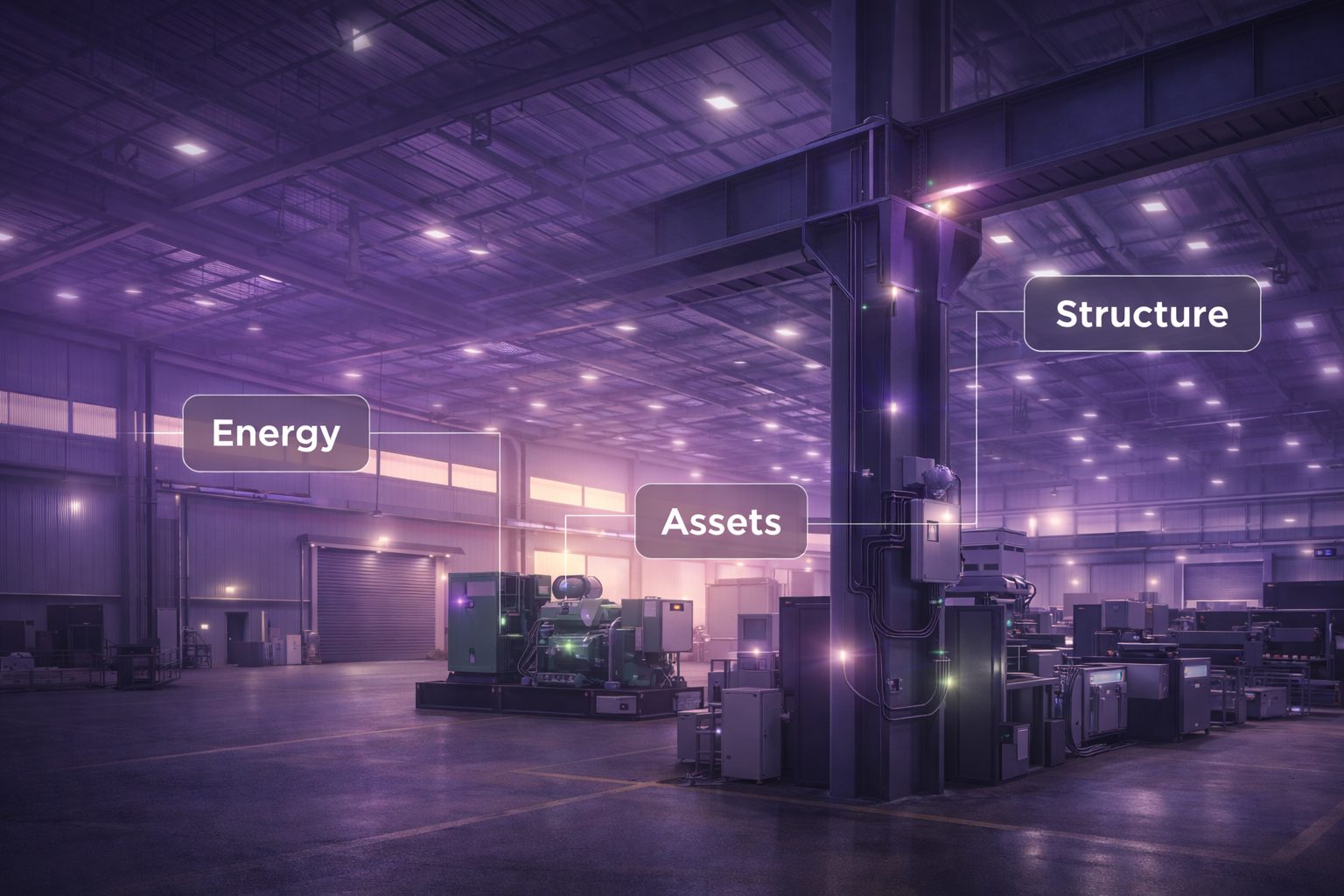
IoT architecture for MSMEs, simple, robust, scalable
Most MSMEs do not struggle with technology choice. They struggle with reliability. Power drops, network gaps, and limited technical staff shape how IoT should be designed in Smart PEB Buildings.
Start with devices that are easy to live with
Monitoring usually works best when the device list is short. Energy measurement is handled at the panel level. Temperature sensors are placed only where overheating has occurred earlier. Vibration monitoring is reserved for equipment that has a history of failure. Sensors that need frequent calibration or cleaning rarely survive beyond the first year.
Network decisions follow site reality
Industrial sheds are rarely network-friendly. Wi-Fi may work in offices but not near cranes or compressors. Many MSMEs rely on cellular or long-range networks because they continue operating during local outages. Data loss during power cuts is common, so local storage becomes important even in small setups.
Keep data ownership uncomplicated
Monitoring data is useful only when it can be accessed easily. Maintenance teams need alerts. Finance teams need summaries. Vendor access must be limited. When ownership is unclear, systems stop being used. Simple access rules keep the system relevant long after installation.
Energy dashboards that procurement and finance can actually use
In many MSME facilities, energy data exists but is rarely used in reviews. Dashboards fail when they show too much detail and too little relevance. For Smart PEB Buildings, energy dashboards must support routine checks, approvals, and cost control discussions.
What finance teams need to see clearly
Finance teams focus on cost movement, not technical graphs. They need to see whether higher electricity bills are linked to higher production or to inefficiency. Peak demand levels matter because they influence fixed charges. Power factor trends matter because penalties repeat quietly. DG usage matters because it raises operating costs even when grid supply appears stable.
When these figures are visible at a glance, bill verification becomes simpler and faster.
How procurement identifies leakage
Procurement teams often review energy when vendor performance is questioned. Consistent weekend consumption usually indicates equipment left running. Sudden spikes during specific shifts suggest poor scheduling or manual overrides. Higher-than-normal DG usage without outages raises concerns around load planning.
Dashboards that highlight such patterns reduce the need for manual data checks.
Keeping dashboards relevant
Dashboards are useful only when they support action. Simple decisions such as adjusting operating hours, correcting load timing, or flagging abnormal equipment behaviour keep dashboards part of regular reviews instead of forgotten screens.

Asset maintenance playbook for PEB, turning data into uptime
Maintenance in most PEB facilities is driven by breakdowns, not plans. Smart PEB Buildings use monitoring only to support what maintenance teams already understand: assets fail in predictable ways when early signs are ignored.
Preventive maintenance linked to real failure points
A maintenance calendar works best when it reflects actual wear, not generic schedules. Roof fasteners loosen after repeated thermal cycles. Gutters clog during specific seasons. Sealants degrade faster near high-heat zones. Ridge ventilators and skylight sheets show stress long before visible damage.
Tracking these elements on a fixed cycle reduces repeated repairs and water ingress issues.
Where predictive maintenance adds value
Not all assets justify predictive tools. Motors, bearings, cranes, compressors, pumps, and electrical panels do. These assets show measurable stress before failure. Temperature rise, vibration changes, and abnormal run-hours provide enough warning to plan repairs during low-impact windows.
Using data here reduces emergency stoppages and overtime costs.
Warranty and AMC risks that often get missed
Many MSMEs assume monitoring strengthens warranty claims. This is not always true. AMC exclusions, unclear response times, and disputed root causes often surface during failures. Clear records help, but only when ownership and responsibility are defined upfront.
A structured playbook aligns data, maintenance action, and vendor accountability.

Compliance and audit readiness, often missed in “smart” projects
Many Smart PEB Buildings fall short during audits, not because systems fail, but because records do. Monitoring data alone does not satisfy auditors unless it aligns with statutory and operational documentation.
Fire safety and operational records
Fire systems, alarms, and safety equipment are inspected against logs, not dashboards. Alarm histories, inspection notes, and maintenance registers must match what is installed on site. When records are incomplete or stored across vendors, audits slow down and corrective notices increase.
Consistent logging also helps during insurance reviews, where evidence matters more than explanations.
Facility documentation discipline
Tender submissions and renewals often require updated drawings, calibration certificates, and service reports. Version control becomes critical. Old documents uploaded by mistake lead to repeated clarifications and rejections.
Smart PEB Buildings reduce this risk by keeping documentation current and easy to retrieve.
Reducing procurement friction
Clean records shorten technical evaluations. Fewer questions come back from auditors and buyers. Handover during AMC renewals becomes smoother. Over time, this discipline lowers compliance fatigue and improves vendor credibility without additional effort.
Vendor selection and procurement checklist for smart upgrades
Most problems in smart upgrades start before the first sensor is installed. They begin with unclear purchase terms. MSMEs often approve proposals without knowing what is included, what is optional, and what will be billed later.
Scope clarity at the time of ordering
A usable proposal lists what is being supplied in simple terms. This includes the number of sensors, the locations covered, and the dashboards that will be accessible. Alert types and user access should be written clearly. Training and handover must be mentioned explicitly. If something is not written, it is usually not delivered.
Fit with existing site equipment
Before placing orders, compatibility checks are necessary. Electrical panels, DG sets, cranes, and older meters may not support direct integration. When this is discovered late, temporary workarounds are introduced and systems become fragmented.
Commercial terms that avoid disputes
Response times, visit frequency, and spare replacement rules must be defined. Annual charges should be fixed in writing. Responsibility for fault analysis should also be clear. When these points are left open, delays and disagreements follow during failures.
Careful procurement reduces rework and keeps upgrades manageable.
ROI for smart PEB buildings, a practical view for MSMEs
Return on investment in Smart PEB Buildings is rarely immediate and rarely uniform. MSMEs see value first where costs are already visible and recurring. Energy charges, unplanned shutdowns, and repeated repairs usually form the starting point.
Where savings appear first
Early gains often come from peak demand control, reduced DG usage, and correction of idle loads. These changes do not require complex analytics. But, however, rely on visibility and timely action. Even small reductions, when consistent, improve monthly cash flow.
Reliability gains that matter over time
Not all returns show up as line items. Fewer breakdowns reduce overtime, emergency spares, and also, production losses. Hence, planned maintenance lowers rework and extends asset life. These benefits accumulate quietly but steadily.
When ROI expectations should be delayed
Smart upgrades do not pay off when basic issues remain unresolved. Persistent roof leaks, unstable electrical layouts, and unclear asset ownership distort data and decisions. In such cases, stabilising the facility first delivers better returns than adding monitoring layers.
ROI improves when control precedes technology.
Practical example: a common MSME workflow, and a smarter alternative
This situation is familiar to many MSME-run PEB facilities, especially where operations have grown faster than internal controls.
What usually happens
Energy bills are reviewed after payment, mainly to check if the amount looks unusually high. Maintenance issues are addressed when equipment stops working. These two areas are rarely reviewed together, even though they impact each other.
Where the gaps show up
Electricity use is understood through monthly invoices. DG usage is directly based on rough estimates, and maintenance records are filled once work is completed. When cranes or panels trip, the focus stays on getting work moving again, not on why the issue keeps returning.
What changed with basic visibility
After simple energy meters and panel temperature checks were added, links became easier to see. Higher demand appeared during fixed working hours. Panel temperatures increased before stoppages. DG was running during short voltage fluctuations.
Conclusion
For MSMEs, a PEB building should run without frequent problems. Costs should not change suddenly. Equipment should not fail repeatedly. When this happens, work becomes harder than necessary.
Basic visibility helps. Knowing where energy is used helps check bills. Knowing asset condition helps plan maintenance. Keeping records updated helps during audits and renewals.
Smart changes work only when they are easy to use. Systems that are complicated are usually ignored. Simple monitoring and regular maintenance are more useful in daily operations.
For MSMEs, stability matters more than technology. Fewer issues mean smoother work and less disruption.
Looking to procure steel?
Tata nexarc helps manufacturers, builders and MSMEs source certified steel products, compare prices, and choose the right grade as per IS codes—with complete traceability and procurement confidence.
FAQs
Does smart monitoring help during factory expansion planning?
Can smart PEB data be used in lender or bank discussions?
Is smart monitoring useful for multi-location MSMEs?
Does monitoring help in prioritising capex decisions?
Can smart PEB monitoring support compliance with buyer audits?
Can smart PEB insights support ESG or sustainability reporting?
Is smart PEB monitoring helpful during peak season planning?
Can smart data reduce dependence on external consultants?
Is smart monitoring useful for leased PEB facilities?
Can monitoring reduce disputes with utility providers?
Charul is a content marketing professional and seasoned content writer who loves writing on various topics with 3 years of experience. At Tata nexarc, it has been 2 years since she is helping business to understand jargon better and deeper to make strategical decisions. While not writing, she loves listing pop music.