Check Price Now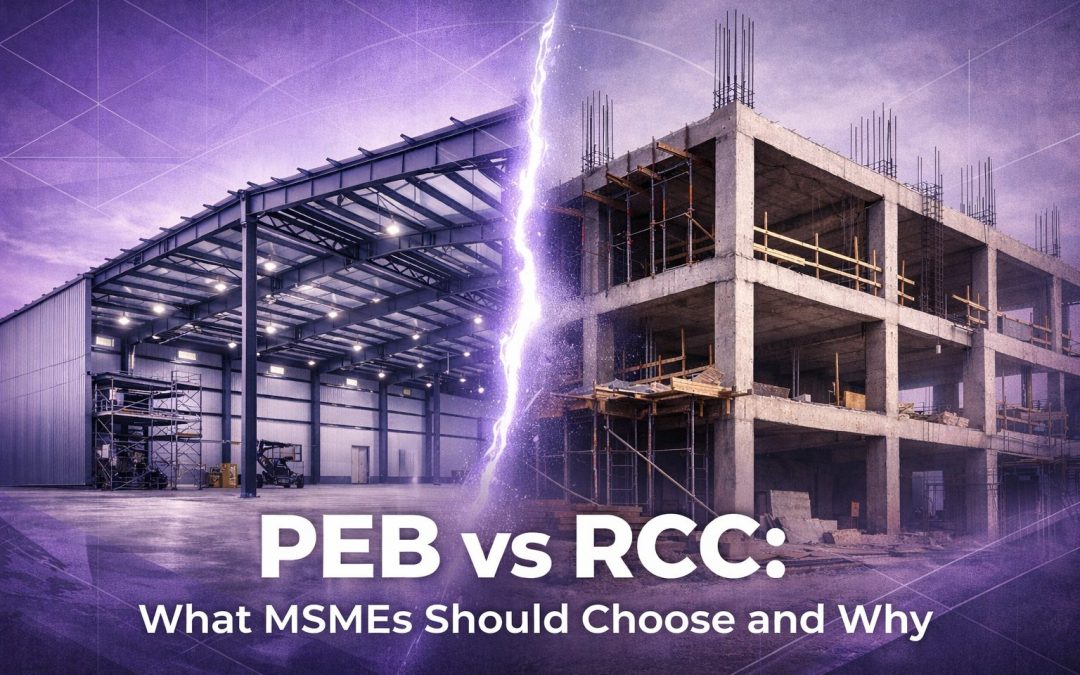
Table of Contents
- Introduction: Why the PEB vs RCC Debate Still Matters
- The Real Question Behind “PEB vs RCC”
- PEB and RCC: Quick Definitions
- Looking at Total Project Cost, Not Just Cost per sq ft
- Understanding the Real Construction Timeline
- Approvals and Documentation That Influence Your Choice
- A Practical Procurement Checklist for PEB and RCC Projects
- A Use-Case-Based Decision Guide for PEB vs RCC
- Conclusion: Making the Right Structural Choice
- FAQs on PEB vs RCC
Introduction
A lot of MSMEs search peb vs rcc when a project is already moving, a plot is shortlisted, a loan file is half-built, and vendors are pushing quotes with tight validity. The comparison looks simple on paper. Steel is faster, concrete is permanent. The reality is messier. A pre-engineered building can save months, but it can also expose gaps in civil readiness, scope clarity, and approvals. RCC can feel safer for long life, yet timelines stretch when labour, curing, and rework collide with production pressure.
In real procurement cycles, timing matters more than cost per sq ft. A delayed shed handover can block dispatch, storage, and even compliance renewals. Many MSMEs also miss that bank disbursements and vendor payments follow different rhythms in PEB warehouse construction versus RCC shed construction. The right choice is rarely about material pride. It is about operational continuity, documentation comfort, and how cleanly vendors can commit to scope

The real question behind “PEB vs RCC”
Most peb vs rcc comparisons begin with structure type. MSME decisions usually begin with what the building must enable on Day 1, and what it must tolerate after a year of real use. A warehouse needs clear span, docking flow, and future bay expansion. A fabrication shop needs crane bay planning and safer zoning. A small plant needs drainage, dust control, and workable maintenance access.
Why “cost per sq ft” misleads
PEB vs RCC cost per sq ft looks clean, but it hides the swing factors that blow budgets.
Key items that change total cost fast:
- Flooring thickness and grade, based on load and forklift traffic
- Plinth height, drainage, and water flow planning
- Internal roads, turning radius, and yard hardstanding
- MEP scope, panels, lighting, ventilation, and fire safety
Quote mismatch is common and avoidable:
- PEB vendors often quote the shell and exclude civil and services
- RCC quotes may include more civil but move slower due to curing and site dependencies
- “Not in scope” clauses show up during execution, not during negotiation
Treat it as a predictability choice
In real procurement cycles, speed matters, but predictability matters more. Lock operational needs, lock scope boundaries, then compare PEB and RCC on total outcome, timeline risk, and documentation comfort.

Also read: Cost Estimation for PEB Building – Real Budget Guide for MSMEs
Quick definitions, without the textbook overload
Now, let’s have a detailed understanding of both the terms and what they actually stands for.
What a PEB really means on site
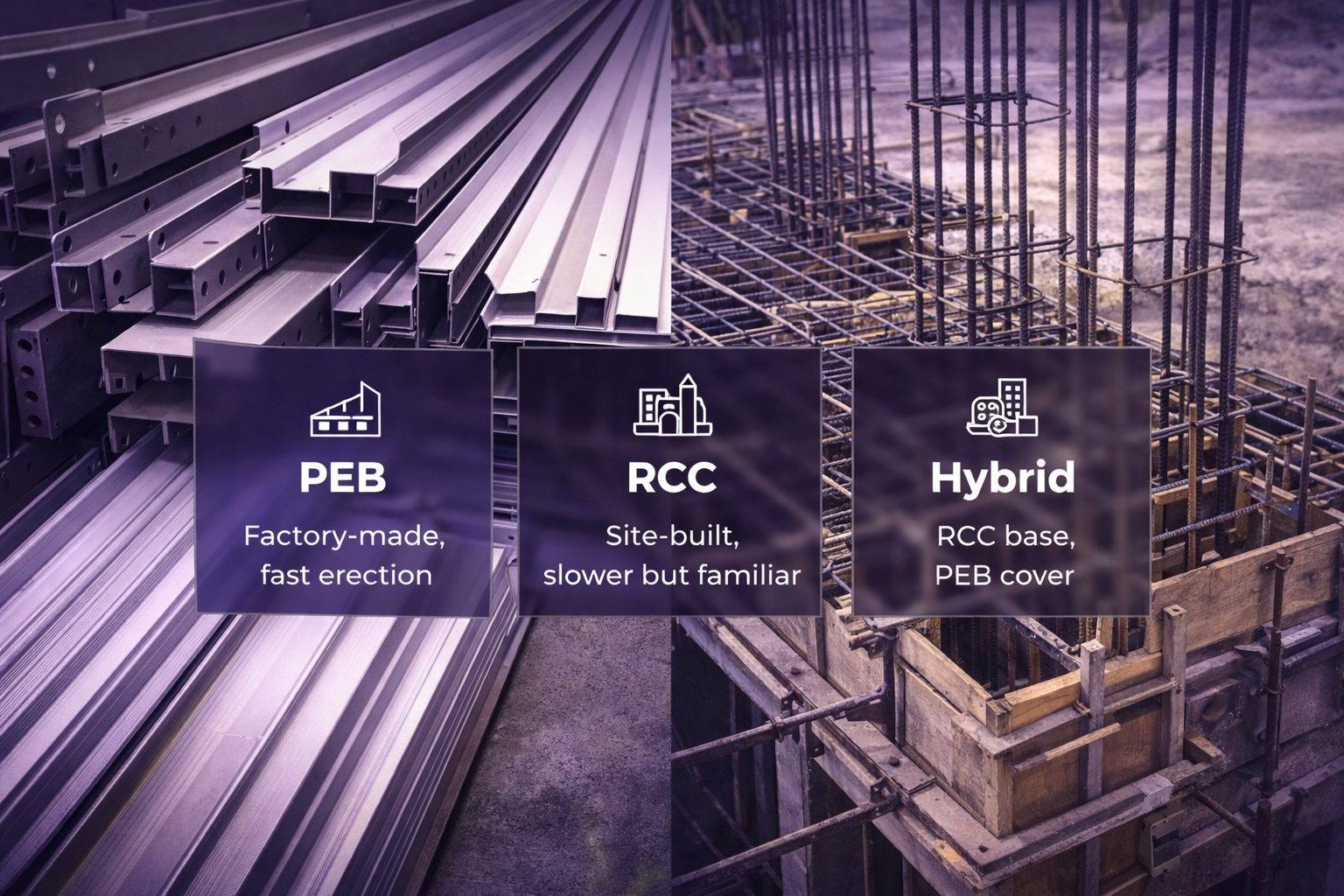
A PEB structure is not just steel and sheets. It is a pre engineered building package where design, fabrication, and erection are linked to one drawing set and one BOQ for PEB. The strength is speed and repeatability, but only when the brief is frozen early.
Typical components in a pre-engineered steel building scope:
- Primary frames, columns, rafters, bracing, portal frame structure
- Roof and wall cladding sheets, roof sheeting, wall cladding
- Secondary members, purlins and girts, fasteners and accessories
- GA drawing plus shop drawings, fabrication and erection sequence
What RCC usually covers, and why it feels “safer”
RCC shed construction is built around on-site civil execution. It moves step by step, formwork, reinforcement, concreting, curing, and finishing. This route is familiar to many MSME project teams, so control feels higher, even when timelines stretch.
RCC industrial building scope often includes:
- Foundations, columns, beams, slabs, staircases, masonry
- Plaster, waterproofing, finishing, and civil detailing
- Better fit for multi-storey blocks or heavy thermal mass needs
The hybrid model that is common in India
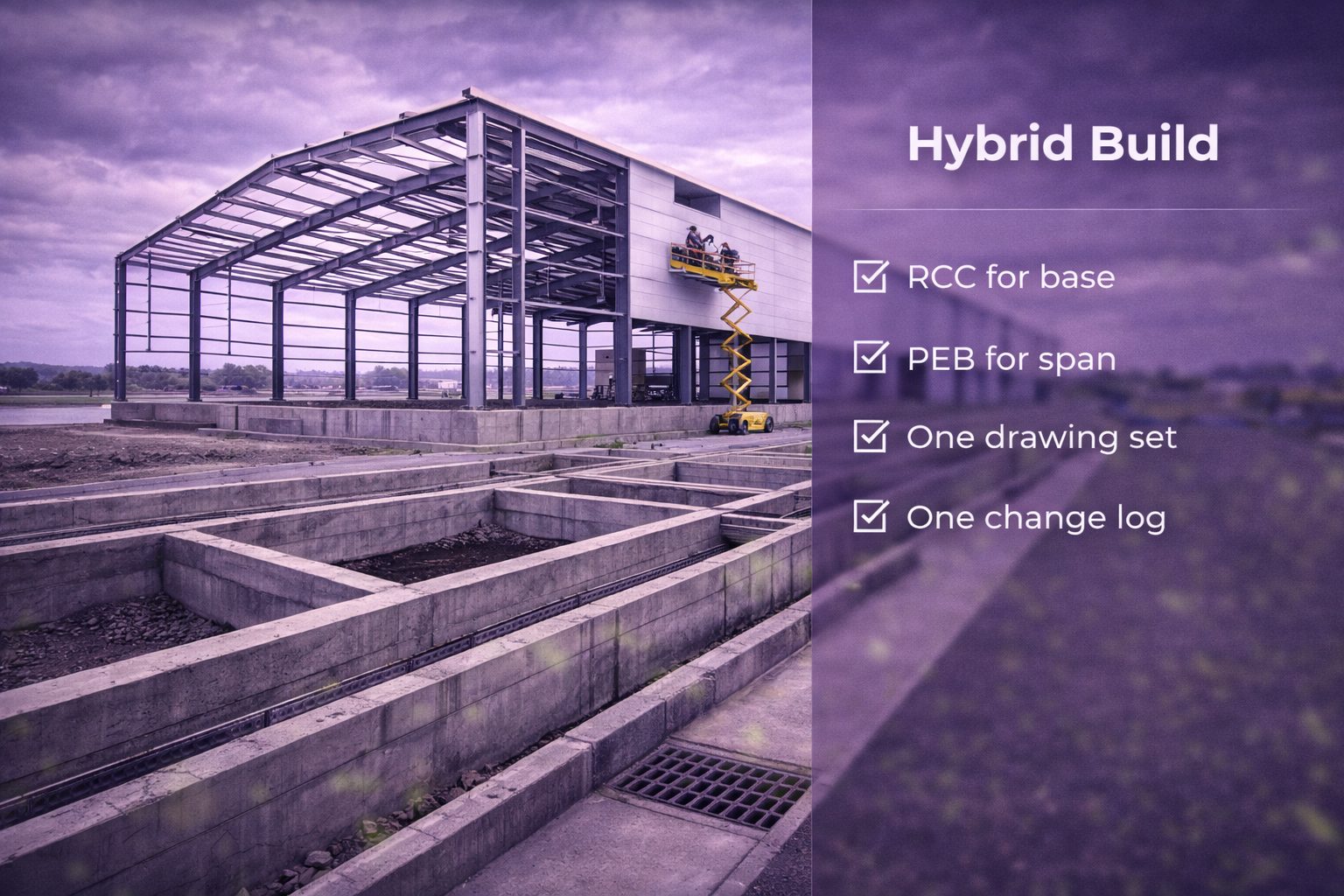
A pure steel shed vs RCC debate misses the hybrid RCC plus PEB structure that most industrial projects end up using. RCC handles foundation, plinth, and heavy floor. PEB handles the superstructure for clear span building needs and faster covering.
Common hybrid pattern:
- RCC foundation and plinth, including drainage and floor
- PEB superstructure and cladding, with insulation panels for PEB if needed
- Separate scope owners unless the EPC vs PEB vendor model is defined early
Total cost, not cost per sq ft
Many MSMEs compare PEB and RCC using one number, cost per sq ft. That number is useful only after the scope is fixed. Before that, it can be misleading. A vendor may quote only the shed shell, while another includes foundations, flooring, drainage, and basic services. Both look comparable, but the total outcome is different. This is why peb vs rcc decisions should be based on total project cost and what is included in writing.
Recent cost benchmarks in India (₹/sq ft)
These ranges help with early planning, but they are not final budgets. Confirm inclusions before using them in internal approvals.
| Project type and scope note | PEB range (₹/sq ft) | RCC range (₹/sq ft) | What this usually covers |
| Business comparison benchmark for a standard shed | 900–1,500 | 1,400–2,200 | Broad comparison ranges, scope can differ by vendor and location |
| Large warehouse build, construction only (100,000+ sq ft) | 1,400–2,600 | 1,800–3,200 | Structure, envelope, basic services, excludes land and fit-out in most cases |
| Factory build, standard manufacturing range | 1,800–2,800 | 2,200–3,500 | Typical factory shell and basic building works, special compliance adds extra |
| State snapshot, typical industrial factory ranges | 1,800–3,200 | 2,200–3,800 | Location-driven variation, labour, logistics, and material handling shift costs |
What changes the number fast
Cost moves when inclusions move. In a peb vs rcc comparison, the biggest jumps usually come from items outside the main frame.
Common budget movers to lock early:
- Foundations and plinth levels, including anchor bolts and pedestals
- Flooring thickness and grade, based on forklifts and rack loads
- Drainage, internal roads, and yard hardstanding
- Roofing and wall cladding specs, gutters, ventilators, skylights
- Fire safety readiness, electrical and ventilation scope
- Special loads like mezzanine floors or crane bays
Like-for-like scope checklist for vendor quotes
| Cost bucket | Fix this in the BOQ | Why it matters in peb vs rcc |
| Civil and foundations | Foundation design basis, plinth height, soil assumptions | Low PEB quotes often exclude civil detail |
| Flooring and yard | Floor spec, VDF needs, joints, drainage, roads | This drives heavy cost variation |
| Envelope | Cladding type, insulation, gutters, ventilators | Accessories get added later if not locked |
| Services | Electrical, ventilation, fire safety allowances | Compliance costs appear late if missing |
| Erection and logistics | Transport, crane scope, erection consumables | Site handling can become a surprise bill |
Keep an eye on price movement and cashflow timing
PEB projects can move faster, but cashflow can bunch up earlier because fabrication starts once drawings freeze. RCC often spreads spending, but timelines stretch with curing, weather, and site dependencies.
Steel-linked cost pressure is also real. A reported safeguard duty notification dated December 30, 2025 was followed by market commentary on higher steel prices and construction cost impact. That is one more reason to freeze scope early and avoid late revisions.

Timeline reality, what speeds up and what still slows you down
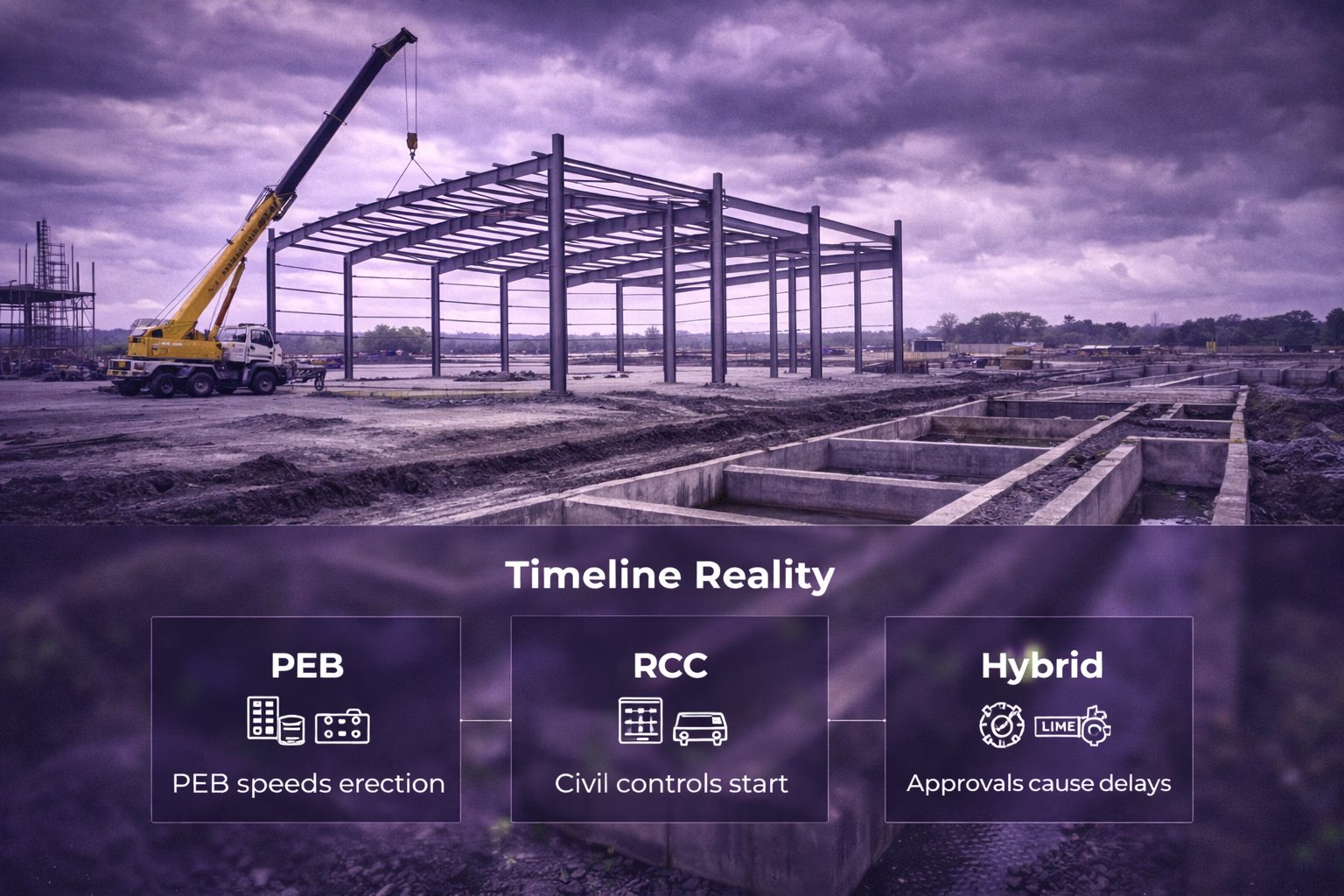
PEB construction time reduces because fabrication and erection move fast once the GA drawing and shop drawings are frozen. The site gets covered earlier, which helps protect material and reduces weather damage. This benefit shows up clearly in PEB vs RCC for warehouse projects, where early covering allows racking, lighting, and flooring work to start sooner.
What still slows projects, even with steel
Many MSMEs expect the steel shed to “solve” the schedule. Civil readiness still controls the clock. Foundations, plinth, drainage, and floor curing decide when erection can start. Approvals and rework also create delays, especially when teams change layout after the BOQ is approved.
Common timeline blockers in PEB vs RCC projects:
- Late soil inputs and redesign of foundation for PEB
- Delayed floor spec decisions, forklift and rack loads come late
- Monsoon waterlogging due to weak drainage planning
- Vendor coordination gaps, civil and steel teams work on different drawings
- Approval changes, fire safety and access roads get added late
A practical sequencing view for MSME teams
A simple approach improves predictability. Freeze scope early, then lock the order of work.
Recommended sequence that reduces friction:
- Finalise layout, clear span, mezzanine, crane bay needs
- Freeze drawings, then approve the PEB drawing set once
- Complete foundations, plinth, and drainage before steel dispatch
- Plan flooring and services in parallel, not after erection
- Keep one change control log for all vendors
In real procurement cycles, timing matters more than the headline rate. A faster shell still fails if civil readiness and documentation discipline slip.
Approvals, compliance, and documentation, often missed in planning
Approvals and paperwork decide timelines more often than construction speed, so this part needs attention early.
Why approvals decide the real timeline
Many MSMEs lose weeks on a project even after finalising peb vs rcc. The delay comes from approvals and document gaps, not from steel fabrication or concrete pouring. Local bodies, industrial area authorities, and internal safety teams ask for clear drawings, stable load assumptions, and signed submissions. When the project brief keeps changing, every submission becomes a fresh loop.
Core documents that typically get checked
A clean file reduces rework and avoids last-minute scope changes.
Common building approval documents that need alignment:
- Layout and architectural drawings, with access roads and setbacks
- Structural design set, including load inputs and design basis
- Structural stability certificate from a qualified engineer
- For larger sheds and warehouses, fire safety plan and fire NOC readiness items
- Vendor drawings, GA drawing and shop drawings, kept consistent with approved layout
This approach helps with government procurement bottlenecks. Tendering teams and loan teams both prefer traceable documents with version control.
Where PEB and RCC create different document pressure
PEB projects move fast, so mistakes surface fast. Teams often approve the PEB drawing set early to start fabrication, then change openings, dock levels, or mezzanine plans later. That creates mismatch between sanctioned drawings and executed scope. RCC projects face a different risk. Site teams may modify reinforcement and dimensions during execution, then struggle to explain deviations during audits.
Often missed in tender planning is a basic point. A tender file may ask for proof of compliance and stability, not just a cost breakup.
Example, a common MSME workflow risk
An MSME bids for a warehouse contract on GeM. The bid requires a stability certificate, fire safety notes, and drawings that match the offered layout. The project team collects a vendor brochure and a rough BOQ. During technical tender evaluation, the buyer asks for signed drawings and a clear scope statement. The bid faces rejection risk, even though pricing is strong. A simple fix is to treat documentation like a project deliverable, not a formality.

Procurement checklist to compare vendors cleanly
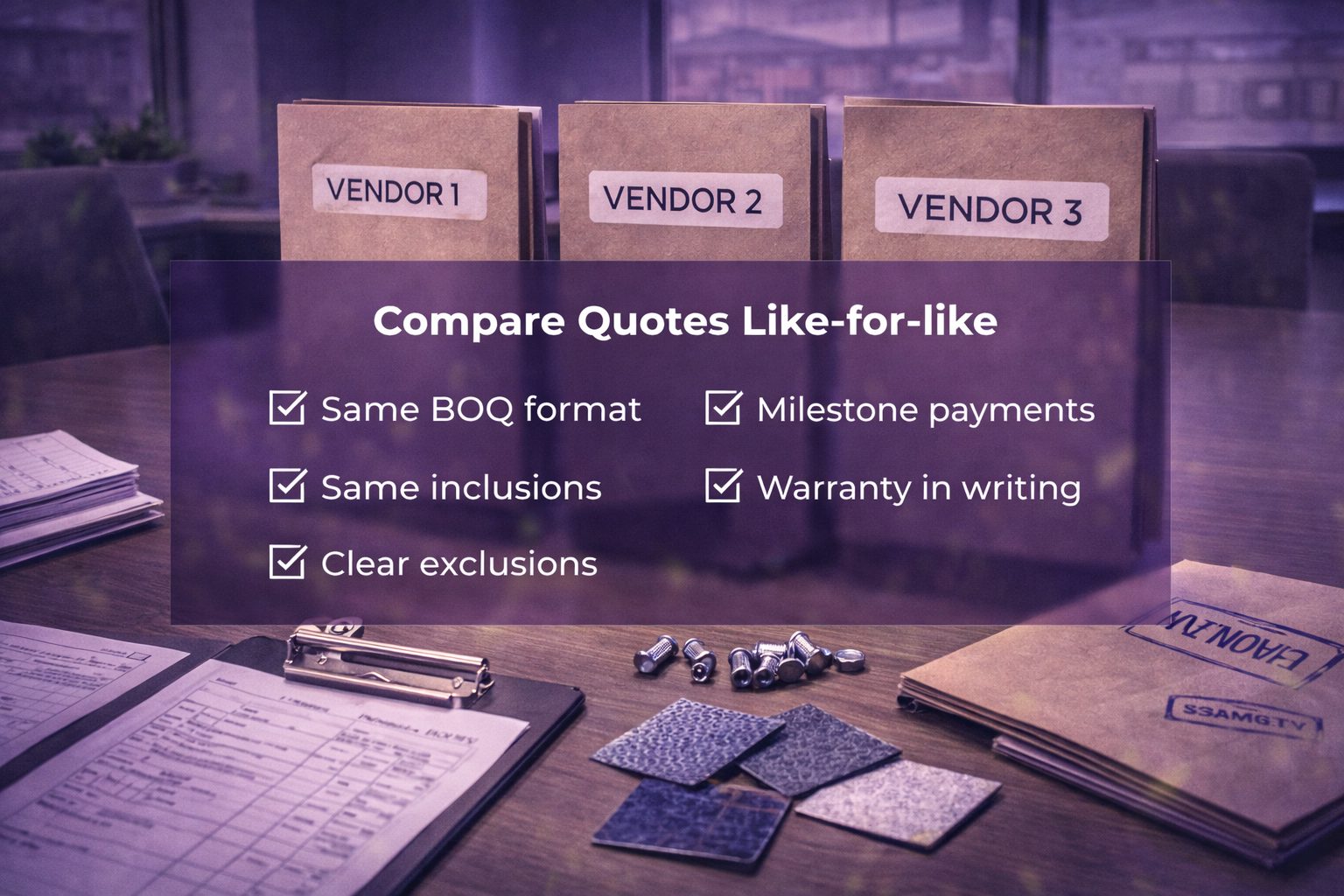
A clean comparison starts with one rule, every vendor must quote the same scope in the same format.
Why quotes look comparable but are not
In many peb vs rcc projects, the first quotation round mixes apples and oranges. One PEB vendor prices only the pre engineered building shell. Another adds a better coating specification and includes gutters, ventilators, and skylights. RCC vendors may include more civil work but leave electrical and fire items open. The cheapest number often comes from the smallest scope, not the best value.
The minimum scope sheet to freeze before pricing
Use a one-page scope sheet and attach it to every RFQ. Keep it simple, but specific.
Fix these items in writing before comparing price:
- Building use, warehouse, factory, cold storage, office block
- Clear span and height needs, crane bay or mezzanine needs
- Flooring load, forklift, racks, machine foundation points
- Envelope needs, insulation panels for PEB, condensation control, ventilators
- Compliance needs, fire safety readiness, access roads, setback constraints
- Delivery expectation, target handover date, working hours, monsoon constraints
Vendor quote checklist for PEB
Here’s a list of items to be confirmed by every PEB vendor:
- PEB drawing set included, GA drawing plus shop drawings, revision control
- Steel grade and section sizes, design basis for wind load and seismic design
- Coating specification, galvanising vs painting, epoxy coating for steel if required
- Erection scope, transport, crane, consumables, testing, and bolt tightening standards
- Warranty terms for PEB, cladding, leakage, corrosion, fasteners
- Exclusions list on one page, signed and dated
Contract and payment terms that reduce disputes
Keep payment terms milestone-based, not percentage-based. Tie them to measurable deliverables like approved drawings, dispatch, erection completion, and final handover. This approach protects MSMEs when scope changes happen late.
A simple habit helps. Maintain one change log shared across civil and PEB vendors, then price changes only through that log.
Decision guide by use-case, pick faster with fewer regrets
A faster decision comes from matching the building to the job, not from debating materials in general.
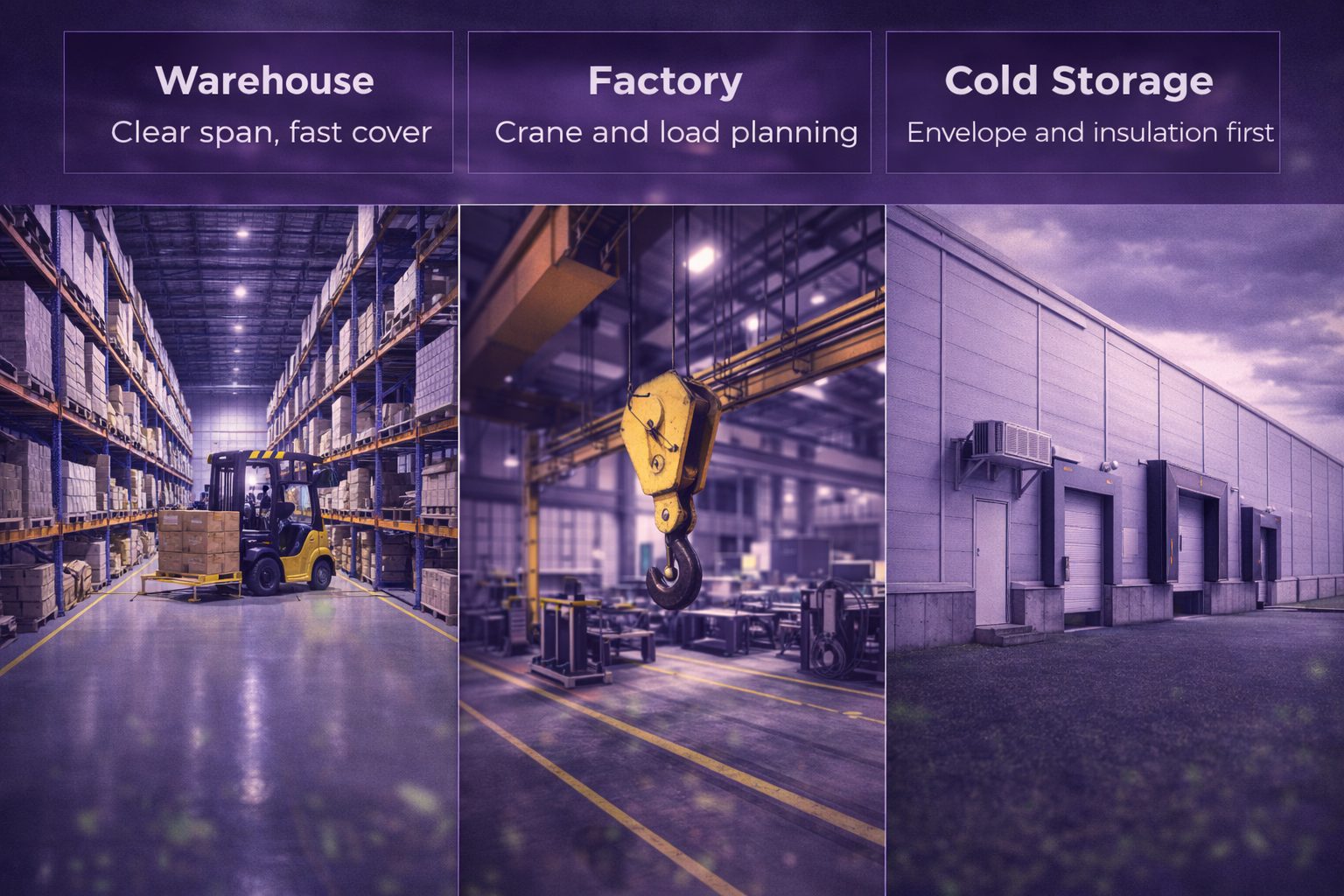
Warehouse and logistics shed
For most MSME warehouse builds, peb vs rcc often leans toward PEB because clear span and faster covering matter.
PEB usually fits when:
- The layout needs wide bays and flexible racking lanes
- Docking flow and vehicle movement need open space
- The project needs quick covering before monsoon
RCC can still win when:
- The site needs heavy retaining work or complex levels
- The plan includes multiple floors or heavy office blocks
Manufacturing shop with crane bay or heavy machines
Factory shed design changes when machines, vibration, and crane loads enter the picture. PEB works well for large span steel structure needs, but the floor and foundations decide performance.
Choose PEB when:
- The shop needs a clear span building with crane bay planning
- The project needs quick erection and future expansion
- The civil team can deliver foundation for PEB on time
Choose RCC when:
- The building needs heavy vibration control and thick RCC framing
- The design includes multiple levels with high load concentration
Cold storage, food, and pharma setups
Here, the structure is only one part. Operational control drives the choice.
PEB often suits when:
- Insulation panels for PEB and thermal control are central
- Condensation control in steel buildings is planned properly
- The envelope spec is locked, cladding sheets, joints, vapour barriers
RCC can suit when:
- The project relies on high thermal mass and strict internal partitions
- The design needs heavier civil integration across zones
Office blocks and multi-storey needs
For multi-storey office and staff facilities, RCC usually fits better. It handles slabs, staircases, and partitions with fewer interfaces.
A practical approach is common in India. Use RCC for the multi-storey block and link it with a PEB industrial shed for production or storage.
Expansion plans and mezzanine decisions
Future growth changes the peb vs rcc call. Many MSMEs expand in phases, so plan it early.
Key checks before finalising:
- Do mezzanine floor and stair locations stay fixed
- Will the bay spacing support future equipment changes
- Can utilities and drainage scale without breaking the floor
The hybrid option, RCC where it matters, PEB where it wins
Many Indian MSME projects avoid an either-or choice, they use a hybrid build to balance speed and control.
When hybrid works best
Hybrid RCC plus PEB structure fits when the site needs strong civil work, but the superstructure needs fast covering and clear spans. This route is gaining attention among MSME manufacturers and 3PL warehouse operators because it reduces schedule risk without forcing a full RCC timeline.
Hybrid usually makes sense when:
- The project needs a heavy-duty floor for forklifts, racks, or machines
- The layout needs clear span space for storage or movement
- The team wants faster covering before monsoon
- The plan includes a small RCC office block plus a larger shed area
What typically stays in RCC scope
RCC gives stability and familiarity for the “ground truth” parts of the site.
RCC commonly covers:
- Foundations and pedestals, including anchor bolt setting
- Plinth beams, retaining needs, and drainage channels
- Industrial flooring, joints, slope, and hardstanding
- Staircases and multi-storey blocks, where required
What PEB covers well in the same project
PEB handles the speed layer once the base is ready.
It commonly covers:
- Frames, bracing, and portal frame structure
- Roof and wall cladding, gutters, ridge ventilator, skylights
- Quick erection after GA drawing and shop drawings freeze
- Future bay expansion, when the design allows it
The interface risk, and how to control it
Hybrid fails when vendors work on different drawings. Many MSMEs overlook this, then face alignment issues at column bases, dock levels, and wall junctions.
Control this early:
- Freeze one master layout, then lock one BOQ baseline
- Assign one owner for interface points, civil-to-steel connections, openings, levels
- Maintain one revision log, do not allow parallel “latest drawings”
- Tie payments to milestones that match both scopes, not loose progress claims
Conclusion: A practical choice, not a debate
A good peb vs rcc decision feels less like a comparison, and more like a plan that survives execution.
What to anchor the choice on
Many MSMEs win time and money by focusing on outcomes, not slogans. The building must support dispatch flow, safe storage, and stable operations, not just look good on a drawing.
Keep these anchors in view:
- Total cost and inclusions, not only cost per sq ft
- Civil readiness and approvals, because they decide the real timeline
- Operational loads, forklifts, racks, cranes, mezzanine, and vibration
- Envelope needs, heat, condensation, corrosion, and ventilation
- Vendor scope clarity, one BOQ, one drawing set, one exclusions sheet
The simplest next step before signing any vendor
Freeze the brief once, then compare like-for-like. This approach helps with loan documentation and tender evaluation too, because the file stays consistent.
Often missed in tender planning is document hygiene. Keep the stability certificate, drawing versions, and scope notes aligned with what is being built.
Final view for MSME projects
PEB often fits fast-covering sheds and warehouses. RCC often fits multi-storey and heavy civil needs. Hybrid works well when RCC must control the base and PEB must speed up the cover. A clear scope makes any route succeed.
Looking to procure steel?
Tata nexarc helps manufacturers, builders and MSMEs source certified steel products, compare prices, and choose the right grade as per IS codes—with complete traceability and procurement confidence.
FAQs
Can PEB and RCC be financed differently by lenders?
Does the choice affect insurance premium or policy terms?
Can vendor lock-in become a risk with PEB?
How does the choice affect maintenance contracts and AMC budgeting?
Is one option better for lease-ready industrial sheds?
Does PEB vs RCC change the resale value of the facility?
How does the choice impact ESG reporting for MSME buyers?
ESG outcomes depend on material sourcing documentation, waste handling, energy efficiency, and lifecycle planning, not only PEB vs RCC.
Which option is safer for multi-tenant industrial parks?
Charul is a content marketing professional and seasoned content writer who loves writing on various topics with 3 years of experience. At Tata nexarc, it has been 2 years since she is helping business to understand jargon better and deeper to make strategical decisions. While not writing, she loves listing pop music.