Check Price Now
Table of Contents
- Introduction: Why Certain PEB Buildings Stand Out in India
- The Top 10 Most Cited PEB Buildings in India
- How the “Top 10” PEB Buildings List Is Curated
- Key Patterns Observed Across Leading PEB Projects
- Common PEB Building Types in India
- Decisions That Repeat Across Successful PEB Projects
- Common Misconceptions Around PEB Buildings in India
- How to Use These PEB Examples in a Real Project
- Conclusion: What These PEB Projects Teach MSMEs
- FAQs
Introduction
In India, PEB buildings are often evaluated through brochures, price ranges, and surface-level comparisons. On site, however, projects behave very differently. Local approvals, land shape, access for trailers, and future expansion plans quietly influence how a pre-engineered building in India finally takes shape. For MSMEs, these gaps usually appear late, when drawings change or timelines stretch.
What real PEB projects show
Across documented pre-engineered steel buildings in India, one pattern stands out. That is, outcomes improve when planning decisions are tied to daily operations rather than only structural design. Warehouses focus on movement and stacking height. Manufacturing units plan around cranes and bay spacing. Public and infrastructure projects prioritise clear spans and safety compliance. These realities shape every PEB structure in India, yet remain underplayed in most generic write-ups.
Signals that repeat across successful steel PEB buildings:
- Clear spans sized for actual movement and storage
- Consistent drawings used across approval submissions
- Early planning for access, staging, and erection flow
- Provisions for ventilation, drainage, and future loads
- Material and coating clarity, not loosely defined specs
What this article focuses on
This article examines ten widely referenced PEB buildings in India and highlights what made them work in practice. The intent is to help MSMEs see how real projects reduce redesign, approval friction, and execution delays, and then apply those lessons while planning a warehouse, factory shed, or industrial unit.
Top 10 most cited PEB buildings in India
The projects below are frequently referenced because they demonstrate how large-scale pre-engineered steel buildings perform under real operational, logistical, and execution constraints. Each example highlights one planning insight that MSMEs can translate into practical decision-making.
Quick comparison snapshot
|
Project |
Location | Approx Covered Area | Est. Steel Tonnage | Typical Clear Span |
Primary Use |
|
Bangalore International Exhibition Centre (BIEC) |
Bengaluru | 10-15 lakh sq ft | 12,000-18,000 MT | 80-100 m | Exhibition |
|
IMTMA Exhibition Centre |
Karnataka | 6-9lakh sq ft | 6,000-10,000 MT | 60-80 m | Exhibition |
| Arshiya Free Trade Warehousing Zone | Panvel | 15-25+ lakh sq ft | 18,000-30,000 MT | 30-45 m |
Warehousing |
|
Reliance Retail Distribution Facility |
Tamil Nadu | 5-8 lakh sq ft | 5,000-8,000 MT | 30-40 m |
Logistics |
|
Amazon Fulfilment Centre |
Multi-city | 8-15 lakh sq ft | 9,000-18,000 MT | 30-40 m |
E-commerce Logistics |
| Flipkart Fulfilment Centre | Multi-city | 6-12 lakh sq ft | 7,000-14,000 MT | 30-40 m |
E-commerce Logistics |
|
Mahindra Logistics Mega Warehouse |
Maharashtra / NCR | 5-10 lakh sq ft | 5,500-12,000 MT | 30-45 m |
3PL Logistics |
|
Adani Logistics / ICD Facility |
Gujarat / Maharashtra | 8-15 lakh sq ft | 10,000-18,000 MT | 35-50 m |
Freight & Container Handling |
|
L&T Heavy Engineering Industrial Shed |
Hazira/ Kattupalli |
4-8 lakh sq ft | 6,000-12,000 MT | 40-60 m |
Heavy Manufacturing |
| Boeing–Tata Aerospace Facility | Hyderabad | 3-4 lakh sq ft | 3,500-5,500 MT | 30-45 m |
Aerospace Manufacturing |
Note- All numeric values are industry-estimated ranges, not audited figures. They are intended to indicate relative project scale and engineering complexity, not contractual benchmarks.
This list is meant for learning and reference, not competitive ranking.
Bangalore International Exhibition Centre (BIEC), Bengaluru
BIEC remains one of the earliest large-scale public references for PEB buildings in India beyond warehousing. With wide uninterrupted halls and heavy service integration, the project demanded predictable roof behaviour, controlled deflections, and strict fire safety coordination.
Approximate scale indicators:
- Covered area: ~10-15 lakh sq ft
- Structural steel: ~12,000-18,000 MT
- Clear spans: 80-100 m
What stands out is how the structural grid was aligned to crowd movement, stall loading, and temporary installations – not only steel efficiency. The takeaway is simple: public-use PEB buildings succeed when service loads and safety logic are locked before fabrication begins.
IMTMA Exhibition Centre, Karnataka
This facility is widely cited for its phased expansion capability. The original grid allowed additional bays to be added without disturbing the operating envelope.
Approximate scale indicators:
- Covered area: ~6-9 lakh sq ft
- Structural steel: ~6,000-10,000 MT
- Clear spans: 60-80 m
For MSMEs planning staged growth, this reinforces the value of designing expansion logic into the first phase itself.
Arshiya Free Trade Warehousing Zone, Panvel
Often referenced in large logistics discussions, this site demonstrates how movement planning shapes structural decisions.
Approximate scale indicators:
- Covered area: ~15-20+ lakh sq ft
- Structural steel: ~18,000-30,000 MT
- Typical spans: 30-45 m
Dock layout, vehicle circulation, and internal flow influenced grid planning more than raw coverage. For warehouse PEB projects, operational efficiency often outweighs pure area optimisation.
Reliance Retail Distribution Facility, Tamil Nadu
Retail distribution facilities impose tight coordination between automation systems and building geometry.
Approximate scale indicators:
- Covered area: ~5-8 lakh sq ft
- Structural steel: ~5,000-8,000 MT
- Spans: 30-40 m
Conveyors, lighting, ventilation, and material handling were coordinated early with column spacing and roof height, reducing late-stage changes.
Amazon Fulfilment Centre
Amazon operates several large fulfilment centres across India that use multi-bay PEB warehouse structures designed for high-throughput automation, rapid dispatch cycles, and continuous operational scaling.
Approximate scale indicators:
- Covered area: ~8-15 lakh sq ft (typical large FCs)
- Structural steel: ~9,000-18,000 MT (approx.)
- Typical spans: 30-40 m
What distinguishes these facilities is the early integration of automation loads, mezzanine structures, fire systems, and material flow into the structural grid. For MSMEs, this reinforces the importance of aligning equipment planning with column spacing and roof height from day one.
Flipkart Fulfilment Centre
Flipkart’s fulfilment centres represent another widely referenced logistics PEB benchmark in India, especially for rapid deployment across multiple cities.
Approximate scale indicators:
- Covered area: ~6-12 lakh sq ft
- Structural steel: ~7,000-14,000 MT
- Typical spans: 30-40 m
Standardised bay modules and repeatable detailing enabled faster rollouts while maintaining predictable erection quality. The lesson here is the operational value of standardisation when projects scale geographically.
Mahindra Logistics Mega Warehouse
Mahindra Logistics has developed multiple mega-warehousing facilities supporting automotive and third-party logistics operations, many of which use large-span PEB systems.
Approximate scale indicators:
- Covered area: ~5-10 lakh sq ft
- Structural steel: ~5,500-12,000 MT
- Typical spans: 30-45 m
These projects demonstrate how dock density, staging zones, and internal circulation shape grid planning more than headline covered area.
Adani Logistics/ Inland Container Depot (ICD) PEB Facility
Adani’s logistics parks and inland container depots involve heavy vehicle movement, container handling loads, and wide operational bays.
Approximate scale indicators:
- Covered area: ~8-15 lakh sq ft
- Structural steel: ~10,000-18,000 MT
- Typical spans: 35-50 m
The key learning is how access roads, crane paths, and container stacking constraints influence foundation layout and erection sequencing.
L&T Heavy Engineering Industrial Shed (Hazira / Kattupalli)
Large fabrication sheds supporting heavy engineering and modular assembly operations demand higher load capacity and tighter fabrication tolerances.
Approximate scale indicators:
- Covered area: ~4-8 lakh sq ft
- Structural steel: ~6,000-12,000 MT
- Typical spans: 40-60 m
These facilities highlight the importance of crane runway integration, service routing, and fabrication precision in industrial PEB buildings.
Boeing–Tata Aerospace Facility, Hyderabad
A compliance-heavy manufacturing facility where traceability outweighed scale.
Approximate scale indicators:
- Covered area: ~3-4 lakh sq ft
- Structural steel: ~3,500-5,500 MT
- Spans: 30-45 m
Documentation discipline, coating traceability, and controlled fastener specifications defined success.
How the “Top 10” list is curated
“Top” in this context does not mean the largest, the most photographed, or the most marketed project. A PEB building earns a place on this list when it demonstrates measurable engineering scale, repeatable execution discipline, and practical learning value for buyers planning real projects.
Instead of subjective ranking, the list follows a multi-metric evaluation approach, similar to how large industrial assets are assessed in procurement and project planning.
How projects were evaluated
Each project was assessed using a multi-parameter framework based on publicly available EPC references, industry disclosures, and trade documentation.
Key indicators included:
- Covered area / footprint: typically 3-25+ lakh sq ft
- Estimated structural steel consumption: approximately 3,000-20,000+ MT (upper-range mega facilities may exceed this)
- Clear span and structural complexity: generally 25-120 m+
- Operational intensity: logistics throughput, crane loads, automation density, public safety loads
- Expansion flexibility: phased scalability, modular bay replication
- Public traceability: availability of verifiable project references
 Patterns from top PEB projects
 Patterns from top PEB projects
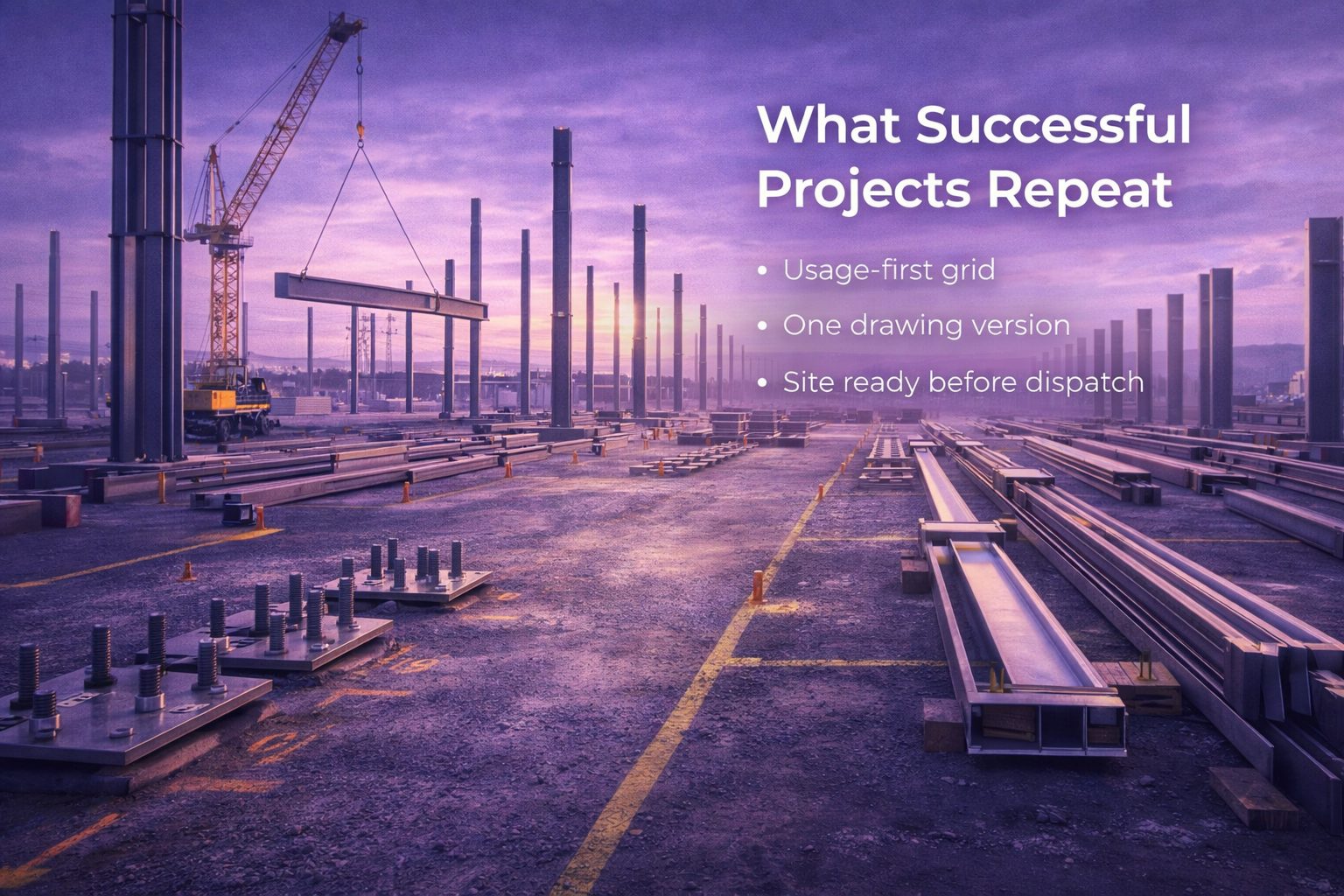
When these projects are viewed together, common themes begin to emerge. Regardless of size or sector, successful PEB buildings in India tend to follow similar planning and execution disciplines. These patterns matter more than individual design choices and often explain why some projects stay predictable while others struggle.
Planning starts with usage, not steel
In many PEB buildings in India, the early discussion stays stuck on cost per sq ft and delivery timelines. The better projects start with how the building will run each day. Storage height, forklift routes, crane movement, dock positions, and drainage lines decide the grid. When usage is clear, the PEB structure India becomes stable early, and redesign reduces.
A common miss is treating internal movement as an afterthought. In real procurement cycles, movement planning saves more time than negotiation. A warehouse that looks cheaper on paper can become expensive when turning radius, staging space, or loading bays are squeezed.
Drawings stay consistent, or approvals and execution break
Approvals in India rarely fail because the project is large. They fail because documents do not match. Different versions of GA drawings, foundation layouts, and structural notes cause repeated queries. Many teams also upload expired certificates in a rush, then lose time fixing basic paperwork. It is a small error with a big cost.
Clean projects treat drawings and documents like controlled inventory. Every submission uses the same latest set. This discipline shows up across serious pre-engineered buildings in India, even when timelines are tight.
Site readiness decides erection speed
Erection rarely slows down because the steel is late. It slows down because the site is not ready. Anchor bolts are off, foundation levels vary, access is blocked, or storage space is missing. Then cranes idle, labour waits, and rework begins. Many industrial PEB buildings India face this pain because civil and PEB schedules are managed separately.
Small operational steps prevent this. A proper access plan, clear staging zones, and foundation checks before dispatch keep PEB erection India predictable.
Standardisation reduces mistakes in multi-bay buildings
Projects with repeated bays and standard members usually run smoother. The same details repeat, fabrication stabilises, and erection crews learn faster. This is visible across infrastructure-style metal building systems India, but the same logic helps MSMEs too. A simple, repeatable grid often beats a complicated layout that looks “optimised” but creates execution risk.
The best projects treat performance as a spec
Not all PEB buildings are judged on span or speed. Cold storage, processing units, and compliance-heavy facilities care about temperature stability, corrosion control, air movement, and safety. When performance is written clearly into the brief, the right insulation, coating, and ventilation choices follow. When it is vague, the building becomes a patchwork of fixes after commissioning.
PEB building types in India
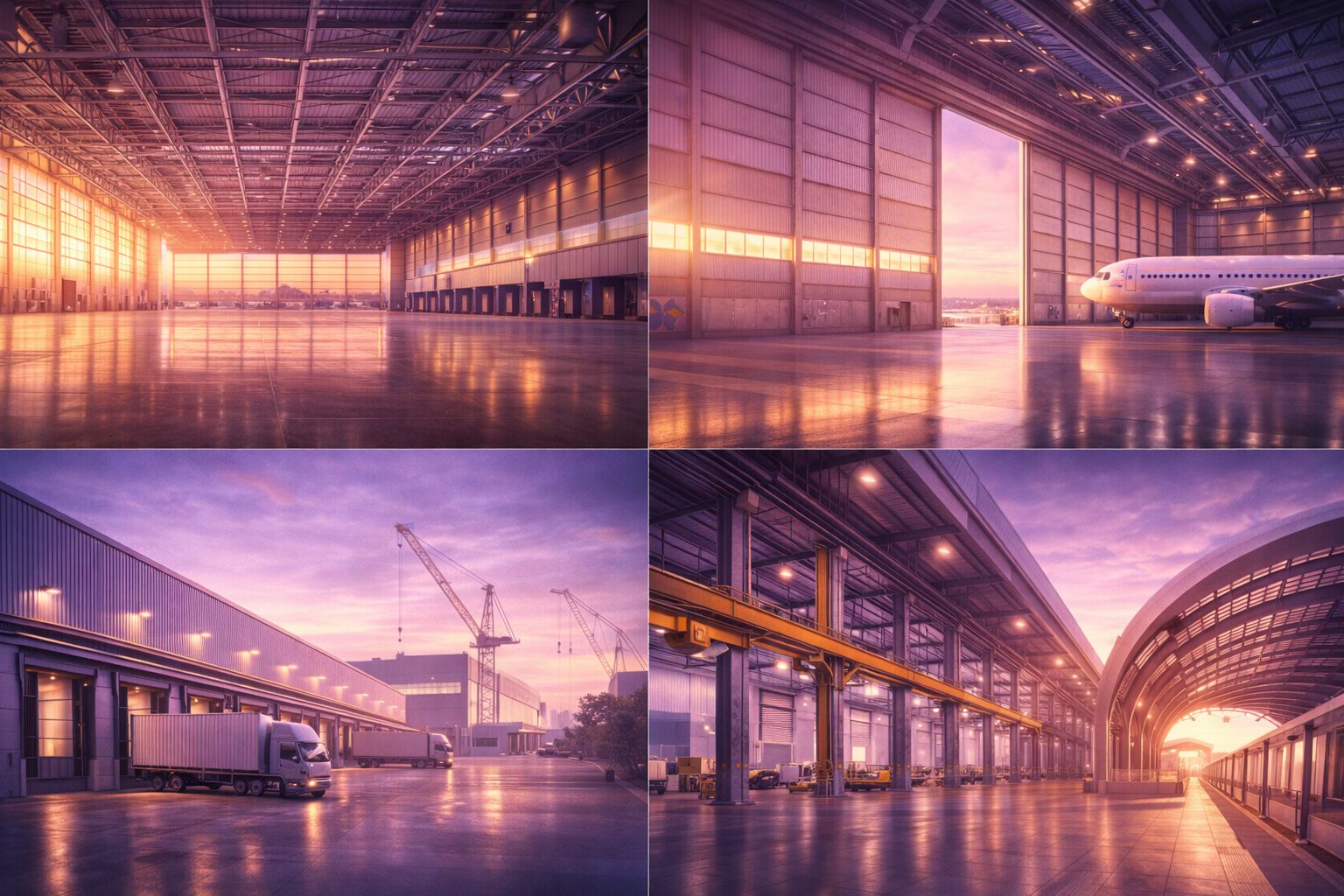
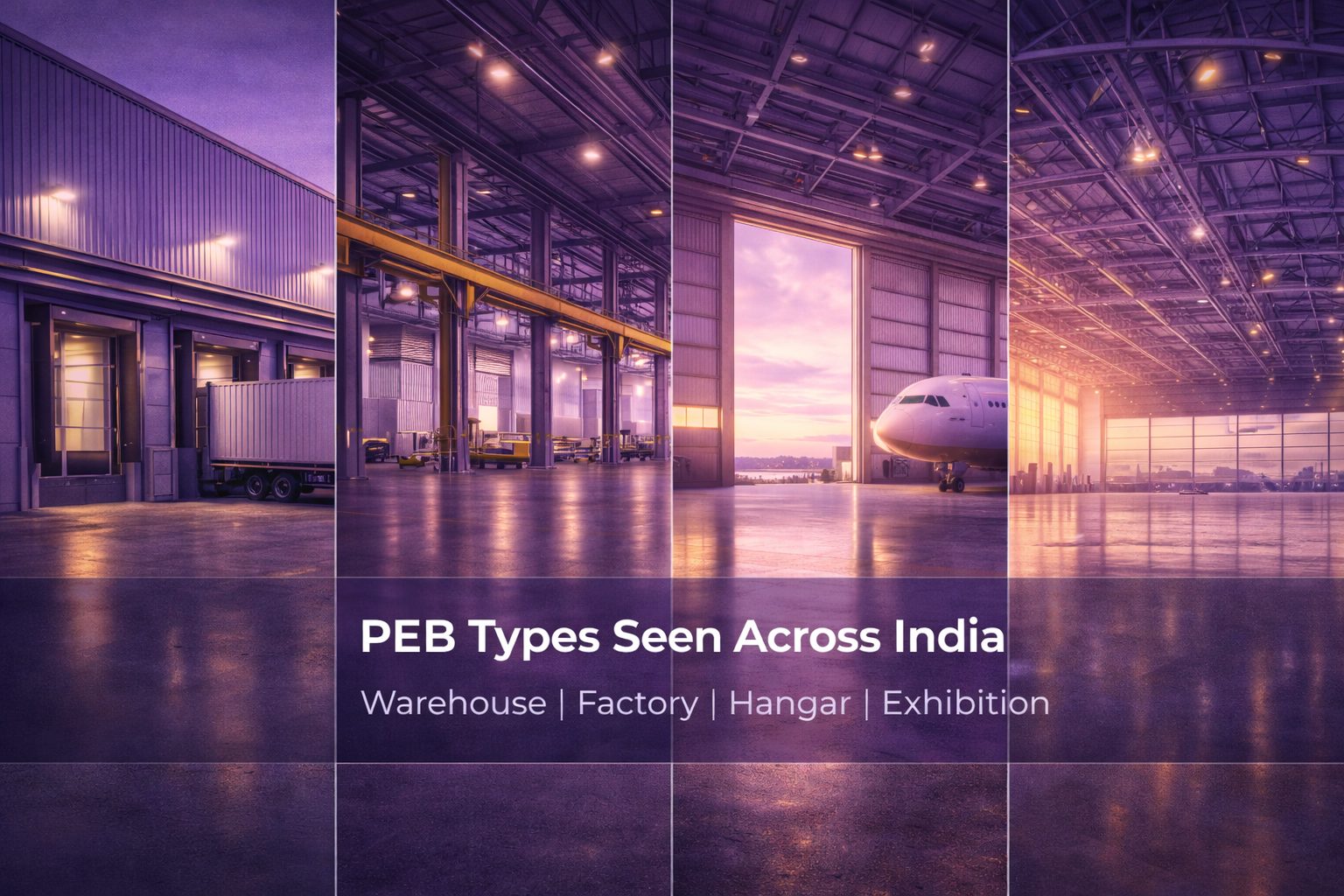
Different PEB buildings in India serve very different purposes. A warehouse, a factory shed, and a metro-linked structure may all use pre-engineered steel, but the planning logic behind each is not the same. Understanding these differences early helps avoid forcing one template onto every project.
Warehouses and logistics hubs
Warehousing-focused PEB buildings in India live or die by flow. Dock layout, turning radius, clear internal lanes, and stacking height shape the grid more than aesthetics. Many teams finalise the shed shell first, then struggle to fit racking, docks, and movement paths inside it.
Common planning inputs that keep this type stable:
- Dock count and dock spacing, aligned to vehicle mix
- Finished floor level and drainage slope, fixed early
- Column grid mapped to racking and forklift aisles
Industrial sheds and factory buildings
A factory-oriented PEB building in India must support process loads, cranes, services, and safe movement zones. Buyers often focus on covered area, then discover that crane runway needs, mezzanine loads, or ducting routes force redesign. The best outcomes come when the operations layout drives the structural brief from day one.
Typical items that need clarity early:
- Crane capacity, runway alignment, and hook height
- Machine foundations and vibration zones
- Service corridors for pipes, cables, and maintenance access
Aircraft hangars and large clear-span structures
Hangars push clear span steel structures in India to the edge of tolerance. These buildings leave little room for mid-course changes. When teams guess wind loads, door requirements, or foundation conditions, costs rise fast and timelines slip. Fabrication and erection require tighter coordination than a standard PEB shed India.
This type demands early locking of:
- Door type and opening width, plus clear height
- Wind zone assumptions and load cases
- Tolerance controls for fabrication and erection
Exhibition halls and public-use large roofs
Exhibition-style pre-engineered buildings in India carry a different risk profile. They handle crowd movement, temporary stalls, lighting, rigging, and strict safety oversight. Many projects lose time when they treat services as “later scope” and then cut and patch the roof for ducts, lighting, or cable trays.
Key planning disciplines for this type:
- Roof service zones and rigging loads defined upfront
- Fire safety coordination aligned to layout changes
- Clear circulation paths protected from column intrusion
Metro and infrastructure-linked steel structures
Infrastructure-linked PEB structures in India usually rely on repeatable modules, strict drawing control, and disciplined sequencing. Work interfaces multiply fast, with civil works, utilities, traffic restrictions, and multiple agencies involved. Small documentation errors can halt progress across multiple sites.
What keeps this type stable:
- Standardised bays and repeated details
- Clear erection sequencing and access planning
- Tight document control, including revision tracking and approvals
Decisions that repeat across successful PEB projects
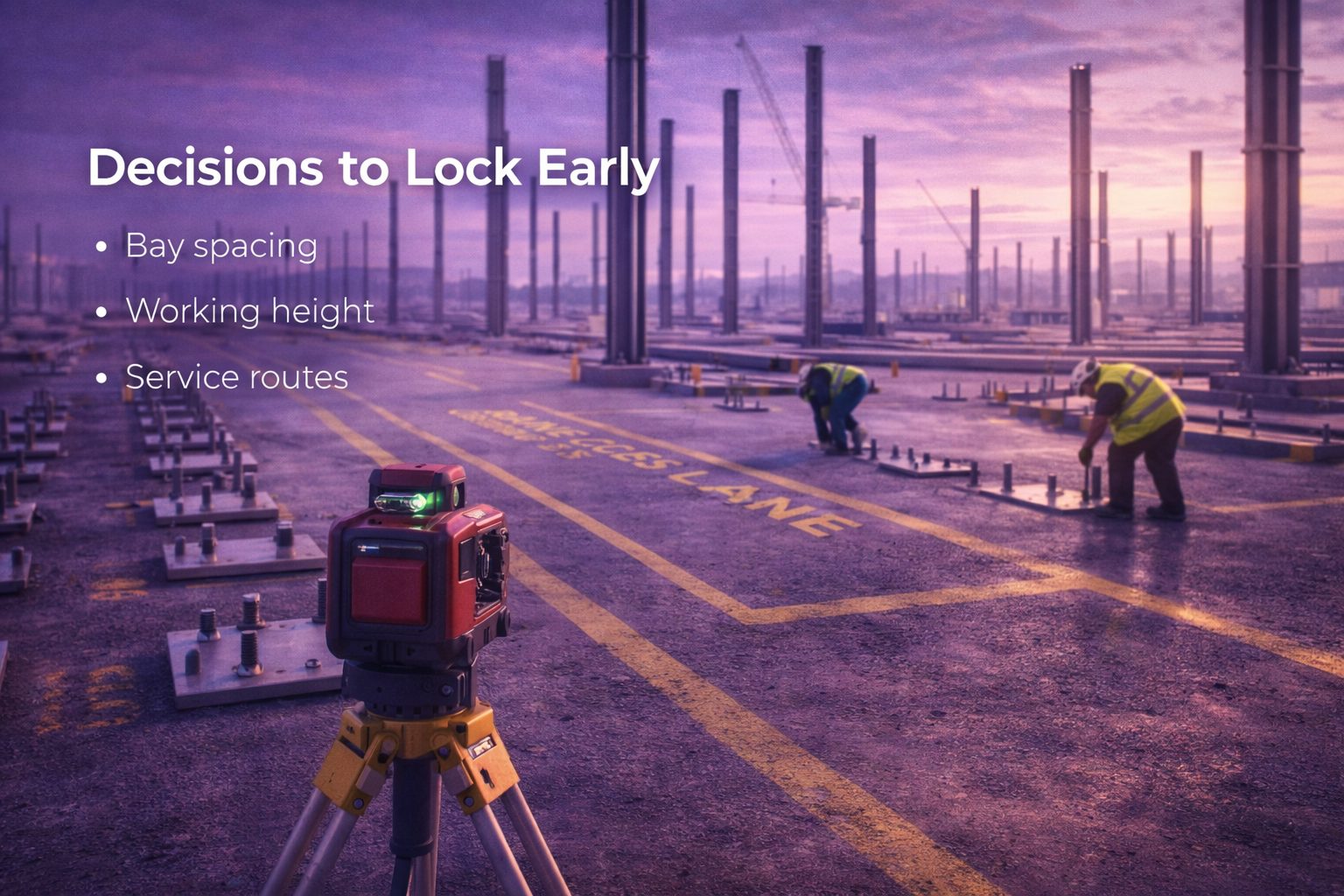
Across many PEB buildings in India, problems rarely come from steel quality alone. They come from small decisions taken late or changed midway. Projects that run smoothly tend to fix a few basics early and then refuse to dilute them.
Bay spacing is settled once, not negotiated repeatedly
In stable pre-engineered buildings in India, bay spacing is fixed after studying movement, storage, and equipment layout. It is not adjusted every time a new drawing is issued. When bay spacing keeps changing, foundation drawings change, anchor bolts shift, and erection planning breaks down. Most delays begin here.
Height is planned for use, not approval
Many industrial PEB buildings India aim for the lowest permissible height and treat everything else as an adjustment later. This works poorly. Racks, cranes, ducts, sprinklers, and lighting all need space. Projects that plan height around actual use avoid awkward retrofits and uneven service routing.
Access is resolved before steel reaches site
Good PEB construction India projects do not assume access will “work out.” They check trailer movement, crane positioning, and storage space well before dispatch. When access is tight, steel arrives but cannot be erected efficiently. Time is lost even though material is available.
Services are decided before fabrication
Ventilation, fire piping, lighting supports, and drainage are easier to install when planned along with the steel. In many troubled PEB steel structure projects, these are added later, leading to cutting, patching, and disputes. Cleaner projects treat services as part of the structure, not an afterthought.
Expansion is acknowledged early
Many PEB buildings in India expand sooner than it is expected. Projects that allow for this through end bays, column sizing, and foundation planning stay flexible. Those that ignore expansion often face shutdowns or expensive strengthening work when growth becomes unavoidable.
Common misconceptions around PEB buildings in India
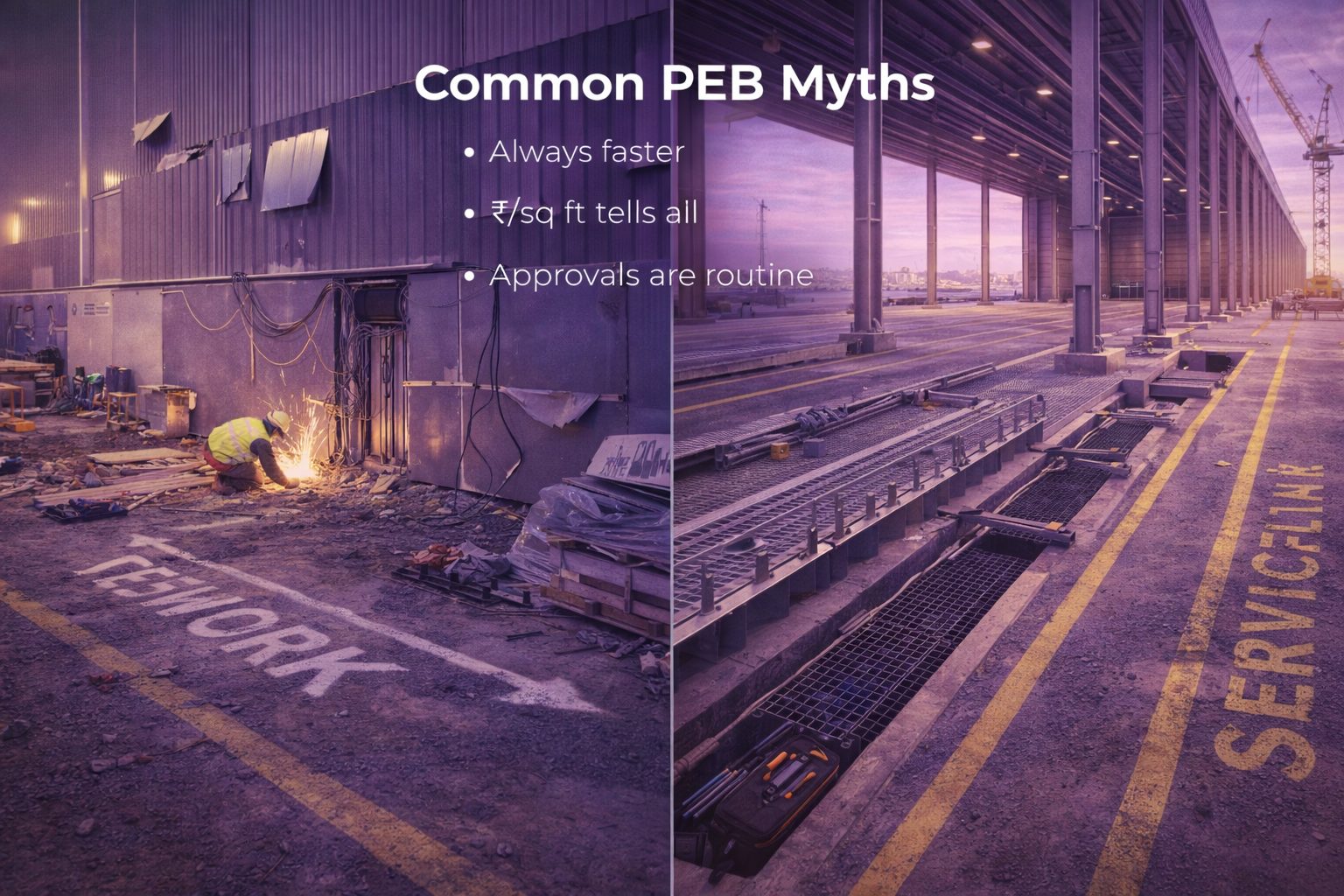
Many PEB projects face challenges not because of technical limitations, but because of assumptions made at the start. These misconceptions often sound logical during procurement but break down once approvals, fabrication, and erection begin. Clearing them early helps buyers set more realistic expectations.
PEB is always faster
Speed depends on readiness, not the system. A PEB building in India moves fast when drawings are frozen, civil work is ready, and dispatch can happen without repeated holds. When foundations are late, anchor bolts are off, or approvals keep cycling, the steel package cannot save the schedule. Erection crews end up waiting, and the project loses the very advantage PEB is chosen for.
₹/sq ft tells the full story
Rates only make sense when scope is identical. Many PEB buildings in India get compared using a single number even when height, wind zone, crane load, insulation, and accessories differ. One vendor may include gutters, ridge vents, fasteners, skylights, and paint system, another may not. The cheaper quote often becomes expensive once exclusions start getting added back.
Any shed vendor can do large spans
Large spans are not just bigger sheds. A wide clear-span PEB structure India demands better detailing, tolerance control, and stronger site discipline. Door openings, wind loads, and connection behaviour become more sensitive. When capability is assumed without proof, the risk shows up as fabrication mismatch, erection difficulty, or conservative redesign that inflates cost and time.
Approvals are routine paperwork
Approvals fail because documents do not match. As different versions of GA drawings, structural notes, foundation layouts, etc. trigger queries and resubmissions. Many buyers also overlook basic hygiene like certificate validity while preparing submissions. In India, approval delays often come from inconsistency, not complexity.
Finishing can be decided later
For many pre-engineered buildings in India, finishing choices decide performance. Insulation, ventilation, drainage, and corrosion protection are not decorative. They affect heat load, condensation, rusting, and operating cost. When these are treated as later decisions, the building starts operating with patchwork fixes and higher maintenance.
Using these examples in a real project
Real project references only create value when they influence planning decisions. The examples discussed above are not meant to be copied directly, but to guide how teams frame their brief, assess vendors, and sequence work. Translating these lessons into action is where most MSMEs see tangible benefit. Let’s have a quick look at how businesses can take advantage of such examples and use them in real projects.
Start with the use case, then freeze the brief
A PEB building in India becomes predictable only when the brief is clear. The fastest way to tighten the brief is to pick two or three examples from the Top 10 that match the use case, warehouse, factory, hangar, or public roof. Then translate those patterns into simple inputs, required clear height, movement lanes, dock count, crane needs, insulation intent, drainage approach, and expansion direction.
Keep the brief short, but specific. Vague inputs lead to vague drawings. Vague drawings lead to changing foundations. That is where timelines start slipping.
Ask for proof that matches the building type
Many buyers ask for “past projects” and get a generic photo deck. A better approach is to ask for proof that matches the same category of PEB buildings in India. Warehouse proof should show dock planning and internal flow. Factory proof should show crane alignment and service coordination. For large spans, proof should show erection stability and connection detailing.
It also helps to request one clean drawing set reference. Not dozens. One stable example often reveals how disciplined the vendor is with revisions.
Keep approvals and site readiness on the same track
Approvals and site readiness should not run in isolation. When civil work moves ahead on an older drawing version, steel dispatch becomes risky. A simple control helps. One “approved for construction” drawing set, one revision log, and one point of truth shared across the approval team, civil contractor, and PEB vendor.
On site, readiness is not a checklist written on day one. It is a sequence. Foundations, levels, anchor bolts, access, and storage zones should be verified before dispatch dates are committed.
Treat the build like a flow, not a purchase order
A pre-engineered steel building in India is not just steel supply. It is design, approvals, civil interface, dispatch planning, and erection sequencing. When this flow is treated as one continuous chain, problems show up early and get solved cheaply. When it is treated like separate purchases, problems show up late and get solved with cost and delay.
If the next section is needed, it can be the conclusion with a tight wrap-up and a clean takeaway for readers planning PEB buildings in India.
Conclusion: How MSMEs should use this top 10 list before locking a project
A “Top 10” list is useful only when it leads to better decisions. The strongest PEB buildings in India do not win because they used more steel or chose the biggest vendor. They win because the brief was clear, drawings stayed consistent, and execution moved in one direction without rework.
For MSMEs planning a PEB building in India, the most practical step is to treat real references as planning tools. Pick examples that match the intended use, warehouse flow, factory loads, large spans, or compliance-heavy operations. Then convert those learnings into a brief that is easy to approve and easy to build.
Good PEB outcomes look boring on paper. The grid is stable. The drawing set is controlled. Site readiness is timed properly. That “boring discipline” is what keeps cost, approvals, and timelines under control in pre-engineered buildings in India.
Disclaimer:
This article is intended for general information and learning purposes only. Project references and metrics are based on publicly available industry information and indicative estimates and may vary by source or scope. They should not be treated as verified technical data or contractual benchmarks. Readers are advised to conduct independent technical and commercial due diligence before making any project or procurement decisions.
Looking to procure steel?
Tata nexarc helps manufacturers, builders and MSMEs source certified steel products, compare prices, and choose the right grade as per IS codes—with complete traceability and procurement confidence.
FAQs
How long does a typical PEB procurement cycle take in India?
Can a PEB project be split across multiple vendors?
How does PEB construction affect factory insurance premiums?
Does PEB construction reduce long-term maintenance costs?
Can solar panels be integrated with PEB roofs?
Is PEB suitable for heavy manufacturing units?
Do PEB vendors manage local approvals?
How does PEB construction impact project cash flow?
What role does third-party inspection play in PEB projects?
Is PEB construction viable in remote industrial locations?
Charul is a content marketing professional and seasoned content writer who loves writing on various topics with 3 years of experience. At Tata nexarc, it has been 2 years since she is helping business to understand jargon better and deeper to make strategical decisions. While not writing, she loves listing pop music.