
 Check Price Now
Table of Contents
- What Is Cast Iron in Engineering?
- Chemical Composition
- Types of Cast Iron (With Applications)
- Mechanical Properties
- Advantages in Industrial Applications
- Limitations and Disadvantages
- Uses of in Industry
- Cast Iron vs Carbon Steel vs Stainless Steel
- When to Choose Cast Iron Over Steel
- Conclusion
- FAQs
Cast iron is widely used in industry. We find it in pipes, machine bases, engine blocks, and heavy equipment parts. It is strong, durable, and cost-effective. Yet, many people confuse cast iron with steel. This often leads to poor material choices in construction and manufacturing.
Cast iron and steel are not the same. They differ in composition, strength, and how they perform under load. Choosing the wrong one can affect durability, cost, and safety.
In this guide, we explain what cast iron is, how it compares to steel, and where it works best. We also cover its properties, uses, advantages, and limitations, so we can choose the right material with confidence.
What is cast iron in engineering?
Cast iron is an iron–carbon alloy used widely in engineering applications. It typically contains 2–4% carbon, along with small amounts of silicon and other elements. This higher carbon content gives cast iron its distinct properties, especially when compared to steel.
Cast iron meaning: An iron-based alloy with high carbon content (2–4%).
Key characteristic: High carbon makes it hard, wear-resistant, and easy to cast into complex shapes.
Why carbon matters: It improves compressive strength but also makes the material brittle.
Cast iron vs steel: Steel has lower carbon content, making it more ductile and suitable for tensile loads.
For a detailed comparison, read our guide on iron vs steel to understand how composition affects performance and applications.
Chemical composition of cast iron
Cast iron composition plays a key role in determining its strength, hardness, and castability. It is primarily made of iron, with carbon and silicon as the main alloying elements. Small amounts of other elements also influence its performance in industrial applications.
| Element | Typical % | Role in cast iron |
| Iron (Fe) | ~92–95% | Base metal that provides structure and strength. |
| Carbon (C) | 2–4% | Increases hardness and compressive strength but adds brittleness. |
| Silicon (Si) | 1–3% | Improves castability and helps control carbon form. |
| Manganese (Mn) | <1% | Enhances wear resistance and reduces brittleness. |
| Sulphur (S) | <0.1% | Undesirable; excess makes cast iron brittle. |
| Phosphorus (P) | <1% | Improves fluidity but can reduce toughness. |
Each element affects how cast iron behaves under load, heat, and wear. This balance of composition is what makes cast iron suitable for applications like pipes, machine parts, and automotive components.
Types of cast iron (with applications)
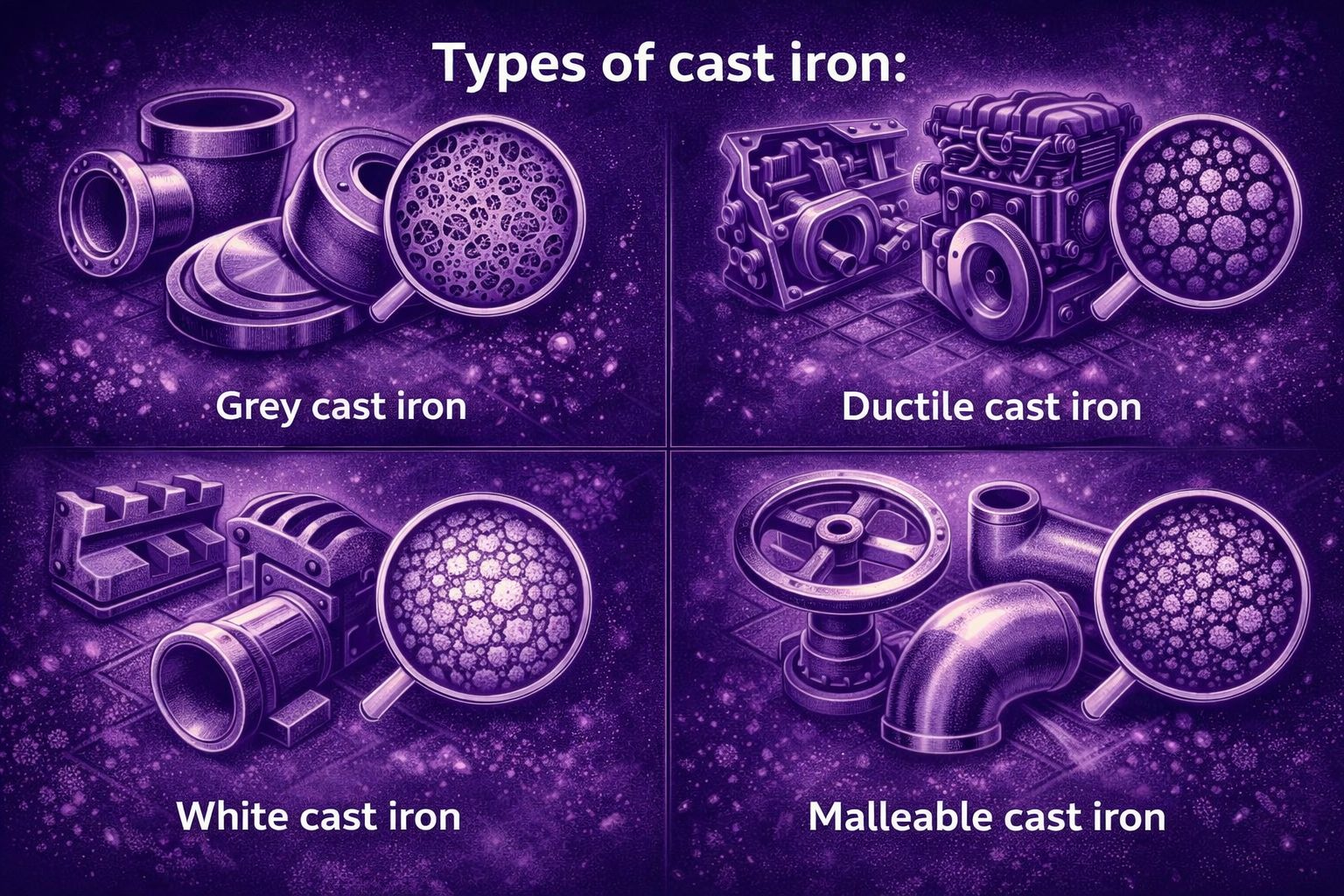
Different types of cast iron are used in industry based on strength, ductility, and wear resistance. Each type has a specific structure and is suited for particular applications.
Grey cast iron
Grey cast iron is the most commonly used type. It contains graphite flakes, which give it good machinability and vibration damping.
- Used in engine blocks, pipes, and machine bases.
- Excellent for applications requiring stability and wear resistance.
Ductile cast iron
Ductile cast iron, also called nodular iron, has graphite in spherical form. This improves strength and flexibility.
- Used in automotive components, gears, and structural parts.
- Suitable for applications requiring higher tensile strength and impact resistance.
White cast iron
White cast iron has a hard, brittle structure with no free graphite. It offers high wear resistance.
- Used in liners, grinding balls, and wear-resistant surfaces.
- Ideal for abrasive environments but difficult to machine.
Malleable cast iron
Malleable cast iron is heat-treated to improve ductility. It is stronger and less brittle than standard cast iron.
- Used in pipe fittings, brackets, and hardware.
- Suitable for parts that require moderate strength and some flexibility.
Also read: Iron vs Steel
Mechanical properties of cast iron
Its properties make it suitable for heavy-duty and wear-resistant applications. Its performance depends on composition and microstructure, but some key mechanical traits remain consistent across most types.
High compressive strength
It can withstand heavy loads without deformation. This makes it ideal for machine bases, columns, and structural supports.
Brittleness
It is strong but not flexible. It can crack under sudden impact or tensile stress, which limits its use in dynamic applications.
Wear resistance
The presence of carbon improves hardness. This helps cast iron resist abrasion, making it suitable for gears, liners, and machinery parts.
Machinability
Grey cast iron, in particular, is easy to machine. The graphite structure allows smooth cutting and reduces tool wear.
Thermal properties
It retains and distributes heat well. It also offers good thermal stability, which is useful in engine components and industrial equipment.
These mechanical properties explain why this type of iron is widely used where strength, durability, and cost efficiency are important.
Advantages of cast iron in industrial applications
Cast iron offers several advantages that make it a reliable choice in engineering and manufacturing. Its properties support both performance and cost efficiency in industrial use.
Cost-effective
It is cheaper than many steel grades. It is widely used in pipes, manhole covers, and machine parts where cost control is important.
Excellent castability
Molten cast iron flows easily into moulds. This allows complex shapes to be produced with minimal machining, making it ideal for engine blocks and equipment housings.
Vibration damping
It absorbs vibrations better than steel. This makes it suitable for machine tool bases and heavy machinery, where stability and precision are critical.
Durability
It resists wear and performs well under compressive loads. This is why it is used in automotive components, industrial machinery, and infrastructure applications.
These benefits make cast iron a practical choice for applications where strength, shape complexity, and cost matter.
Also read: Mechanical properties of steel
Limitations and disadvantages of cast iron
Cast iron has clear advantages, but it also has limitations. These affect where and how it can be used in industrial applications.
| Limitation | Explanation |
| Brittle under tensile load | It can crack when subjected to tension or impact. It is not suitable for components that bend or stretch. |
| Not suitable for dynamic stress | It performs poorly under cyclic or shock loading. This limits its use in moving or high-impact parts. |
| Heavy | It has a high density. This makes handling, transport, and installation more difficult compared to lighter materials. |
| Corrosion (contextual) | It can rust if exposed to moisture without protection. Coatings or maintenance are often required in outdoor use. |
These disadvantages mean cast iron is best used in stable, load-bearing applications rather than dynamic or high-impact environments.
Uses of cast iron in Industry
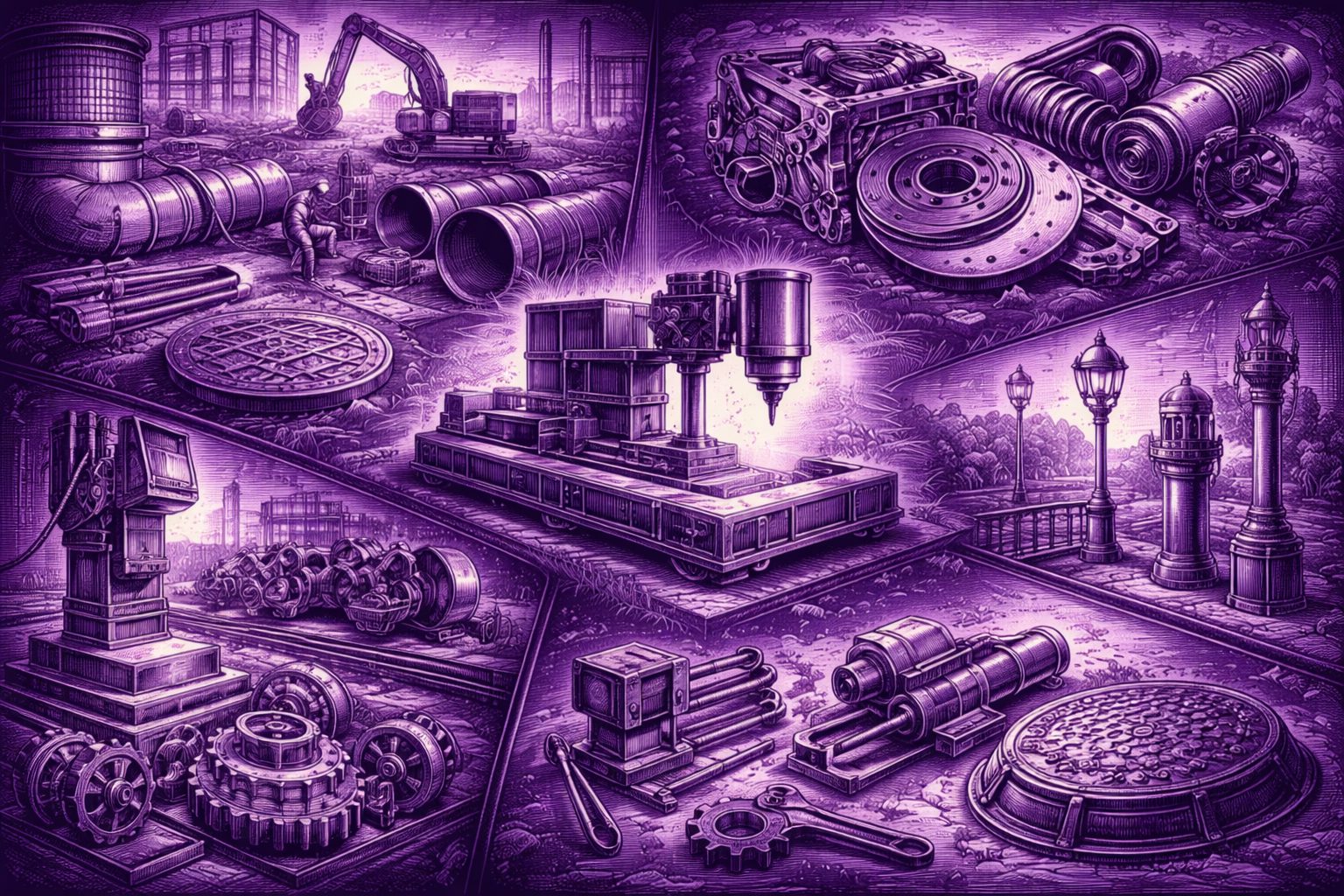
Cast iron is widely used across industries due to its strength, wear resistance, and cost efficiency. Its properties make it suitable for both structural and mechanical applications.
Construction and drainage systems
It is commonly used in pipes, sewer lines, and drainage systems. It offers high compressive strength and long service life in underground conditions.
Automotive components
It is used in engine blocks, cylinder heads, and brake components. Cast iron can handle high temperatures and mechanical stress, making it reliable for vehicle parts.
Machinery and equipment
Machine tool bases, frames, and housings are often made from this material. Its vibration damping improves stability and precision during operation.
Infrastructure applications
It is used in manhole covers, street fittings, and support structures. It can bear heavy loads and withstand harsh outdoor environments.
Industrial tools and wear parts
It is also used in gears, rollers, and liners where resistance to abrasion is important.
These applications show why cast iron remains a preferred material in heavy-duty and cost-sensitive industries.
Also read: Steel scrap recycling policy in India
Cast iron vs carbon steel vs stainless steel
Choosing between cast iron, carbon steel, and stainless steel depends on strength, cost, flexibility, and application needs. Each material performs differently under load and in different environments.
| Property | Cast iron | Carbon steel | Stainless steel |
| Strength | High compressive strength, low tensile strength. | High tensile and overall strength. | High strength with corrosion resistance. |
| Cost | Low to moderate | Moderate | High |
| Ductility | Low (brittle) | Medium to high | High |
| Corrosion resistance | Moderate (needs protection) | Low to moderate | Excellent |
| Applications | Pipes, engine blocks, machine bases. | Structural components, tools, rails. | Food processing, medical, corrosion-prone environments. |
- Cast iron is best for static, load-bearing applications where compressive strength and cost matter.
- Carbon steel is preferred for structural and load-bearing uses where strength and flexibility are required.
- Stainless steel is ideal for environments where corrosion resistance and hygiene are critical.
When to choose cast iron over steel
Cast iron is a better choice than steel in specific industrial situations. The decision depends on load type, cost, and design requirements.
Static load applications
Use cast iron where loads are stable and compressive. It performs well in machine bases, pipes, and structural supports that do not face impact or bending.
Cost-sensitive projects
It is more affordable than many steel grades. It helps reduce material and manufacturing costs in large-scale or budget-driven projects.
Complex shapes required
It has excellent castability. It can form intricate shapes with minimal machining, making it suitable for engine blocks, housings, and customised components.
In such cases, cast iron offers a practical balance of performance, manufacturability, and cost efficiency.
Must read: Grey Cast Iron: Definition, Composition, Manufacturing Process, and Applications
Conclusion
Cast iron remains a practical material in modern engineering due to its balance of performance and cost. Its suitability depends on selecting the right type and matching it to the application. While it may not replace steel in all cases, it continues to offer clear advantages in specific industrial uses. Understanding its behaviour under different conditions helps engineers and buyers make more efficient, reliable, and cost-effective material decisions across projects.
Looking to procure steel?
Tata nexarc helps manufacturers, builders and MSMEs source certified steel products, compare prices, and choose the right grade as per IS codes—with complete traceability and procurement confidence.
FAQs
What is cast iron used for?
Is cast iron stronger than steel?
Why is cast iron brittle?
What are the main types of cast iron?
Is cast iron still used today?
What is the difference between cast iron and carbon steel?
Does cast iron rust?
Why is cast iron used for machine bases?
Can cast iron handle high temperatures?
When should you not use cast iron?
Sohini is a seasoned content writer with 12 years’ experience in developing marketing and business content across multiple formats. At Tata nexarc, she leverages her skills in crafting curated content on the Indian MSME sector, steel procurement, and logistics. In her personal time, she enjoys reading fiction and being up-to-date on trends in digital marketing and the Indian business ecosystem.




One tip I would offer is to consider the specific needs of your project or application when choosing between cast iron and steel. While cast iron offers unique advantages such as heat retention and durability, steel may be preferable for certain applications due to its strength and corrosion resistance.
The table compares cast iron to stainless steel and carbon steel, mentioning cost. But are there situations where I’d use cast iron even if it wasn’t the cheapest option?
Yup. Despite the higher cost, cast iron’s exceptional heat retention and distribution make it ideal for searing, slow cooking, and baking etc